Police recorded road collisions: January to March 2026 (provisional)
Data on severity of injury and type of road user for January to March 2026.
In this page
Introduction
The provisional data presented here reflect the personal injury road collisions reported by police in Wales from January to March (Q1) 2026. While these data are the most detailed and reliable source of information on road collisions and casualties, they do not include road collisions:
- that were not reported to the police
- that occurred on private land i.e. car parks or fields
- where no personal injury was recorded
- where the collision was later confirmed by a medical professional or coroner to be a suicide or medical episode
In this publication, we are publishing adjusted severity casualty data for the first time as official statistics in development. In our previous blog on understanding road collision and casualty statistics, we described changes to how injury severity is recorded by police forces across Great Britain. To assist users with what this change means, we have recently published a further Chief Statistician’s blog explaining these changes, their impacts and the adjustments needed to severity data. All data relating to severity is presented together with guidance on using this data. These changes do not affect the overall number of collisions and casualties, and these remain as accredited official statistics.
Main points
The number of quarterly road collisions in Wales has generally been declining steadily over the last decade, and quarterly figures can be volatile. Care should be taken when interpreting this data over a short time period.
In 2026 Q1, there were 621 police reported road collisions in Wales. These collisions resulted in 865 casualties, a decrease of 5% compared to the same quarter in 2025.
The number of collisions and casualties were 15% and 11% lower than the same quarter in 2023 respectively, which was the last quarter 1 period before the change in default speed limit.
Figure 1: casualties in police recorded road collisions, 2012 Q1 to 2026 Q1
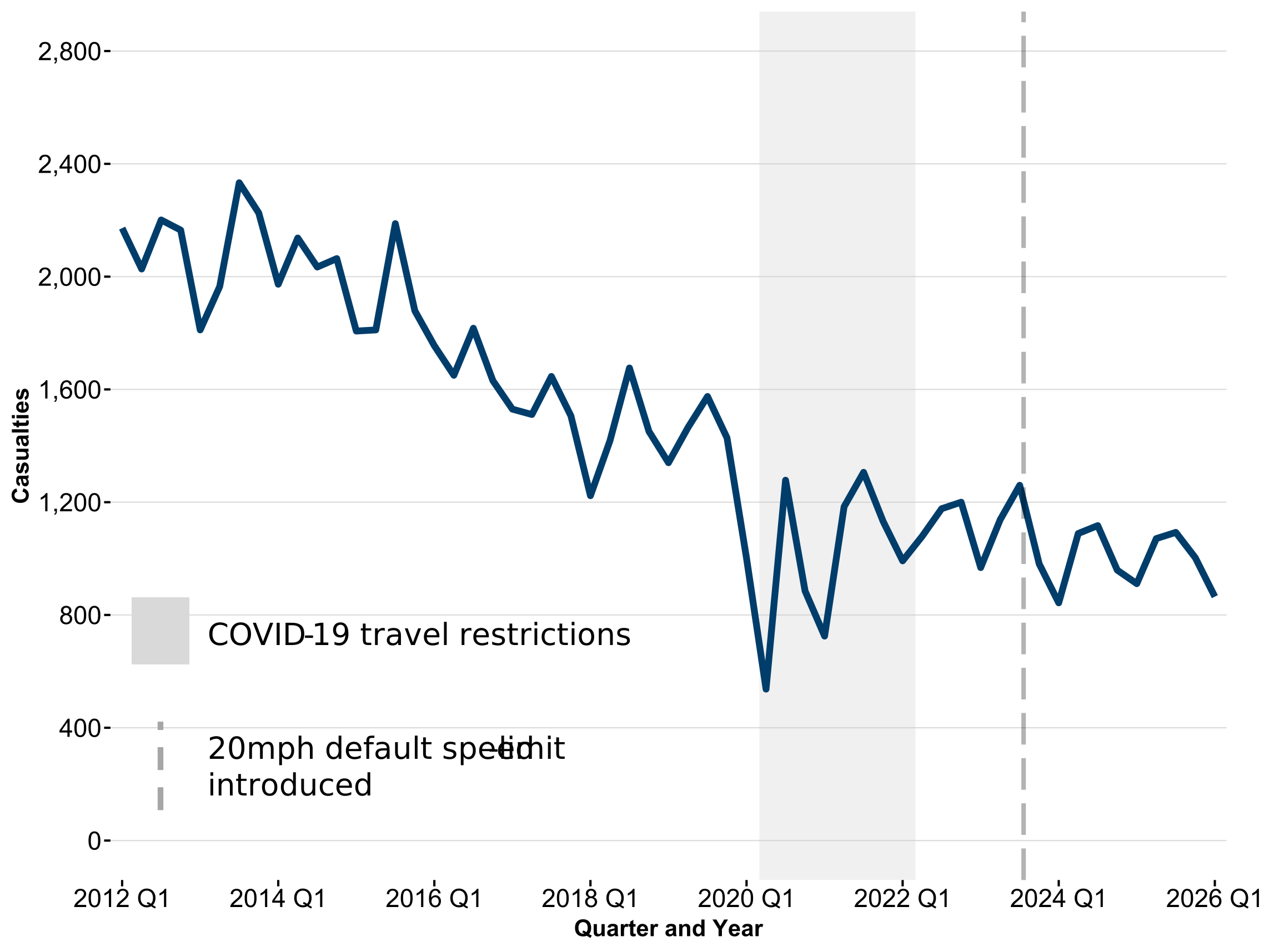
Description of figure 1: the line chart shows a time series for the number of police reported road collisions in Wales each quarter from 2012 Q1 to 2026 Q1. The number of quarterly road collisions has declined steadily over the last decade.
Source: Police recorded road collisions, Welsh Government
All the underlying data is published on StatsWales, and our road collisions dashboard. This includes additional detail on collisions and casualties by geographical area, speed limit, severity and vehicle type.
Data for 2026 Q1 are provisional and subject to potential revision in the future. Detailed quality information is published in the accompanying quality report.
Collisions data is seasonal and impacted by factors such as traffic volume and weather. It is advisable and meaningful to compare quarterly data with the same quarter in previous years rather than with the previous quarter. However, longer term trends give a better indication of patterns and changes in police recorded road collisions.
Time series data over the long term are presented in our annual statistical release. This shows a long-term decrease in road collisions reported by police in Wales.
Given the increased interest in collisions data since the roll out of the 20mph default speed limit on 17 September 2023, we published a Chief Statistician’s update on ‘understanding road collisions and casualty statistics’ on 24 May 2024.
20 and 30mph road speed limit
Most roads that were 30mph became 20mph on 17 September 2023. Therefore, significantly more roads are now 20mph roads (an increase from approximately 870km to 13,000km), and significantly fewer are 30mph (a decrease from approximately 13,100km to 980km).
This section considers collisions that occurred on all 20mph and 30mph roads (combined) to allow direct comparisons for the same set of roads before and after the change in default speed limit on restricted roads.
Road collisions data after the change to the 20mph default speed limit is currently limited to a relatively short period of time (17 September 2023 to 31 March 2026) and can be volatile over the short term. Care should be taken when interpreting this data over a short time period, we will continue to monitor this over time as more data becomes available. Our Chief Statistician’s update includes more information.
In 2026 Q1, there were 305 road collisions on roads with 20 and 30mph speed limits (combined) resulting in 379 road casualties
The number of casualties on 20 and 30mph roads (combined) is 10% lower than the same quarter in 2025 (421). It is 26% lower than the same quarter in 2023 (510) which was the last quarter 1 period before the change in default speed limit.
The number of collisions on 20 and 30mph roads (combined) is 11% lower than the same quarter in 2025 (341). It is 28% lower than the same quarter in 2023 (421) which was the last quarter 1 period before the change in default speed limit.
There has been a general decline in both collision and casualties over the last decade.
Figure 2: casualties in police recorded road collisions on roads with a 20 or 30mph speed limit (combined), 2012 Q1 to 2026 Q1
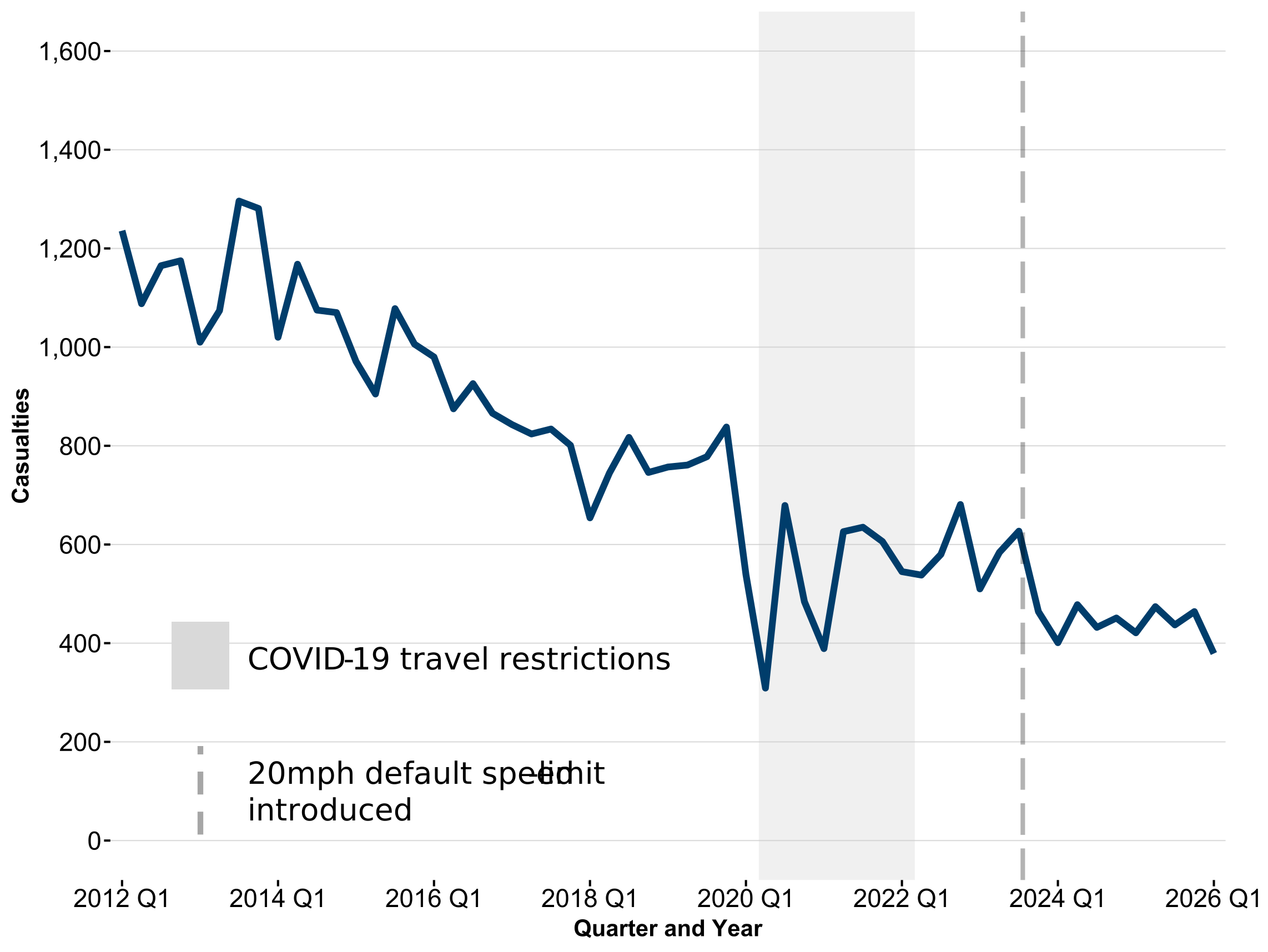
Description of figure 2: the line chart shows a time series for police-recorded road collisions on roads with a 20 or 30mph speed limit (combined) in Wales each quarter from 2012 Q1 to 2026 Q1. The number of quarterly road collisions on 20mph or 30mph has declined steadily over the last decade.
Source: Police recorded road collisions, Welsh Government
Injury severity
In 2026 Q1, there were 317 killed or seriously injured (KSI) casualties in police-recorded road collisions. This figure uses adjusted data which estimates the severity of each casualty’s injury as if all Welsh police forces were using the same recording system. It is not comparable to figures in our previous publications which have not been adjusted.
Figure 3: KSI casualties in police recorded road collisions, adjusted and unadjusted, 2015 to 2025
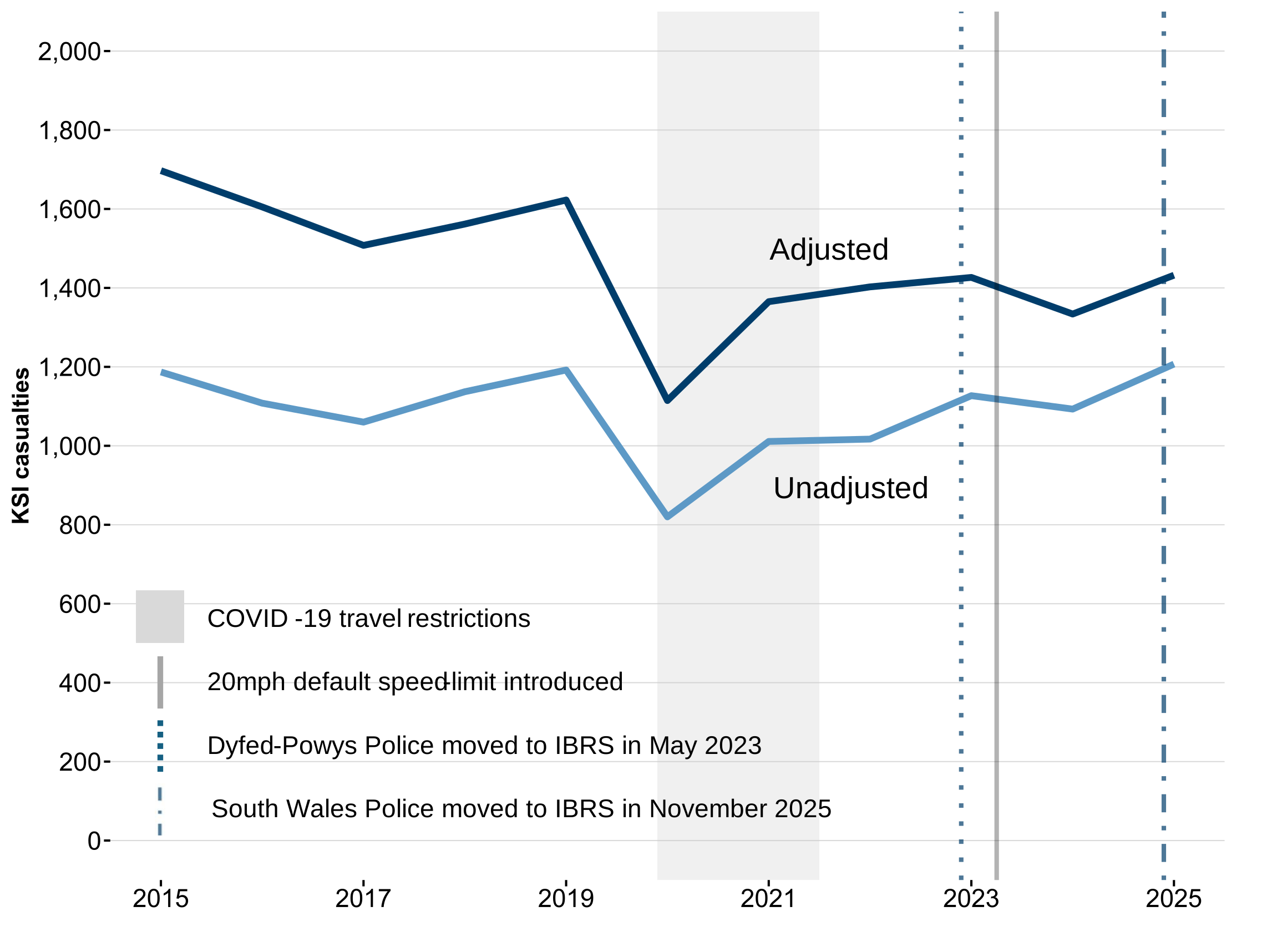
Description of figure 3: the line chart shows adjusted and unadjusted time series for the number of KSI casualties in police reported road collisions in Wales from 2015 to 2025. The number of KSI casualties has remained steady over the last 10 years but the adjusted time series shows more KSI casualties than unadjusted.
Source: Police recorded road collisions, Welsh Government
Casualties in road collisions are recorded as either killed, seriously injured or slightly injured. Historically, this was based on the judgement of reporting police officers. Over the last decade, many police forces across Great Britain have adopted an injury-based reporting system (IBRS), where severity is determined using a predefined list of injuries. This approach reduces subjectivity and is intended to improve both accuracy and consistency across forces.
However, with moving to IBRS, the Department for Transport have found that there is an increase in the number of serious injuries and a decrease in the number of slight injuries. This is likely to be a more accurate representation of injury severity as it removes subjectivity of police officers’ judgements of whether the injury was ‘slight’ or ‘serious’. The move to IBRS does not affect the total number of collisions, casualties, or fatalities.
Dyfed-Powys police force became the first Welsh force to move to IBRS in May 2023 followed by South Wales police force in November 2025.
Due to severity reporting under the old and new systems not being consistent, we need to adjust historical road casualties data by severity to allow us to compare the data consistently over time and between police forces.
In this publication, we are publishing adjusted casualty severity data as ‘official statistics in development (Office for Statistics Regulation)’ for the first time, together with a plan for their development. We have adopted the methodology that was developed by Office for National Statistics and Department for Transport which uses a statistical model to estimate how severe each case would be if it had been recorded using IBRS rather than based on the police officer’s judgement. The model then adjusts the figures to reflect what it estimates the severity would have been if IBRS had been used. This means that the trends in severity reflect what really happened, rather than reflecting the change in reporting method.
During our analysis of South Wales police data, we have found that the move to IBRS has resulted in a larger increase in serious collisions than in most other police forces, including Dyfed-Powys. We believe, this is likely due to historical mis-categorisation of serious collisions as slight collisions by South Wales police, which is now being categorised correctly due to IBRS. However, as we only have one quarter of data from South Wales police on IBRS, it is too early for us to conclude this with confidence. Therefore, we will continue investigating this as we receive more data from South Wales police and continue to update users throughout our upcoming releases.
Given South Wales police adjusted data is based on IBRS data from November 2025 to March 2026, we expect this to be subject to a higher level of revision as we receive more quarters of IBRS data. We would also expect to update the model as the remaining two police forces move to IBRS. This will have an implication for the overall Wales total for breakdowns of adjusted seriously or slightly injured collisions and casualties. However, it does not affect the total number of people killed or the total number of collisions or casualties.
Wherever possible we would advise users to avoid comparing trends in severity data until we publish further iterations of adjusted data in future publications. We will monitor the scale of revisions and advise users accordingly. We have continued publishing unadjusted data on StatsWales. The uncertainty associated with the adjusted data would be magnified for more detailed breakdowns. Therefore, we have not yet published the adjusted data on StatsWales. We expect to publish it next quarter when additional data becomes available.
Official statistics in development plan
We have introduced the adjusted severity data as ‘Official statistics in development’, in line with the Code of Practice for Statistics (UK Statistics Authority). Official statistics in development are official statistics that are undergoing development; they may be new or existing statistics, and will be tested with users, in line with the standards of trustworthiness, quality, and value in the Code of Practice for Statistics.
The adjusted severity data has been designated as ‘Official statistics in development’ because we will continue to review and develop the model for adjusting severities as more police forces in Wales move to IBRS and we receive more Welsh data. The other statistics throughout the release remain ‘Accredited official statistics’.
Over the next few years, we will take the following actions to develop these statistics.
Developing the model
- Run the model annually to ensure the adjustments include the most recent data and the adjustments are as accurate as possible.
- Monitor the scale of the adjustments each year.
- Work closely with our data providers, i.e. the four police forces in Wales to ensure that they have robust quality assurance processes in place as they move from one system to another.
- Continue to work with our partners (including the Department for Transport, Office for National Statistics, and independent academics) as more IBRS becomes available to ensure the model is the most appropriate methodology for our data.
User engagement
- Work with the remaining police forces to encourage them to move to IBRS.
- Keep users informed of which police forces have moved to IBRS and how this affects the data.
- Advise users on where it is most appropriate to use adjusted or unadjusted data and updating this guidance as the remaining Welsh police forces move to IBRS.
- Seek feedback from users via our statistical publication.
- Present and share with a wide range of users through different stakeholder groups e.g. Data and analysts’ group.
Finalising the adjustments
- We expect over time that the scale of annual revisions will reduce as we receive more IBRS data.
- Once there is enough Welsh IBRS data and the annual revisions are minimal, we will finalise the adjustments and stop revising the historical data.
- We will work with our partners on this, in particular the Department for Transport.
The figures in this data table show the severity of a casualty as reported by the police officer that recorded the collision. These unadjusted severities are not consistent across different recording methods and care should be taken when comparing the number of serious or slight casualties over time or between police force areas.