
School Workforce Census results: as at November 2024 (official statistics)
Statistics on the size and characteristics of the school workforce as at November 2024.
In this page
Introduction
These are official statistics relating to information collected in the School Workforce Annual Census (SWAC) for Wales at November 2024. The SWAC collects information on teachers and support staff in local authority maintained schools in Wales.
Between 2023 and 2024, the number of teachers working in local authority-maintained schools has decreased by 2.4% and the number of support staff has decreased by 2.3%. The decrease in teachers and support staff may be due to the temporary nature and changes to the Recruit, Recover and Raise Standards (RRRS) funding. Welsh Government provided the RRRS funding to schools during the COVID pandemic and the recovery period up to 2023-24, though the amount distributed decreased since the initial funding in 2020-21. Most of the staff funded as part of the RRRS scheme should have been employed on a temporary basis and this is impacting the reported changes in school workforce. Further information can be found in the Evaluation of the Recruit, Recover and Raise Standards (RRRS) Programme.
At this time, the Pupil Level School Census (PLASC) also collects information on the school workforce in Wales and is published in the annual Schools' Census results release. Once SWAC data has been fully quality assured, the workforce elements of PLASC will be removed.
The SWAC School return is completed by local authority-maintained school settings in Wales, including Pupil Referral Units (PRUs). Schools record and update data on the workforce throughout the year in their Management Information System (MIS) software. The SWAC Pay, HR and Absences return is completed by local authorities, as well as some schools which have opted-out of payroll and/ or human resource (HR) service level agreements with their local authority. The data is maintained throughout the year in their HR and payroll systems. The two elements are linked anonymously to provide breakdowns of teachers’ pay and sickness absence by school and staff characteristics.
Please see the ‘School Workforce Annual Census: Background Information’ for more details on the SWAC collection and comparison of data items collected in SWAC and PLASC (relating to qualified teachers, teacher sickness absence and teacher recruitment and retention).
Main points
- There were 25,115 teachers in local authority maintained schools in Wales, a decrease of 2.4% on November 2023.
- 18,655 teachers (74.3%) were female. Females accounted for 66.6% of teachers in leadership.
- 9,805 teachers (39.0%) reported having Welsh skills at intermediate level or above.
- On average, 10.0 applications were received per teacher post advertised. The average was lower for Welsh medium posts (5.1) compared to English medium posts (11.5).
- The average (mean) FTE salary of all teachers was £48,930.
- The average number of working days lost per teacher that had taken a period of sickness absence was 12.3, up from 11.3 in 2022/23.
- There were 29,250 support staff, a decrease of 3.0% on November 2023.
Teachers
The data below is collected as part of the SWAC School return. The SWAC School returns are completed by all local authority-maintained schools and reflect the workforce at Census date which is normally in early November. The census date was at 5 November 2024. The SWAC School data will not include local authority centrally employed staff who are not contracted to a specific school. These staff are included in the teachers’ pay section. As part of the SWAC School return the full-time equivalents (FTE) is recorded which indicates the proportion of full-contract time they spend in each role and school.
Teacher roles
- In November 2024, there were 25,115 teachers in local authority maintained schools in Wales, a decrease of 2.4% on November 2023.
- The full-time equivalence [footnote 1] of all teachers was 23,410
- Based on the full-person equivalent [footnote 2], 20,915 teachers (83.3%) worked as a qualified classroom teacher.
- Most teachers worked in Primary schools (46.9%) or Secondary schools (40.7%).
Teacher characteristics
- 18,665 teachers (74.3%) were female. Females accounted for 66.6% of teachers in leadership [footnote 3].
- There was a greater proportion of female teachers in Primary schools (82.9%) compared to Secondary schools (65.2%).
- 340 teachers (1.3%) were of Black, Asian, Mixed or Other ethnicity [footnote 4].
- 15,235 teachers (60.7%) identified as Welsh.
- 210 teachers (0.8%) reported having a physical or mental health condition expected to last 12 months or more.
Teachers’ Welsh language ability and teaching through the medium of Welsh
Teachers record their Welsh linguistic skills measured against the Welsh Language Competency Framework for education practitioners. Figures below provide a measure of how many teachers have Welsh language skills at intermediate, higher or proficient as this indicates that the individuals possess the necessary skills to teach through the medium of Welsh but some may need to develop their skills and confidence in using Welsh in their work.
- 9,805 teachers (39.0%) reported having Welsh skills at intermediate level or above [footnote 5]. The proportion varied between sectors, from 20.4% in Special Schools to 50.8% in Middle schools. At the local authority level, the proportion ranged from 13.9% in Blaenau Gwent to 93.0% in Gwynedd.
- 6,195 teachers (24.7%) were teaching/working through the medium of Welsh in their current post, with a further 1,590 (6.3%) able to teach/work through the medium of Welsh but not doing so in their current post.
Figure 1: Proportion of teachers with Welsh skills at intermediate level or above by local authority, November 2024 [Note 1]
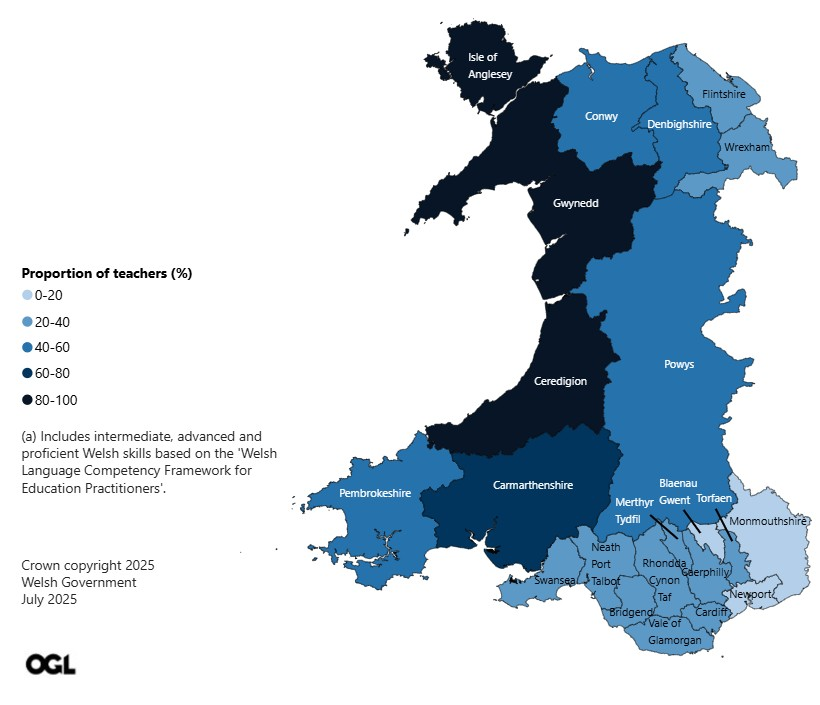
Description of Figure 1: This map shows Isle of Anglesey, Gwynedd and Ceredigion have the highest proportion of teachers with Welsh skills at intermediate level or above. Whilst Blaenau Gwent, Newport and Monmouthshire have the lowest proportion.
Source: SWAC School return
Teachers Welsh language ability by local authority on StatsWales
[Note 1] Includes intermediate, advanced and proficient Welsh skills based on the ‘Welsh Language Competency Framework for Education Practitioners’.
Subjects taught by teachers
This data reflects subjects taught to pupils in years 7 to 13 in a typical two-week timetable.
- The greatest proportion of schools’ teaching timetable for years 7 to 13 was spent teaching Mathematics (13.6%), English (13.3%), Science [footnote 6] (10.6%), Welsh (7.4%) and Physical Education (6.7%).
- On average, 1 in 5 teaching hours (20.4%) were taught bilingually or through the medium of Welsh.
- Individuals teaching Mathematics spent the greatest proportion of their timetable teaching that subject (83.8%) [footnote 7]. For those teaching English the proportion was 81.3%, Welsh 75.0% and for Modern Foreign Languages 74.6%.
Figure 2: Number of teachers by measure (headcount and full-person equivalent) and subjects taught, November 2024
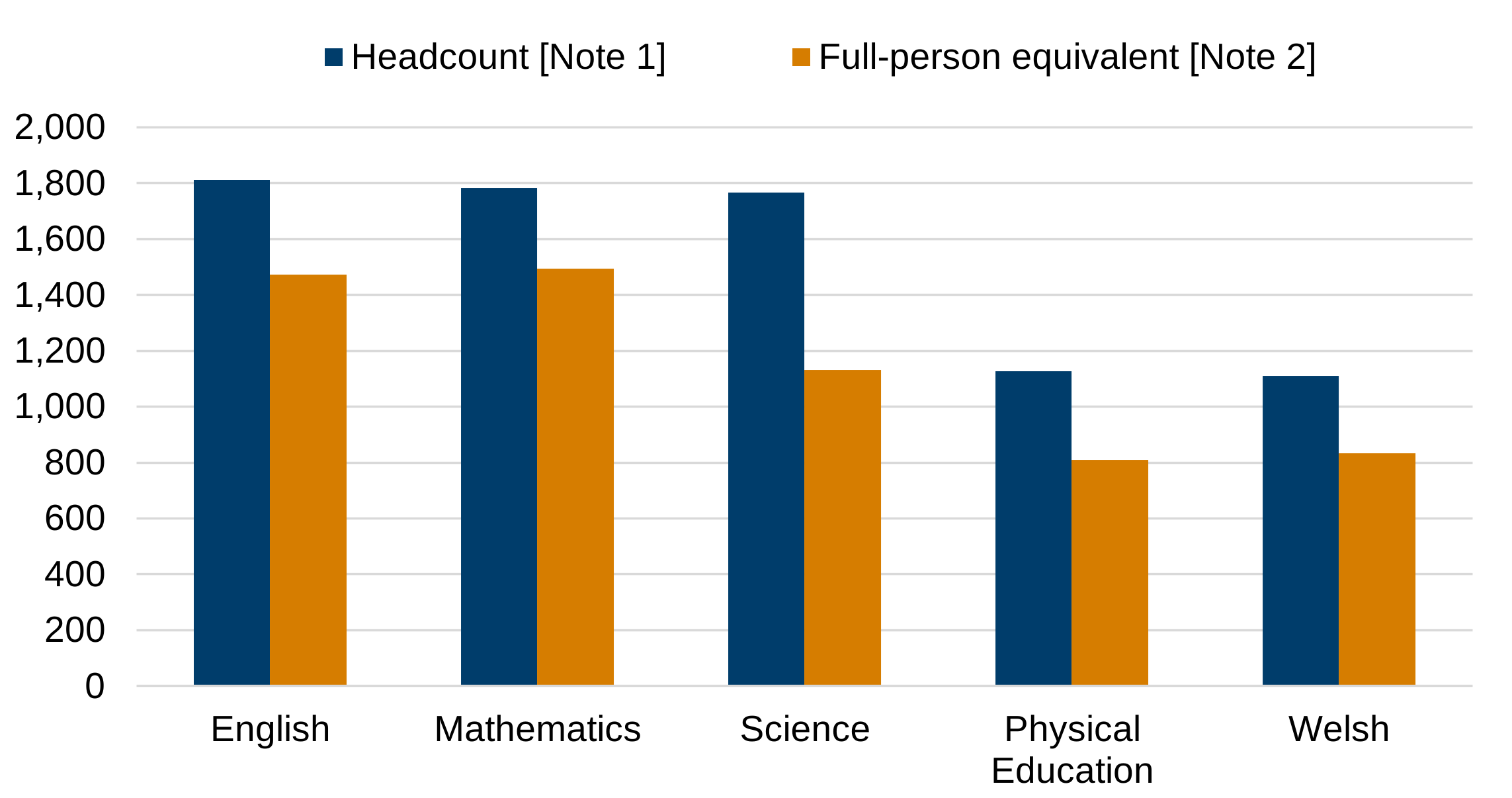
Description of Figure 2: This bar chart shows the five subjects with the greatest number of teachers teaching the subjects as at November 2024. These are Mathematics, English, Science, Physical Education and Welsh. Headcount ranged from 1,810 teaching English to 1,110 teaching Welsh. And full-person equivalent ranged from 1,520 of teachers teaching Mathematics to 820 of teachers teaching Physical Education.
Source: SWAC School return
[Note 1] The headcount counts teachers once for each subject taught.
[Note 2] The full-person equivalent splits teachers according to the proportion of time spent teaching each subject. A teacher that spends half of their time teaching Maths and half of their time teaching English would be recorded as 0.5 in each category.
Teacher recruitment and retention
Data on teacher recruitment and retention, including posts advertised, number of applications and teachers who left the profession. This data is collected retrospectively and covers any permanent post advertised for a contract of a term or more, and teachers who left the profession during the 2023/24 academic year.
- On average, 10.0 applications were received per post advertised, an increase from 7.8 in 2022/23 and the highest since 2020/21. The average was lower for Welsh medium posts (5.1) compared to English medium posts (11.5). The average was also lower for Secondary school posts (5.2) compared to Primary school posts (15.2).
- At the end of the 2023/24 academic year, 1,926 of posts advertised were filled (88.7%).
- Of the 1,465 teachers that left the profession, 455 (31.0%) retired (at normal or early retirement age).
Teachers pay and allowances
The following data on teachers’ pay and allowances and teacher sickness absence are collected as part of the SWAC Pay, HR and Absences return. This is completed by local authorities and schools which have opted-out of payroll and/or human resource (HR) service level agreements with their local authority. Most members of the workforce will be recorded in both the SWAC School and SWAC Pay, HR and Absences parts of the collection, however there are some exceptions. Teachers that are centrally employed by the local authority will be recorded in the SWAC pay, HR and absences return but not the SWAC school return. Further information on this can be found in the School Workforce Annual Census – background information. As part of the SWAC HR, Pay and Allowances return FTE shows individuals counted for the proportion of full-contract time they are paid on a particular pay range and will differ to the FTE figures for teacher characteristics data from the SWAC School return.
The teachers’ pay award for academic year 2024/25 was not finalised and implemented until after the SWAC census date. As a result, figures on teachers’ pay in this release do not fully reflect the pay uplift for 2024/25. See the School Workforce Annual Census – background information for further information.
- The full-time equivalence (FTE) of teachers paid on pay scales as set out in the School Teachers’ Pay and Conditions (Wales) Document 2024 was 24,710, with 15,090 (61.1%) paid on the upper pay range.
- The average (mean) FTE salary of all teachers was £48,930.
- Classroom teachers received an average salary of £45,342. Average classroom teacher salary ranged from £45,271 in Primary schools to £45,750 in Secondary schools.
- The average salary of headteachers [note 1] was considerably higher in Secondary schools (£104,025) compared to Primary schools (£73,761).
- On average, males (£50,665) were paid £2,329 more than females (£48,336). For classroom teachers, females (£45,434) were paid more than males (£45,048). However, in leadership roles, males (£74,733) were paid more than females (£69,156) on average.
- Between November 2023 and 2024, 7,980 teachers (27.7%) received a Teaching and Learning Responsibility (TLR) allowance with an average value of £5,198.
| Post | Male | Female | Total |
|---|---|---|---|
| Unqualified teacher | £29,765 | £29,055 | £29,290 |
| Classroom teacher | £45,048 | £45,434 | £45,342 |
| Leading practitioner | £65,406 | £61,427 | £62,832 |
| Headteacher [Note 1] | £83,208 | £76,525 | £79,041 |
| Other leadership [Note 2] | £68,101 | £64,675 | £65,761 |
| Total leadership | £74,773 | £69,156 | £71,070 |
| Total | £50,665 | £48,336 | £48,930 |
Description of Table 1: This table shows the average FTE salary by post and sex at November 2024. The average salary for all teachers was £48,930. Headteachers average salary was £79,041, whilst classroom teachers average salary was £45,342.
Source: SWAC HR, Pay and Absences return
[Note 1] Includes executive headteacher.
[Note 2] Includes acting, deputy and assistant headteacher.
Teacher sickness absence
Data relates to 2023/24 academic year.
- 34,785 sickness absence records were opened or closed during the year.
- 16,145 teachers (60.6%) took at least one period of sickness absence.
- An average of 5.7 working days were lost per absence, an increase from 5.3 in 2022/23. The average number of working days lost per teacher that had taken a period of sickness absence was 12.2, an increase from 11.3 in 2022/23.
Figure 3: Number of teacher sickness absence records opened by month and absence type, 2023/24

Description of Figure 3: The line graph shows the number of short-term and long-term absences opened throughout the school year in each month of the academic year 2023/24. The number of short-term absences are significantly higher than long term absences, with peaks reached in October and June. During the academic year 2023/24 there was a significant decrease in absences during the month of April, explained by the Easter break, and then again in July at the end of the school year.
Source: SWAC HR, Pay and Absences return
Number of teacher sickness absences opened by month and absence type on StatsWales
[Note 1] More than 20 working days lost.
Support staff
The data below are collected as part of the SWAC School return are completed by all local authority-maintained schools and reflect the workforce at Census date. Support staff include teaching assistants, higher level teaching assistants, foreign language assistants, Additional Learning Need (ALN) coordinators, ALN support staff, business managers, administrative staff and other support staff roles. More information can be found in the School Workforce Annual Census – background information.
Support staff roles
- In November 2024, there were 29,250 support staff, a decrease of 3.0% on November 2023.
- The full-time equivalence [footnote 8] of all support staff was 23,050, down 3.4%.
- Based on the full-person equivalent [footnote 9], 14,675 support staff (50.2%) worked as a teaching assistant, with a further 1,645 (5.6%) working as a higher level teaching assistant (HLTA) and 3,370 (11.5%) as ALN support staff.
- There were 1,560 staff working as ALN co-ordinators or undertaking the role in addition to their main role.
- Most support staff worked in Primary schools (59.1%) or Secondary schools (24.1%).
Support staff characteristics
- 26,320 support staff (90.0%) were female, compared to 74.3% of teachers.
- 16,030 support staff (54.8%) identified as Welsh.
- 1,040 support staff (3.6%) were of Black, Asian, Mixed or Other ethnicity [footnote 10], compared to 1.3% of teachers.
- 420 support staff (1.4%) reported having a physical or mental health condition expected to last 12 months or more.
Support staff Welsh language ability
- 6,100 support staff (20.9%) reported having Welsh skills at intermediate level or above [footnote 4], compared to 39.0% of teachers.
- The proportion of support staff with Welsh skills at intermediate level or above ranged from 4.5% in Blaenau Gwent to 90.9% in Gwynedd.
Figure 4: Proportion of support staff with Welsh skills at intermediate or above level by local authority, November 2024 [Note 1]
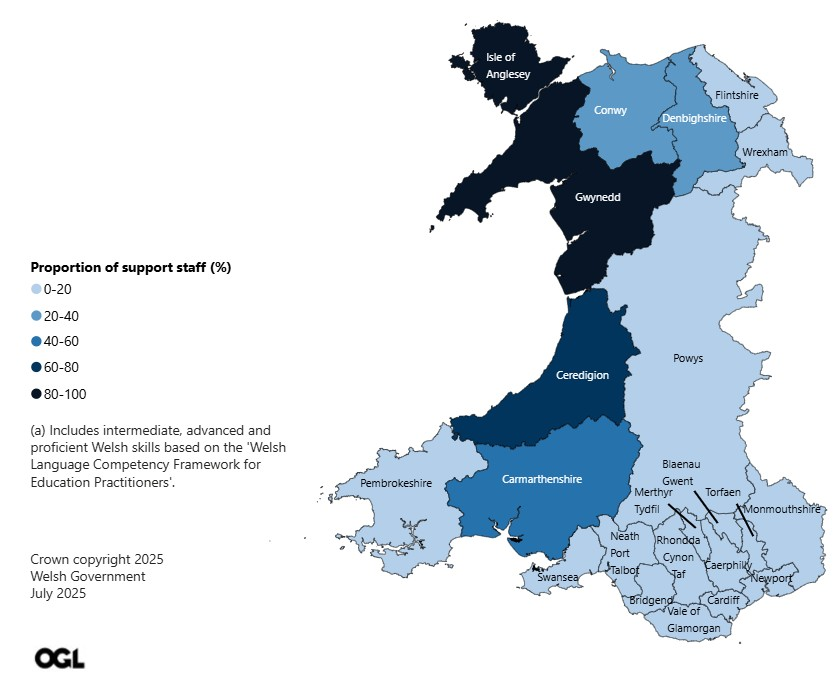
Description of Figure 4: This map shows Isle of Anglesey and Gwynedd have the highest proportion of support staff with Welsh language skills at intermediate level or above, whilst almost three quarters of the local authorities have less than 20% of support staff with Welsh skills at intermediate level or above.
Source: SWAC School return
Support staff Welsh language ability by local authority on StatsWales
[Note 1] Includes intermediate, advanced and proficient Welsh skills based on the ‘Welsh Language Competency Framework for Education Practitioners’.
Support staff recruitment and retention
This data relates to teaching assistants, higher level teaching assistants, foreign language assistants, Additional Learning Need (ALN) coordinators and ALN support staff posts advertised and leavers from the profession in academic year 2023/24 only. This differs from the full list of support staff roles collected as part of the SWAC due to the temporary nature and how posts are advertised for other support staff roles.
- On average, 7.6 applications were received per post advertised, an increase from 5.8 in 2022/23. The average was lower for Welsh medium posts (3.8) compared to English medium posts (9.1). The average was also lower for Secondary school posts (4.9) compared to Primary school posts (7.8).
- At the end of the academic year, 1,443 (88.6%) of posts advertised were filled.
- Of the 2,090 support staff that left the profession, 615 (29.4%) moved to employment outside of education.
Quality and methodology information
The information collected in 2024 has not undergone a formal final validation process. However, various stages of automated validation and sense-checking have been built in to ensure the collection of high-quality data to inform policy making.
Our ‘School Workforce Annual Census: background information’ report provides further quality and methodology information.
Well-being of Future Generations Act
The Well-being of Future Generations Act 2015 is about improving the social, economic, environmental and cultural wellbeing of Wales. The Act puts in place seven wellbeing goals for Wales. These are for a more equal, prosperous, resilient, healthier and globally responsible Wales, with cohesive communities and a vibrant culture and thriving Welsh language.
Under section (10)(1) of the Act, the Welsh Ministers must (a) publish indicators (“national indicators”) that must be applied for the purpose of measuring progress towards the achievement of the wellbeing goals, and (b) lay a copy of the national indicators before Senedd Cymru. Under section 10(8) of the Well-being of Future Generations Act, where the Welsh Ministers revise the national indicators, they must as soon as reasonably practicable (a) publish the indicators as revised and (b) lay a copy of them before the Senedd. These national indicators were laid before the Senedd in 2021. The indicators laid on 14 December 2021 replace the set laid on 16 March 2016.
Information on the indicators, along with narratives for each of the wellbeing goals and associated technical information is available in the Wellbeing of Wales report.
Further information on the Well-being of Future Generations (Wales) Act 2015.
The statistics included in this release could also provide supporting narrative to the national indicators and be used by public services boards in relation to their local well-being assessments and local well-being plans.
Footnotes
[1] The full-time equivalent is the proportion of full-contract time spent in a role. An individual working one day a week in a leadership role and one day a week in a classroom teacher role would be recorded as 0.2 against each role.
[2] The full-person equivalent is the proportion of working time spent in a role. An individual working one day a week in a leadership role and one day a week in a classroom teacher role would be recorded as 0.5 against each role.
[3] Including executive headteachers, headteachers, acting headteachers, deputy headteachers and assistant headteachers.
[4] Including Black/African/Caribbean/Black British, Asian/Asian British, Mixed/Multiple ethnic groups and Other ethnic groups.
[5] Includes intermediate, advanced and proficient Welsh skills based on the ‘Welsh Language Competency Framework for Education Practitioners’.
[6] Science excludes Biology, Chemistry and Physics where they are taught as separate subjects.
[7] This is the full-person equivalent divided by the headcount. The greater the similarity between the headcount and full-person equivalent, the greater the proportion of time individuals spend teaching that subject. If an individual spends a high proportion of time teaching a particular subject, they may be more likely to be a specialist in that subject.
[8] The full-time equivalent is the proportion of full-contract time spent in a role. An individual working one day a week in a teaching assistant role and one day a week in a SEN/ALN support staff role would be recorded as 0.2 against each role.
[9] The full-person equivalent is the proportion of working time spent in a role. An individual working one day a week in a teaching assistant role and one day a week in a SEN/ALN support staff role would be recorded as 0.5 against each role.
[10] Including intermediate, advanced and proficient Welsh skills based on the ‘Welsh Language Competency Framework for Education Practitioners’.