
Welsh Index of Multiple Deprivation (WIMD) 2025 results report - Education domain results
WIMD is designed to identify the small areas of Wales that are the most deprived.
In this page
Introduction
The purpose of this domain is to capture the extent of deprivation relating to education, training and skills. It is designed to reflect educational disadvantage within an area in terms of lack of qualifications and skills. The domain has a relative weight of 14% in the overall index.
Indicators
Figure 5.1: education domain indicators, WIMD 2025
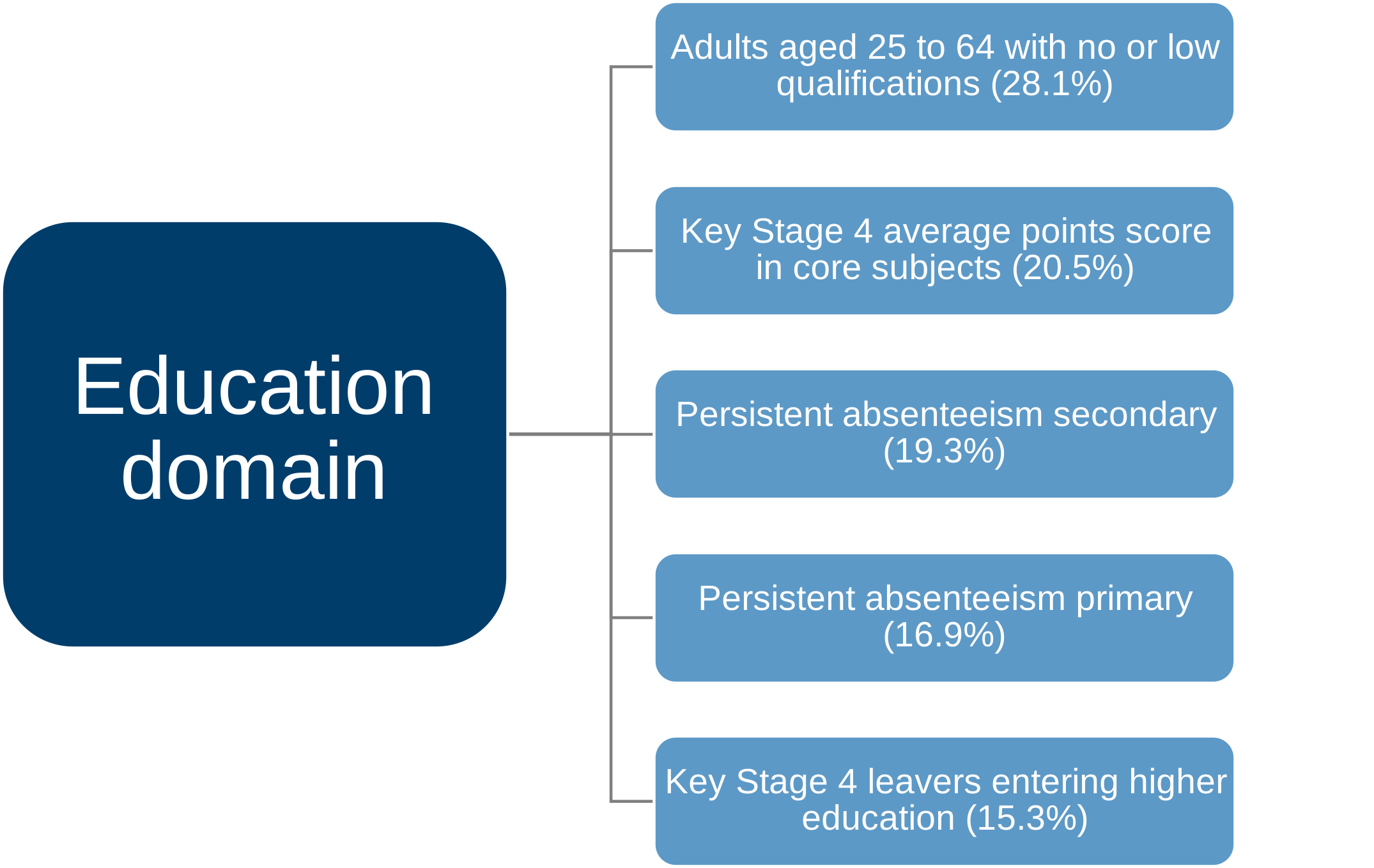
Description of figure 5.1: diagram showing that the education domain has 5 indicators, and the percentage shown next to each indicator is the amount it contributes to the overall domain.
Of the indicators, 3 focus on capturing low attainment and behaviours that may impact that (such as absenteeism) among school children:
- average points score of year 11 pupils (Key Stage 4, KS4) calculated from the grades achieved in the core subjects of GCSE English or Welsh, mathematics and science (or equivalent qualifications); a 2-year average based on academic years 2022 to 2023 (2022/23) and 2023/24
- two persistent absenteeism indicators of the percentage of primary and secondary school pupils respectively missing 10% or more of school sessions; 2-year averages based on academic years 2022/23 and 2023/24
Of the indicators, 2 focus on capturing the lack of qualifications and skills in adults and young people post-compulsory education age:
- the proportion of KS4 pupils who, at some point in the 4 years after leaving year 11, enter higher education; a 4-year average based on pupils who left school between academic years 2016/17 and 2019/20
- the proportion of adults aged 25 to 64 with no qualifications or low (level 1) qualifications, based on 2021 Census data
Full details on the indicators and construction of the domain is available in the WIMD 2025 technical report. This includes information about the 2 previous indicators (Foundation Phase and Key Stage 2 attainment) that are no longer able to be included.
Main points
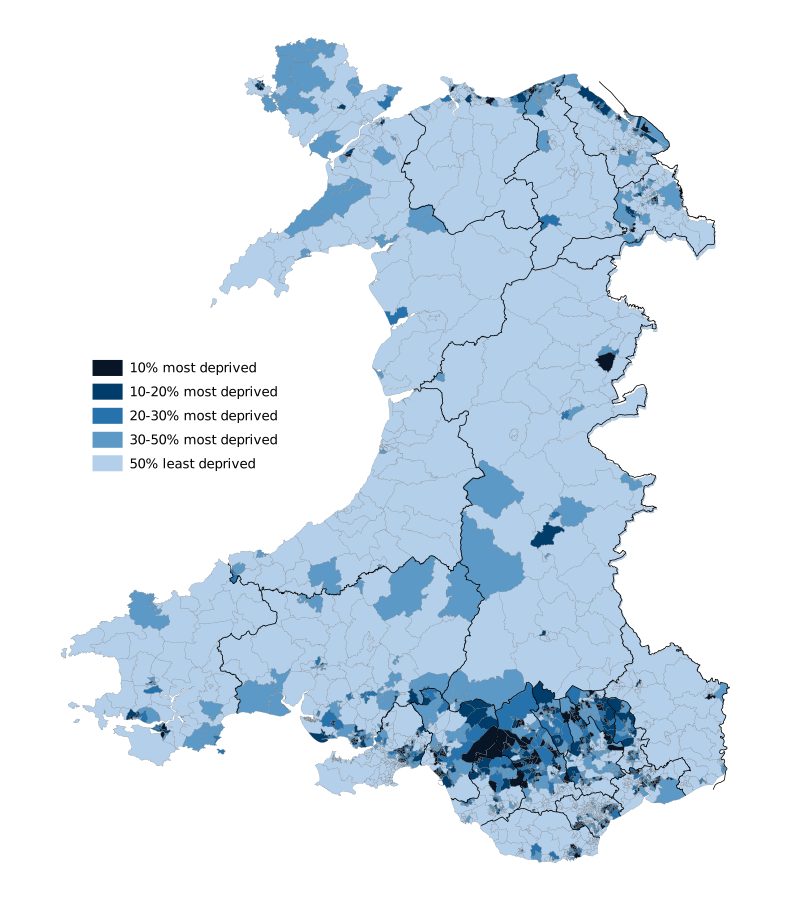
Figure 5.2: map of LSOAs shaded by education deprivation group, WIMD 2025
© Crown copyright 2025. Cartographics. Welsh Government.
Description of figure 5.2: the map shows that in the WIMD 2025 education domain, there were pockets of high education deprivation in the South Wales valleys, in larger towns and cities, and in some North Wales and West Wales coastal towns.
- For the education domain, the most deprived area in Wales was Cymer 2 (Neath Port Talbot), this area was ranked 53rd most deprived in 2019.
- Out of the 10 most deprived areas in WIMD 2025, 3 were also in the 10 most deprived areas in WIMD 2019.
- The local authority with the highest proportion of areas in the most deprived 10% was Blaenau Gwent (22%), followed by Neath Port Talbot (21%).
- Ceredigion was the only local authority with no LSOAs in the most deprived 10% of areas.
- The overall patterns of education deprivation in WIMD 2025 are similar to those for WIMD 2019.
Comparison between WIMD 2019 and WIMD 2025
Two indicators have been removed from this domain, another split into 2 indicators (by stage of school) and another has changed slightly in scope. The education domain is therefore not directly comparable with that for WIMD 2019. For full information on how the domain has changed since 2019 see the technical report.
| WIMD deprivation group | 10% most deprived 2025 | 10% to 20% most deprived 2025 | 20% to 30% most deprived 2025 | 30% to 50% most deprived 2025 | 50% least deprived 2025 |
|---|---|---|---|---|---|
| 10% most deprived 2019 | 73% | 21% | 5% | 1% | 0% |
| 10% to 20% most deprived 2019 | 25% | 41% | 23% | 9% | 2% |
| 20% to 30% most deprived 2019 | 2% | 26% | 32% | 34% | 6% |
| 30% to 50% most deprived 2019 | 0% | 6% | 19% | 50% | 25% |
| 50% least deprived 2019 | 0% | 0% | 1% | 11% | 88% |
The table shows the percentage of small areas (LSOAs) in each deprivation group for WIMD 2019 that have stayed or moved group in WIMD 2025. For an explanation of how we have treated the minority of areas that changed boundary, please see the guidance report.
The diagonal (top left to bottom right), shows the percentage of areas which have remained in the same deprivation group. Above the diagonal are percentages of areas which have moved from a more to a less deprived group. Below the diagonal are the percentages of areas which have moved from a less to a more deprived group.
The table shows that:
- most LSOAs in the most deprived and least deprived deprivation groups remained in the same group between 2019 and 2025
- of the 10% most deprived areas in 2019, 73% remained in that group in 2025
- of the 50% least deprived areas in 2019, 88% remained in that group in 2025
Relatively more deprived
Only one area moved by more than 2 deprivation groups to become relatively more deprived, Mardy 3 in Monmouthshire, which moved from the 30% to 50% least deprived in 2019 to the 10% most deprived in 2025 (note that this does not appear in the above table due to rounding).
Relatively less deprived
Six LSOAs moved by more than 2 deprivation groups becoming relatively less deprived, and of these areas:
- two have moved from the 10% most deprived group in WIMD 2019 to the 30% to 50% most deprived group in WIMD 2025
- four have moved from the 10% to 20% most deprived group to the 50% least deprived group
Cardiff contained 4 of these areas, in Adamsdown, Cathays and Butetown, with very small pupil numbers affecting the latter 2 areas. Rhondda Cynon Taf contained one (in the Treforest area) and Wrexham contained one (in the Brynyffynnon area).
Local authority analysis
Figure 5.3: box plot of WIMD 2025 education domain ranks, by local authority
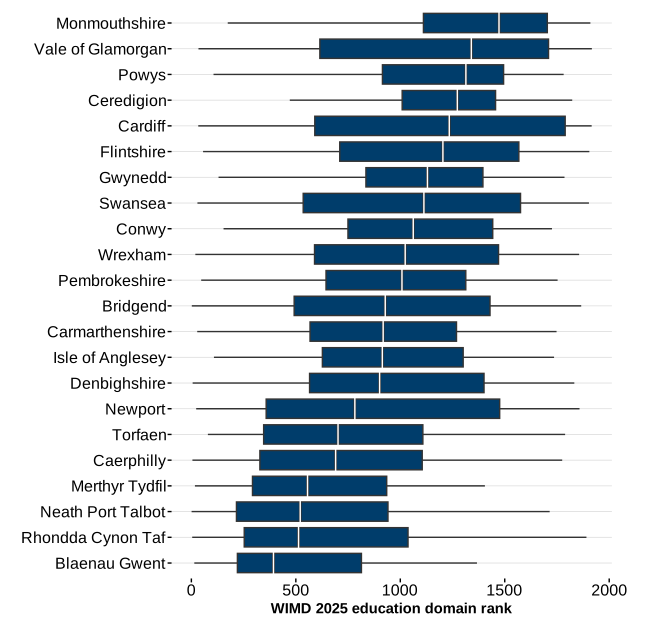
Description of figure 5.3: the chart shows the spread of education domain ranks for each local authority. The blue boxes contain half the total number of small areas (LSOAs) in each local authority, centred on the median (middle) rank for each local authority and the ‘whiskers’ show the full range of ranks within the local authority. Deprivation increases with decreasing rank (that is, towards the left-hand side of the plot).
The spread of education domain ranks is greatest in Cardiff, Newport and Vale of Glamorgan and narrowest in Ceredigion. Monmouthshire has the highest median rank (less deprived) and Blaenau Gwent has the lowest (more deprived).
Concentrations of education deprived areas, by local authority
One way of considering WIMD data at the local authority level is to look at the proportion of areas within the local authority that are in the most deprived 10% (or 20% etc) of all areas. This method can be seen as identifying the concentration of the most deprived areas in a local authority, rather than an average level of deprivation.
The WIMD 2025 education domain results show that:
- the local authority with the highest proportion of areas in the most deprived 10% was Blaenau Gwent (22%), followed by Neath Port Talbot (21%) then Rhondda Cynon Taf (20%)
- Blaenau Gwent and Merthyr Tydfil had the highest percentage of areas in the most deprived 50% (at 85% and 83% respectively)
- Ceredigion was the only local authority with no small areas in the most deprived 10%. Isle of Anglesey, Gwynedd, Conwy, Powys and Monmouthshire each have 2 areas in the 10% most deprived
- Ceredigion had the lowest proportion of areas in the 50% most deprived at 18%, followed by Monmouthshire (21%) and Powys (28%)
Concentrations of WIMD 2025 education deprived areas, by local authority on StatsWales.
Other relevant sources
Welsh Government education statistics
The Welsh Government publishes information on education and skills in Wales. These statistics cover a wide range of topics relating to education including examination results and absence.
Medr
Medr, the Commission for Tertiary Education and Research, publishes official statistics about tertiary education and other data relating to tertiary education and research. This includes information on destination of post-16 learners on completion of their learning programmes.
Office for National Statistics
The Office for National Statistics also publishes statistics relating to education from the 2021 Census.
Pupil destinations survey
Data on young people who are not in education, employment or training (NEET) is published by CareersWales based on the pupil destinations survey. Whilst it was not possible to use this data in WIMD 2025 due to concerns around coverage and consistency at LSOA level, we will consider any developments for future WIMD releases.