
Welsh Index of Multiple Deprivation (WIMD) 2025 results report - Employment domain results
WIMD is designed to identify the small areas of Wales that are the most deprived.
In this page
Introduction
The purpose of this domain is to measure the proportion of working-age people involuntarily excluded from the labour market. This includes people who may want to work but are unable to do so due to unemployment, sickness or disability, or caring responsibilities. The domain has a relative weight of 20% in the overall index.
Indicators
Figure 3.1: employment domain indicator, WIMD 2025
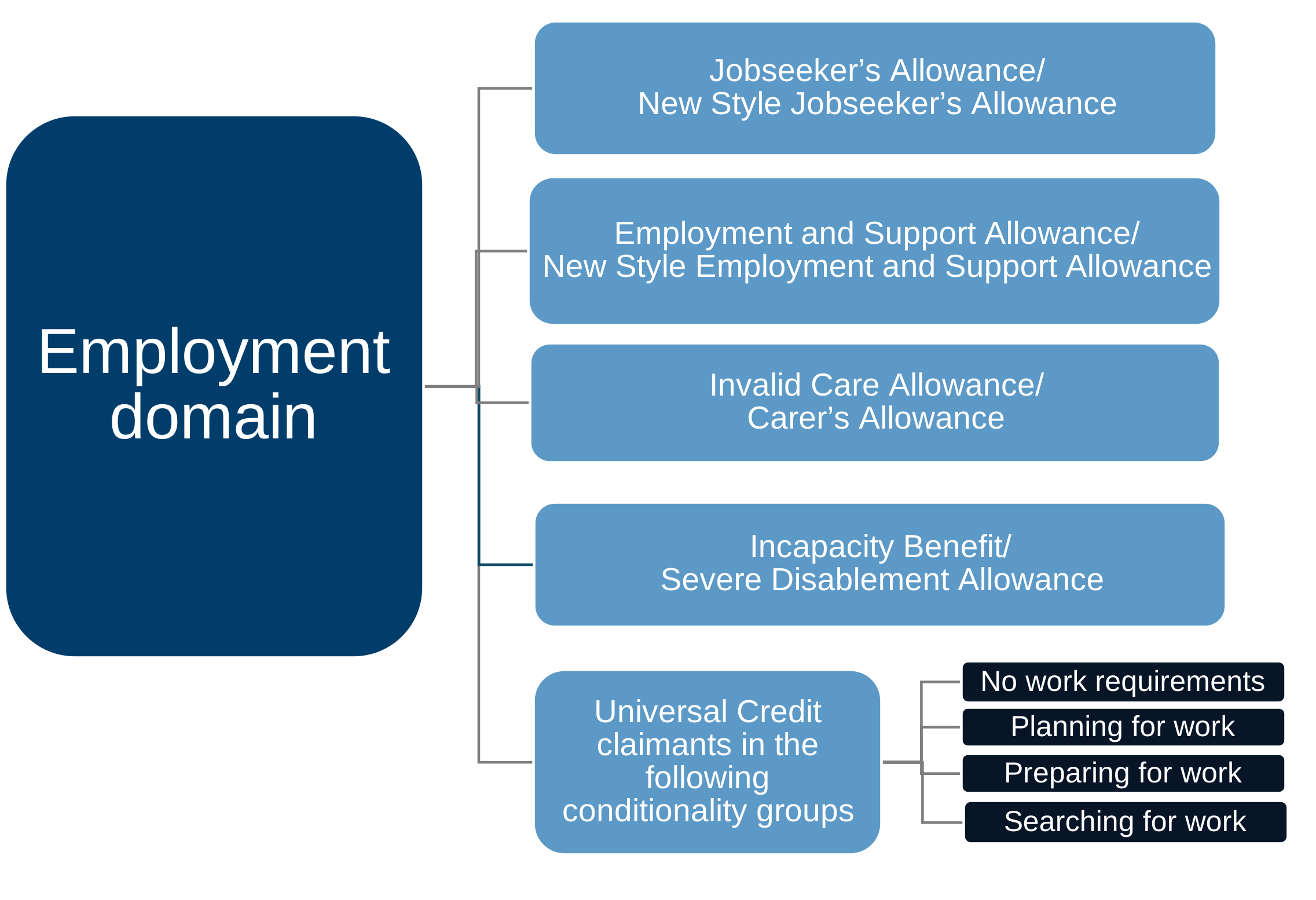
Description of figure 3.1: Diagram showing which benefits are used to derive the employment domain, also described below.
The domain has one indicator made up of several components, a snapshot of working age people in receipt of unemployment-related benefits. It is expressed as a percentage of the estimated population aged 18 to 66 in an LSOA. The numerator is a count of individuals aged 18 to 66, averaged over 12 separate monthly timepoints from April 2022 to March 2023, who were entitled to:
- Jobseeker’s Allowance (both contribution-based and income-based)
- New Style Jobseeker’s Allowance
- Employment and Support Allowance (both contribution-based and income-based)
- New Style Employment and Support Allowance
- Incapacity Benefit
- Severe Disablement Allowance
- Carer’s Allowance
- Income Support
- Universal Credit (UC) claimants in the following conditionality groups:
- no work requirements
- planning for work
- preparing for work
- searching for work
Full details on the indicator and construction of the domain is available in the WIMD 2025 technical report.
Main points
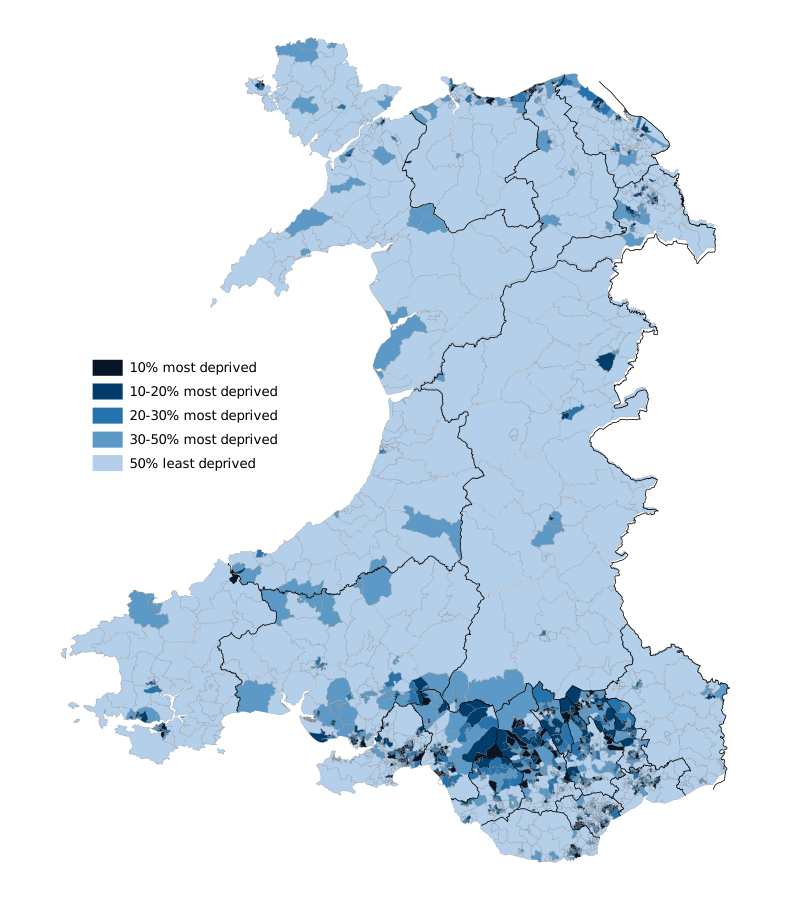
Figure 3.2: map of LSOAs shaded by employment deprivation group, WIMD 2025
© Crown copyright 2025. Cartographics. Welsh Government.
Description of figure 3.2: the map shows that in the WIMD 2025 employment domain, there were pockets of high employment deprivation in the South Wales valleys and large cities, and in some North Wales coastal towns.
- All local authorities except Monmouthshire had at least one area with over 32% of people in employment deprivation, equivalent to being in the most deprived 10% of areas.
- The local authorities with the highest proportion of areas in the most deprived 10% were Blaenau Gwent (at 24%) followed by Neath Port Talbot (at 20%).
- The overall patterns of employment deprivation in WIMD 2025 are broadly like those for WIMD 2019.
- For the employment domain, the most deprived area in Wales was Rhyl West 2, Denbighshire (around Rhyl High Street), the same as for WIMD 2019 (and WIMD 2014).
- Six of the 10 most deprived areas in WIMD 2025 were also in the 10 most deprived areas in WIMD 2019.
- A fifth (20%) of people who are employment deprived live in the most deprived 10% of small areas for the employment domain (the areas ranked 1 to 191).
- Half of those who are employment deprived live in the most deprived 30% of areas for the employment domain.
- Across Wales, 17% of people are in employment deprivation.
- There is a wide range in the percentage of people who were employment deprived within the most deprived 10% of areas, from 64% in Rhyl West 2, to 32% for ‘Bedwas Trethomas and Machen 2’, the area ranked 191.
The full set of domain ranks from WIMD 2025 and the underlying indicators can be downloaded from our StatsWales web pages.
More information on the distribution of the employment deprived population in WIMD 2025 can be found in the WIMD guidance report.
Comparison between WIMD 2019 and WIMD 2025
The introduction of UC has significantly influenced how employment deprivation is measured in WIMD. This has led to the adoption of new indicators developed by the Ministry of Housing Communities and Local Government (MHCLG) and DWP that reflect policy and data changes. This updated method also includes people who may want to work but are unable to do so due to caring responsibilities, a change since WIMD 2019. The employment deprivation indicator is therefore not directly comparable with that for WIMD 2019. For full information on how the domain has changed since 2019 see the technical report.
| WIMD deprivation group | 10% most deprived 2025 | 10% to 20% most deprived 2025 | 20% to 30% most deprived 2025 | 30% to 50% most deprived 2025 | 50% least deprived 2025 |
|---|---|---|---|---|---|
| 10% most deprived 2019 | 78% | 19% | 2% | 1% | 0% |
| 10% to 20% most deprived 2019 | 19% | 56% | 22% | 3% | 0% |
| 20% to 30% most deprived 2019 | 3% | 22% | 44% | 30% | 1% |
| 30% to 50% most deprived 2019 | 0% | 2% | 16% | 63% | 19% |
| 50% least deprived 2019 | 0% | 0% | 0% | 8% | 92% |
The table shows the percentage of small areas (LSOAs) in each of the deprivation groups for WIMD 2019 that have stayed or moved groups in WIMD 2025.
For an explanation of how we have treated the minority of areas that changed boundary, and the ranks counted in each category for WIMD 2019 and WIMD 2025, please see the guidance report.
The diagonal line of data (i.e., from top left to bottom right), shows the percentage of areas which have remained in the same deprivation group. Above the diagonal are percentages of areas which have moved from a more to a less deprived group. Below the diagonal are the percentages of areas which have moved from a less to a more deprived group.
The table shows that:
- except for the 20% to 30% most deprived grouping, most LSOAs remained in the same deprivation group between 2019 and 2025
- of the small areas ranked in the 10% most deprived in 2019, 78% remained in that group in 2025
- of the small areas ranked in the 50% least deprived in 2019, 92% remained in that group in 2025
Only one LSOA moved by more than 2 deprivation groups (see second bullet point below). Below we focus on a few that have moved the most in the most deprived groups.
Relatively more deprived
Two of the areas that moved from the 30% to 50% most deprived group in WIMD 2019 to the 10% to 20% most deprived group in WIMD 2025 were:
- Ringland 1 in Newport (the Coldra area)
- ‘Milford: North 2’ in Pembrokeshire, an LSOA that has changed boundary since WIMD 2019, when it was grouped with what is now ‘Milford: North 1’ (in the 30% to 50% most deprived for employment deprivation).
Relatively less deprived
One area moved from the 10% most deprived group in WIMD 2019 to the 30% to 50% most deprived group in WIMD 2025. This was Plasnewydd 7 in Cardiff, an area close to the city centre including the junction of City Road and Newport Road.
Local authority analysis
Figure 3.3: box plot of WIMD 2025 employment domain ranks, by local authority
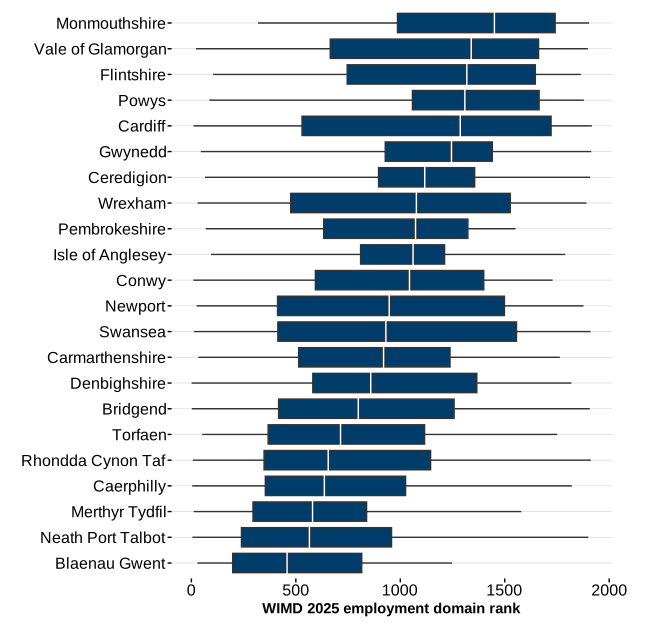
Description of figure 3.3: the chart shows the spread of employment domain ranks for each local authority in Wales. The blue boxes contain half the total number of small areas (LSOAs) in each local authority, centred on the median (middle) rank for each local authority and the ‘whiskers’ show the full range of ranks within the local authority. Deprivation increases with decreasing rank (that is, towards the left-hand side of the plot).
The spread of employment domain ranks was greatest in Cardiff followed by Swansea, while the narrowest were in Isle of Anglesey and Ceredigion. Monmouthshire had the highest median rank (less deprived) and Blaenau Gwent the lowest (more deprived).
Concentrations of employment deprived areas, by local authority
One way of considering WIMD data at the local authority level is to look at the proportion of areas within the local authority that are in the most deprived 10% (or 20% etc) of all areas . This method can be seen as identifying the concentration of the most deprived areas in a local authority, rather than an average level of deprivation.
The WIMD 2025 employment domain results show that:
- the local authority with the highest proportion of areas in the most deprived 10% in Wales was Blaenau Gwent (24% or 11 areas) followed by Neath Port Talbot (20% or 18 areas)
- Monmouthshire had no small areas in the most deprived 10% , followed by Ceredigion, Gwynedd and Powys with only one each of their areas
- Powys and Monmouthshire were also the local authorities with the lowest concentrations of areas in the most deprived half of Wales, at 22% and 24% respectively
- Blaenau Gwent and Merthyr Tydfil had the highest percentage of areas in the most deprived 50%, at 87% and 81% respectively
Concentrations of WIMD 2025 employment deprived areas, by local authority on StatsWales.
Other relevant sources
Data for England and Wales
We will continue to work with MHCLG and other devolved governments to explore opportunities to produce harmonised outputs. Release plans will be announced on GOV.UK in due course.
Benefit statistics
The Department for Work and Pension’s dissemination tool Stat-Xplore (DWP) allows you to download and customise benefit statistics, including local area data and time series.
Labour market statistics
The Welsh Government publishes labour market data for UK countries and regions and also for Welsh economic regions and local authorities, based on the Annual Population Survey. This includes estimates of employment, unemployment and economic inactivity.
Working and workless households
The Office for National Statistics publish data at a local level about households and the adults and children living in them, by their economic activity status. These are based on the Annual Population Survey Household (APSH) datasets.