
Welsh Index of Multiple Deprivation (WIMD) 2025 results report - Overall index
WIMD is designed to identify the small areas of Wales that are the most deprived.
In this page
Introduction
The introduction provides important information about WIMD and an explanation of terms used in the results chapters. Full details on the indicators, domains and construction of the index is available in the WIMD 2025 technical report.
Main points
Figure 1.1: map of LSOAs shaded by deprivation group, WIMD 2025

© Crown copyright 2025. Cartographics. Welsh Government.
Description of figure 1.1: the map shows that in WIMD 2025 there were pockets of high relative deprivation in the South Wales cities and valleys, various coastal towns, and some towns in North East Wales.
- The overall picture is similar to that of WIMD 2019.
- Five of the 10 most deprived areas from WIMD 2019 remained in the 10 most deprived areas in WIMD 2025.
- The most deprived small area in Wales in WIMD 2025 was Rhyl West 2 (the area around Rhyl High Street) in Denbighshire, the same as in WIMD 2019.
- Deprivation is dispersed across Wales: all but one of the 22 local authorities contain at least one of the most deprived 10% of areas in Wales.
- The local authority with the highest proportion of small areas in the most deprived 10% in Wales was Blaenau Gwent (20% or 9 areas) followed by Newport (18% or 18 areas).
- Monmouthshire was the only local authority with no areas in the most deprived 10%, Powys and Ceredigion each had one area in the most deprived 10%.
- Analysis of deep-rooted deprivation looks at areas that have remained in the top 50 most deprived for all WIMD iterations in the past 20 years: there are 22 small areas in deep-rooted deprivation, spread across 10 local authorities.
The full set of domain ranks from WIMD 2025 and the underlying indicators can be downloaded from our StatsWales web pages.
Comparison between WIMD 2019 and WIMD 2025
The introduction summarises changes for 2025. For detailed information on how the index and each domain has changed since 2019 see the technical report.
| WIMD deprivation group | 10% most deprived 2025 | 10% to 20% most deprived 2025 | 20% to 30% most deprived 2025 | 30% to 50% most deprived 2025 | 50% least deprived 2025 |
|---|---|---|---|---|---|
| 10% most deprived 2019 | 85% | 14% | 2% | 0% | 0% |
| 10% to 20% most deprived 2019 | 15% | 65% | 18% | 2% | 0% |
| 20% to 30% most deprived 2019 | 0% | 19% | 59% | 21% | 1% |
| 30% to 50% most deprived 2019 | 0% | 1% | 11% | 69% | 19% |
| 50% least deprived 2019 | 0% | 0% | 0% | 8% | 92% |
The table shows the percentage of small areas (LSOAs) in each of the deprivation groups for WIMD 2019 that have stayed or moved group in WIMD 2025. Deprivation groups used within this report are designed to have smaller groups at the more deprived end of the distribution, where the difference between areas is greater than at the less deprived end.
Due to changes in the total number of LSOAs and the boundaries of some LSOAs this comparison is approximate as explained further in the WIMD 2025 guidance report.
The diagonal (top left to bottom right), shows the percentage of areas which have remained in the same deprivation group. Above the diagonal are percentages of areas which have moved from a more to a less deprived group. Below the diagonal are the percentages of areas which have moved from a less to a more deprived group.
The table shows that:
- most LSOAs remained in the same deprivation group between 2019 and 2025
- of the 10% most deprived areas in 2019, 85% remained in that group in 2025
- of the 50% least deprived areas in 2019, 92% remained in that group in 2025
- there were 29 areas that moved into the 10% most deprived group in 2025, all of these were in the 10% to 20% most deprived group in 2019
Areas that changed rank the most
No areas moved by more than 2 deprivation groups between 2019 and 2025, and only 14 LSOAs moved 2 deprivation groups.
Relatively less deprived
Focussing on the more deprived groups, three areas moved from the 10% most deprived group in 2019 to the 20% to 30% most deprived group in 2025, becoming less deprived. Two of these were in Rhondda Cynon Taff, and were Pentre 5 (an area around Ystrad Rhondda railway station that has changed boundary) and Tonyrefail West 3 (which includes the Bryngolau area).
The other area was Plasnewydd 7, an area of Cardiff around the Newport Road and City Road junction. This area became relatively less deprived in 5 domains, moving from the 10% most deprived group to the 30% to 50% most deprived group on both employment and income (new student accommodation has led to an increase in the student age population in this area).
Outside the most deprived groups, the two largest changes included one area which moved from the 30% to 50% most deprived group to the 50% least deprived group becoming relatively less deprived. This was Tredegar Park 3 in Newport, an LSOA that has changed boundary since WIMD 2019 when it was grouped with what is now Tredegar Park 4 (now in the 10% to 20% most deprived group).
Relatively more deprived
The other largest change outside the most deprived groups was in Grangetown 12. This area around Grangemoor Park in Cardiff has seen the introduction of temporary accommodation for the homeless in recent years. Its overall rank fell from 1,648 in 2019 to 715 in 2025, moving from the 50% least deprived group to the 30% to 50% most deprived group to become relatively more deprived.
Local authority analysis
Figure 1.2: box plot of WIMD 2025 ranks, by local authority
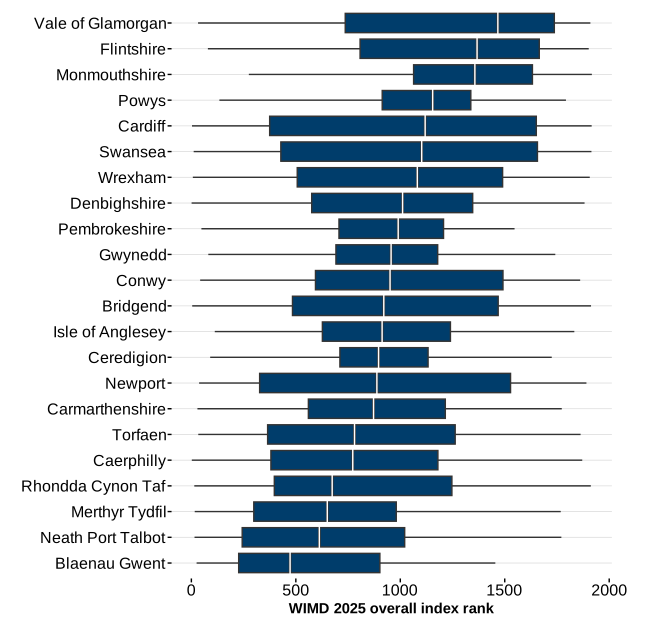
Description of figure 1.2: the chart shows the spread of ranks for each local authority in Wales. The blue boxes contain half the total number of small areas (LSOAs) in each local authority, centred on the median (middle) rank for each local authority and the ‘whiskers’ show the full range of ranks within the local authority. Deprivation increases with decreasing rank (that is, towards the left-hand side of the plot).
The spread of the overall index ranks is greatest in Cardiff, followed by Swansea and Newport and narrowest in Ceredigion and Powys. Vale of Glamorgan has the highest median rank (less deprived) and Blaenau Gwent has the lowest (more deprived).
Concentrations of deprived areas, by local authority
One way of considering WIMD data at the local authority level is to look at the proportion of areas within the local authority that are in the most deprived 10% (or 20% and so on) of all areas. This method can be seen as identifying the concentration of the most deprived areas in a local authority, rather than an average level of deprivation.
The WIMD 2025 overall index results show that:
- the local authority with the highest proportion of areas in the most deprived 10% in Wales was Blaenau Gwent (20% or 9 areas) followed by Newport (18% or 18 areas)
- Monmouthshire had no small areas in the most deprived 10% and Powys and Ceredigion each had only one area
- Monmouthshire was the local authority with the lowest concentration of areas in the most deprived half of Wales, at 19%, followed by Powys (29%) and Flintshire (29%)
- Blaenau Gwent (76%), Merthyr Tydfil (72%) and Neath Port Talbot (72%) had the highest percentage of areas in the most deprived 50%
Concentrations of WIMD 2025 deprived areas, by local authority on StatsWales
The most deprived areas in WIMD 2025
The table below lists the 10 most deprived areas in Wales according to WIMD 2025, together with 5 areas that were ranked between 1 and 10 in WIMD 2019, but have moved out of that group in WIMD 2025.
Note that WIMD does not measure the level of deprivation in a small area, but rather whether an area is more or less deprived relative to all other small areas in Wales. It is not possible to determine from a change in rank alone whether deprivation has improved or not in an area.
| LSOA | Local authority | LSOA name [Note 1] | WIMD 2019 rank | WIMD 2025 rank |
|---|---|---|---|---|
| W01000240 | Denbighshire | Rhyl West 2 | 1 | 1 |
| W01001421 | Caerphilly | St James 3 | 3 | 2 |
| W01001741 | Cardiff | Ely 5 | 14 | 3 |
| W01000991 | Bridgend | Caerau (Bridgend) 1 | 5 | 4 |
| W01000237 | Denbighshire | Rhyl South West 2 | 19 | 5 |
| W01001884 | Cardiff | Trowbridge 8 | 13 | 6 |
| W01000413 | Wrexham | Queensway 1 | 9 | 7 |
| W01001738 | Cardiff | Ely 2 | 28 | 8 |
| W01000239 | Denbighshire | Rhyl West 1 | 2 | 9 |
| W01000241 | Denbighshire | Rhyl West 3 | 11 | 10 |
| W01001274 | Rhondda Cynon Taf | Tylorstown 1 | 4 | 23 |
| W01001209 | Rhondda Cynon Taf | Penrhiw-ceiber 1 | 6 | 60 |
| W01001308 | Merthyr Tydfil | Penydarren 1 | 7 | 16 |
| W01001428 | Caerphilly | Twyn Carno 1 | 8 | 12 |
| W01001662 | Newport | Pillgwenlly 4 | 10 | 49 |
[Note 1]: Links are to 2021 Census area profile for the LSOA (ONS), which includes a map of the area
The table shows that:
- Rhyl West 2, Denbighshire remains the most deprived small area in Wales
- half of the 10 most deprived areas in WIMD 2019 remained in the 10 most deprived areas for WIMD 2025
The table includes links to 2021 Census profiles for these areas. To explore household and demographic characteristics of any area in more detail enter the LSOA code into the 2021 Census Profile for areas in England and Wales tool on the NOMIS website (ONS).
Deep-rooted deprivation
Small areas of ‘deep-rooted’ deprivation are those that have remained within the top 50 most deprived, roughly equal to the top 2.6% of small areas in Wales for the last 6 publications of WIMD ranks (WIMD 2005, 2008, 2011, 2014, 2019 and 2025). This means that across a period of 20 years, the small areas that fall into this category are considered the most deprived, as they have consistently ranked in the top 50 out of all small areas in Wales. The analysis only looks at ranks as far back as WIMD 2005 as this was the first index when LSOAs became the standard geography. The data underlying this analysis has been published on StatsWales and as an OpenDocument Spreadsheet.
Since WIMD is a measure of relative deprivation, it doesn’t give an indication of the level of deprivation in these small areas. The small areas that fall into the deep-rooted deprivation category may have seen a decrease in levels of deprivation since WIMD 2005 but are still some of the most deprived when compared to other small areas in Wales.
In total, there are 22 small areas that are in deep-rooted deprivation, representing roughly 1.1% of all small areas in Wales. These are listed in the table below, ordered by their WIMD 2025 overall rank.
| LSOA code | Local Authority | LSOA Name | WIMD 2025 rank |
|---|---|---|---|
| W01000240 | Denbighshire | Rhyl West 2 | 1 |
| W01001421 | Caerphilly | St James 3 | 2 |
| W01000991 | Bridgend | Caerau (Bridgend) 1 | 4 |
| W01000237 | Denbighshire | Rhyl South West 2 | 5 |
| W01000413 | Wrexham | Queensway 1 | 7 |
| W01000239 | Denbighshire | Rhyl West 1 | 9 |
| W01000830 | Swansea | Penderry 1 | 11 |
| W01001428 | Caerphilly | Twyn Carno 1 | 12 |
| W01000833 | Swansea | Penderry 4 | 13 |
| W01001222 | Rhondda Cynon Taf | Pen-y-waun 2 | 14 |
| W01000921 | Neath Port Talbot | Cymer (Neath Port Talbot) 2 | 15 |
| W01001308 | Merthyr Tydfil | Penydarren 1 | 16 |
| W01000863 | Swansea | Townhill 2 | 19 |
| W01000864 | Swansea | Townhill 3 | 20 |
| W01001274 | Rhondda Cynon Taf | Tylorstown 1 | 23 |
| W01001739 | Cardiff | Ely 3 | 24 |
| W01000862 | Swansea | Townhill 1 | 26 |
| W01001339 | Caerphilly | Bargoed 4 | 27 |
| W01000742 | Swansea | Castle 1 | 30 |
| W01001345 | Caerphilly | Bedwas Trethomas and Machen 6 | 31 |
| W01000832 | Swansea | Penderry 3 | 36 |
| W01001479 | Blaenau Gwent | Tredegar Central and West 2 | 44 |
Of the small areas listed, 2 have been ranked within the top 10 most deprived since WIMD 2005 (Rhyl West 2 and Queensway 1). In addition to these 2 small areas, a further 5 (Rhyl West 1, St. James 3, Twyn Carno 1, Penydarren 1, Pen-y-waun 2) make up the 7 small areas that have consistently been ranked within the top 20 most deprived.
Figure 1.3: map of LSOAs of deep-rooted deprivation across Wales, WIMD 2025
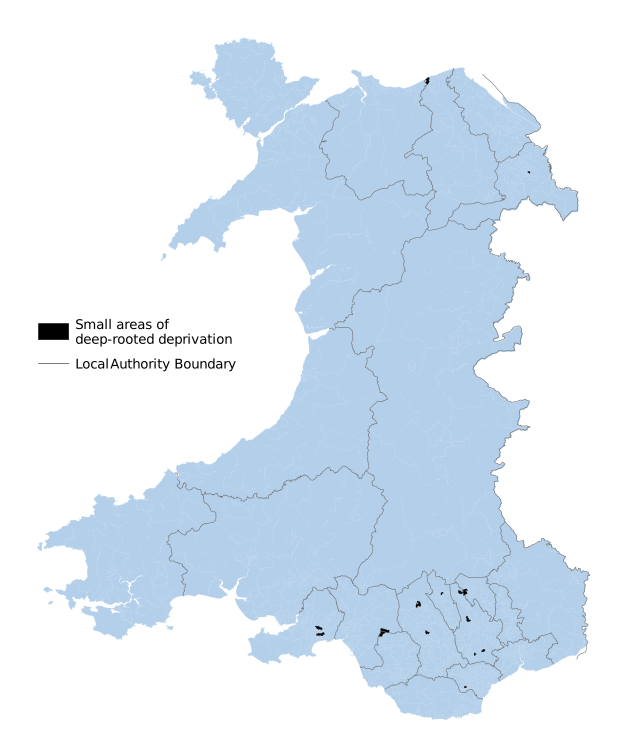
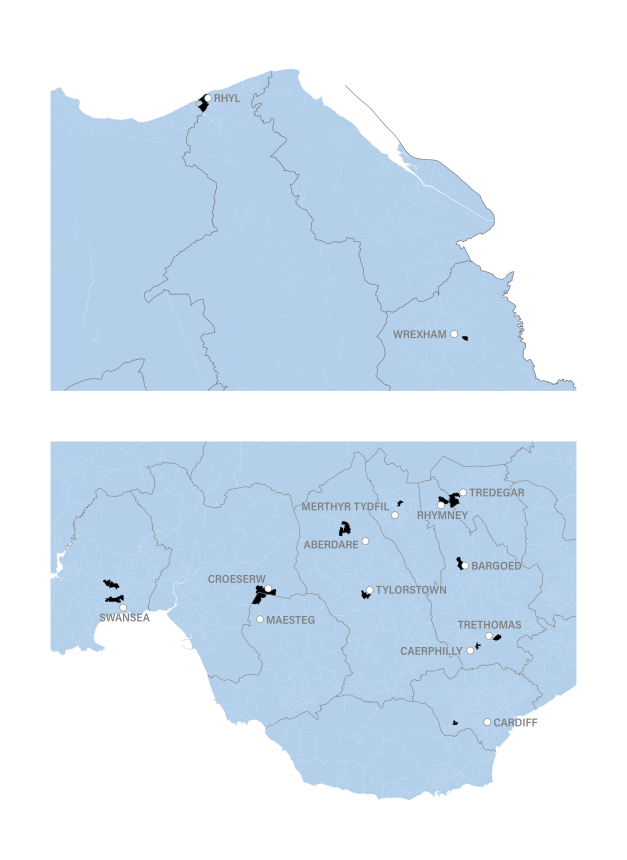
Figure 1.4: map of LSOAs of deep-rooted deprivation, close ups for South and North East Wales, WIMD 2025
© Crown copyright 2025. Cartographics. Welsh Government.
Description of figures 1.3 and 1.4: the maps show that in WIMD 2025 the 22 small areas of deep-rooted deprivation are spread across 10 local authorities; the highest number of which are found in Swansea.
These 7 small areas located in Swansea account for almost a third (32%) of those consistently ranking within the top 50 most deprived, almost twice as many as the local authority with the next highest number (Caerphilly, with 4 small areas).
All but 2 of the 22 are located within a named built up area (BUA), with the most being found in Swansea (6) followed by Rhyl (3). Other BUAs with one small area of deep-rooted deprivation each are Aberdare, Bargoed, Caerphilly, Cardiff, Croeserw, Maesteg, Merthyr Tydfil, Rhymney, Tredegar, Trethomas and Wrexham. The areas in deep-rooted deprivation but not in a BUA are Penderry 3 in Swansea and Tylorstown 1 in Rhondda Cynon Taf.
There are 12 local authorities with no small areas of deep-rooted deprivation (Isle of Anglesey, Gwynedd, Conwy, Flintshire, Powys, Ceredigion, Pembrokeshire, Carmarthenshire, Vale of Glamorgan, Torfaen, Newport, and Monmouthshire). This does not mean that there aren’t currently any very deprived areas in these local authorities.
Areas that have recently left the 50 most deprived group
There are 6 areas that were in the 50 most deprived areas in 3 or 4 of the earlier iterations of the index but were not in the top 50 most deprived areas for 2019 or 2025. However they all remain in the 10% most deprived group for WIMD 2025:
- Cyfarthfa 2 (Merthyr Tydfil) ranked 69 in WIMD 2025
- Gurnos 1 (Merthyr Tydfil) ranked 87 in WIMD 2025
- Gurnos 2 (Merthyr Tydfil) ranked 89 in WIMD 2025
- Butetown 1 (Cardiff) ranked 136 in WIMD 2025
- Hengoed 2 (Ystrad Mynach, Caerphilly) ranked 158 in WIMD 2025
- Pillgwenlly 3 (Newport) ranked 174 in WIMD 2025
Related sources
Indices of multiple deprivation across the UK
England, Scotland and Northern Ireland all produce their own indices of multiple deprivation:
- English Indices of Deprivation (Ministry of Housing, Communities and Local Government, MHCLG)
- Scottish Index of Multiple Deprivation (Scottish Government)
- Northern Ireland Multiple Deprivation Measure (NISRA)
These datasets are based on the same concept and general methodology, however there are differences (described in the guidance report) meaning the indices are not directly comparable. The ONS previously published information explaining in more detail the similarities and differences between the 4 Indices (ONS).
We continue to work with MHCLG and devolved governments to explore opportunities to produce harmonised outputs. This includes sourcing data which will enable the publication of UK-wide products. Release plans are yet to be confirmed but will be announced on GOV.UK in due course.
Other local data for Wales
ONS have published data and information relating to the 2021 Census (ONS) as well as local statistics (ONS). Statistics specifically for Wales can be found in National Survey for Wales bulletins, and in the National Survey for Wales results viewer.
Trajectories of deprivation
Academics continue to use census and indices of deprivation data to research and evidence deprivation trajectories, or ‘deprivation histories’ for small areas in the UK, investigating case studies of local authority districts. For example see the published article 50-year Deprivation Trajectories: Local Area Change in England and Wales, 1971–2021 (Norman, P., Lloyd, C.D., McLennan D., Ferguson, S. and Catney, G., 2024). The upcoming article ‘Trajectories of deprivation in the UK’ (Lloyd, C. D., Ferguson, S., Catney, G., McLennan, D. and Norman, P., Nuffield Foundation 2025) will include analysis of Welsh data up to the 2021 Census and WIMD 2019.