
Welsh Revenue Authority: Annual Report and Accounts 2024 to 2025
Our performance, financial, and governance activities at the Welsh Revenue Authority (WRA).
In this page
Chair's overview

As we report on the end of the latest financial year and look ahead to our next three-year corporate plan, this feels like a pivotal moment in the evolution of the Welsh Revenue Authority (WRA).
We’ve continued to make strong progress with our current responsibilities. And we've been working hard on preparations to deliver new services on behalf of Welsh Government. We look forward to the next chapter as we deliver more for Wales.
A significant milestone in our journey is the departure of our founding Chief Executive Officer, Dyfed Alsop. Dyfed worked on establishing the WRA and became our first Chief Executive and Accounting Officer. He inspired and built every aspect of our organisation - our people, our partnerships, and ‘Our Approach’. Our continued commitment to Our Approach is evident through the passion and dedication of our people. And they remain our biggest strength.
Finally, I'd like to thank Dyfed for his hard work and personal commitment to the WRA. He leaves us confident in our direction and ready for our next chapter. I’m delighted that Rebecca Godfrey (previously Chief Operating Officer) has been appointed as Interim Chief Executive Officer and Accounting Officer; I look forward to working with her in that new capacity, with the support of the rest of the senior leadership team.
Our Interim Chief Executive Officer and Accounting Officer, Rebecca Godfrey (in post from May 2025), has signed this Annual Report and Accounts, taking assurances from Dyfed from his period as Accounting Officer during 2024 to 25.
Ruth Glazzard
Chair of the WRA
Performance report: Chief Executive Officer’s overview

As we close our corporate plan 2022 to 2025, we’re proud to reflect on a period of achievement and growth for our organisation. We’ve reached a significant milestone in collecting £2 billion in tax revenue since 2018; money that Welsh Government invests in vital public services, from schools to the NHS, in communities across Wales.
During the three-year period, we’ve achieved what we set out to do: growing our capability while maintaining efficiency as we've focused on making it fair and easy to pay tax. In the last year, most of our performance measures have improved and we've shown how nimble we can be by using our resources flexibly; we achieved spend within 1% of our budget.
We've demonstrated our ability to deliver in new areas through our work on new taxes. Collaborating with wider Welsh Government, we had input on the design and delivery of the Visitor Accommodation (Register and Levy) Etc. (Wales) Bill. At the same time, we continue to innovate with our existing responsibilities of Land Transaction Tax and Landfill Disposals Tax.
Our Approach, which inspires all we do and represents a ‘Welsh way of doing tax’, has been further strengthened through additional investment in our tax risk mitigation teams working on current taxes. This will enable us to explore new areas of tax risk while continuing to deliver effective services for our customers.
Our organisation has evolved. We've moved towards further embedding a service approach across our operations. Throughout this period, we've been building this approach to ensure we keep customers at the heart of all we do and that we're well placed to continue to deliver in a sustainable way as we grow.
In April, we published our corporate plan 2025 to 2028. As we set out in that plan, we'll continue to act with 'hyder' (confidence) to remain 'uchelgeisiol a dewr' (ambitious and brave) in how we serve Wales into the future. We look forward to building long lasting services that will benefit Wales for years to come.
Dyfed Alsop, Chief Executive Officer (April 2024 to April 2025)
Rebecca Godfrey, Interim Chief Executive Officer (from May 2025)
Performance overview
This section gives an overview of our organisation and activities and briefly outlines our performance against our strategic objectives.
About us
The Welsh Revenue Authority (WRA) is a non-ministerial department of Welsh Government. This means there is a separation between Welsh ministers and us in respect of the data we hold and the operational decisions we make.
We’re an organisation of more than 100 people, with skills and experience spanning 14 different professions. We manage Land Transaction Tax (LTT) and Landfill Disposals Tax (LDT) on behalf of Welsh Government. By managing these devolved taxes, we raise vital revenue to support local services, such as the NHS and schools, in communities across Wales.
We’re also supporting Welsh Government on the Visitor Accommodation (Register and Levy) Etc. (Wales) Bill. Assuming new legislation is passed in summer 2025, we’ll be responsible for collecting and managing a visitor levy and the national register of visitor accommodation in Wales.
Our Approach
We’ve developed ‘Our Approach’, a Welsh way of doing tax, which underpins the way we collect and manage tax. Starting from a position of high trust, we work with taxpayers and agents to help them pay the right amount of tax first time. This approach helps us deliver a fair tax system for Wales.
We recognise there’ll be times when people will get things wrong, however. We proactively try to identify circumstances where there’s a higher likelihood of taxpayers paying the wrong amount of tax. These are what we call ‘tax risks’. We take action to make sure people pay the right amount of tax in these instances.
At times, we need to intervene to make sure a taxpayer or agent pays tax that would otherwise have remained unpaid without our involvement. We call this ‘tax protection’ or ‘tax recovery’. We report on this activity in the Performance analysis section.
Our purpose and strategic objectives
We set out our purpose and our strategic objectives in our Corporate Plan 2022 to 2025. They are agreed by Welsh ministers. This annual report and accounts represents our final reporting year of this corporate plan. The new Corporate Plan 2025 to 2028 has recently been published.
In our corporate plan for 2022 to 2025, we set out our purpose to:
- design and deliver revenue services
- lead the better use of Welsh taxpayer data for Wales
We had the following strategic objectives during the period:
- easy: we’d make it easy to pay the right amount of tax
- fair: we’d be fair and consistent in the way we collect and manage tax, taking proportionate action when people do not meet their obligations
- capable: we’d develop and maximise our individual and collective capability
- efficient: we’d deliver in a way that is sustainable and proportionate, using the resources we have in the best way
Appraisal report
When we report on our performance, we report on corporate plan measures developed around our objectives, as set out above. These range from tax-focused measures to people and skills-focused measures.
Many of our measures have shown improvement during the year, and levels of performance are generally within or near our explicit targets. We summarise the data below and report more fully on this in the performance analysis section. We also publish the more detailed data behind all our performance measures in our data annex.
How people find dealing with us
- Objectives: easy, fair and capable.
- 2025 target: as many people as possible find it easy to use our services.
- 2024 to 2025 performance: nearly 90% of people found it easy to use our services, which was marginally down on the previous year.
Support people to get their taxes right
- Objectives: easy, fair and efficient.
- 2025 target: support people to get their taxes right.
- 2024 to 2025 performance: we estimate that 97.4% of taxpayers declared the right tax, marginally down on last year following the identification of some additional tax risks.
Timeliness of filing
- Objectives: easy, fair and efficient.
- 2025 target: 98% to be filed on time.
- 2024 to 2025 performance: almost 99% of transactions were filed on time, up slightly on the previous year. Our average time to file cases decreased throughout the year.
Timeliness of paying
- Objectives: easy, fair and efficient.
- 2025 target: 98% to be paid on time.
- 2024 to 2025 performance: in almost 97% of transactions with tax due, full payment was received within 30 days, which is slightly better than last year but narrowly below our target.
Timeliness of higher rate refunds
- Objectives: easy, fair and efficient.
- 2025 target: 95% processed in 30 days and 98% in 60 days or fewer.
- 2024 to 2025 performance: over 95% of higher rate refunds were made within 30 days, and nearly 99% were paid within 60 days.
Debts are recovered quickly
- Objective: fair.
- 2025 target: 90% of debts paid within 30 days and 98% within 90 days.
- 2024 to 2025 performance: 87% of transactions that became a debt were paid within 30 days, and 95% within 60 days, narrowly below our targets. However, this measure fluctuates due to the small number of cases that now enter debt.
Payments made correctly first time
- Objective: easy.
- 2025 target: maximise the number of payments made correctly first time.
- 2024 to 2025 performance: 95% of payments were made correctly first time, up on the previous year.
Extent of automation
- Objective: efficient.
- 2025 target: 98% of transactions completed without requiring manual intervention.
- 2024 to 2025 performance: 95% of transactions required no intervention, which is similar to last year, and marginally up over the past 3 years. However, the measure is still a little short of our 98% target.
How our people feel
- Objective: capable.
- 2025 target: top 25% of Civil Service organisations for engagement.
- 2024 to 2025 performance: we ranked sixth in the Civil Service People Survey for overall employee engagement levels in 2024.
Our skills mix
- Objective: capable.
- 2025 target: maintain breadth of professions and develop our Welsh language skills.
- 2024 to 2025 performance: we currently employ people from across 14 different professions and 49% of them know at least some Welsh, with 13% fluent or nearly fluent. This is marginally lower than the previous year.
Diversity
- Objective: capable.
- 2025 target: be an inclusive organisation that values and involves people, regardless of their background or circumstances.
- 2024 to 2025 performance: according to our latest Civil Service People Survey results (2024), our overall score for inclusion and fair treatment is 90%. This has increased from the previous year.
Our data annex has the detailed data, both current and historic, for the more complex diversity indicators.
Our principal risks
During the year we identified and managed 5 main corporate risks. These relate to:
- securing the right resources
- maintaining our positive culture
- information management and security
- funding our current and future functions
- maintaining stakeholder support for ’Our Approach’
How we manage organisational risks is covered in the Governance statement section.
Performance analysis
Overall, during the reporting year we passed the £2 billion threshold for the total amount of tax we’ve collected and managed since we started operating in 2018.
In 2024 to 2025, we recorded just over 56,000 LTT transactions, an increase on the previous year. This reflects a recovery in the housing market. For LDT, we recorded around 940,000 tonnes of waste disposed of at authorised landfill sites in Wales. This figure was 10% lower than the previous year, due to falls in both lower-rated waste and waste subject to reliefs or discounts, while standard rate disposals increased marginally.
We focused our resources on minimising known tax risks and exploring potential new risk areas. We gathered more data and insight to further build our understanding of risk and how to maximise the effectiveness of our interventions.
As explained in the Our Approach section of the performance overview, we focus our resources on supporting people to pay the right tax at the right time, across both LTT and LDT. This is the core part of our tax risk mitigation work.
We estimate that 97.4% of transactions during the year declared the right tax, reflecting the continued success of Our Approach. This is marginally down on the previous year. But we’ve successfully tested new ways to explore a wider range of tax risks (see the Innovating with existing responsibilities section).
And alongside this, we’ve continued to manage our more established risks by contacting agents and taxpayers in all those cases where potential risks were flagged in their tax returns. See our data annex for further detail.
As explained in Our Approach section, tax recovery and tax protection are also important aspects of our work. This is where we need to intervene to ensure the right amount of tax is paid.
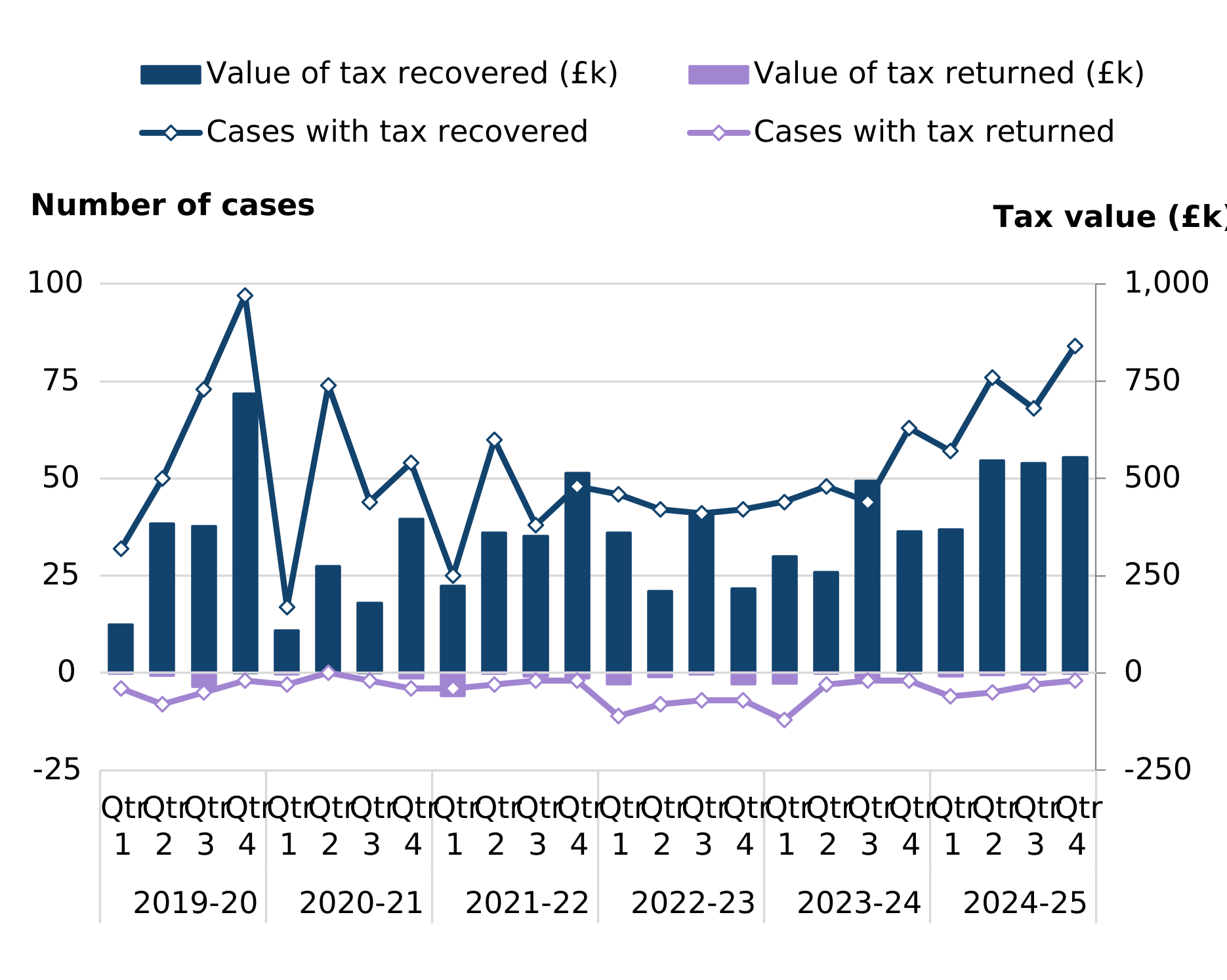
During the year, tax recovery exceeded £2 million for the first time. This was because we corrected a high number of cases – around 300 overall – across a variety of both established and new tax risks. There were also some cases where we returned tax where it had been overpaid in error (see the chart below for details).
Chart 1: number and value of cases where LTT was recovered or returned
We also protected almost £400,000 of tax during the year. This figure represents a substantial achievement in preventing the loss of tax to invalid claims. It's lower than the previous year, and this reflects our continued success in challenging claims once we receive them as well as stopping invalid claims reaching us. Our success is due to engagement activities to support agents and taxpayers.
Delivering in new areas of responsibility
We’ve evidenced how we can deliver in new areas, as demonstrated by our work on new taxes. A particular highlight during the year was providing the Welsh Treasury with operational insight to help develop visitor levy and national registration legislation. This partnership approach means we can both inform draft legislation and prepare earlier for the implementation of new services.
Anna Adams, Deputy Director, Welsh Treasury:
One of our goals that we set out at the start of the Visitor Levy Bill process was to ensure that we considered policy alongside delivery. We worked in partnership with teams across the Welsh Revenue Authority to iterate on design questions, ensuring that the policy would be delivered in the way that it was intended. I’m convinced the legislation is much better and the levy will be more effective as a result.
Innovating with existing responsibilities
We’ve demonstrated how we continue to innovate within our existing responsibilities. This is mainly focused on increasing our tax risk mitigation activity. Here are some examples from the year:
Additional investment in tackling tax risk
- Building on the success of our tax recovery work and our deepening understanding of the tax risk landscape, we developed proposals to expand our tax risk mitigation activities throughout 2025 to 2026 and beyond.
- We worked with the Office for Budget Responsibility (OBR) to agree projected outcomes from additional investment.
- The Cabinet Secretary for Finance and Welsh Language endorsed Our Approach in a draft budget statement, with WRA funding for 2025 to 2026 adjusted accordingly.
Engaging, supporting and mitigating
- We continued to use engagement, support and mitigation as an approach that remained central to our work in managing tax risk.
- We relaunched in-person tax forums in north and south Wales, and more than 40 agents came to these to learn directly from our experts.
- We ran a series of webinars on different topics, ranging from tax administration to higher rates, attended by more than 800 agents in total.
One of the attendees who attended the webinars, said: "I found the session very helpful and informative. Looking forward to the further two webinars."
Quality assurance for LTT team
- Our LTT team underwent an audit by the Welsh Government Internal Audit Service (IAS) on tax enquiries and inaccuracy penalties. The substantial assurance we received from the audit shows our risk management and control processes are suitably designed and applied effectively. This is a significant result for us and supports our approach of supporting and helping taxpayers get their tax right first time.
- The final IAS report said: “For each case we reviewed there is a detailed audit trail in place to support the decision reached.”
LDT risk activity
- We continued to work with landfill site operators to help them get their tax right. Where we identified risk, we began enquiries to check the tax position.
- We built on our delegation agreement with Natural Resources Wales and received more referrals in the year. This resulted in further opportunities to collect and charge the LDT unauthorised disposals rate.
- We continued to work with HM Revenue and Customs (HMRC) and Revenue Scotland to increase our knowledge of UK-wide business waste sector initiatives.
- We shared best practice and lessons learnt with all our partners. This supports our approach to identifying and managing tax risk.
Gareth O’Shea, Executive Director of Operations, NRW:
“Our partnership with the Welsh Revenue Authority is vital in helping identify potential tax non-compliance and contributing to tackling waste crime in Wales. By working together, we’re not only strengthening the way waste is regulated and managed but also delivering real environmental benefits for our communities and natural environment. This collaboration continues to demonstrate the power of shared purpose and co-operative working, and we look forward to building on this strong relationship in the years ahead.”
Building our services approach
We continued to develop how we approach services to ensure we’re well placed to continue to deliver these effectively as we grow. Here are some highlights.
- We built partnerships with service-based organisations, the Driver and Vehicle Licensing Agency (DVLA) and Companies House to learn, share best practice and shape our own approach to services.
- We invested in our people by working with the Centre for Digital Public Services (CDPS) to provide them with agile and leadership training.
- We started to move towards a service-orientated structure, creating our first multi-disciplinary service teams, including national registration.
- We grew our skills and capabilities in the digital, data and technology (DDaT) profession to shift away from a reliance on external resources and boost skills in the Welsh Civil Service.
Harriet Green, Joint Chief Executive Officer, CDPS:
We're delighted to have built such a productive partnership with the Welsh Revenue Authority, whose commitment to investing in their people through our agile and leadership training programmes demonstrates real vision as they evolve into a service-led organisation. This investment will give their teams the confidence and capabilities needed to drive meaningful transformation which keeps citizens at the heart of their services.
As part of Welsh Government’s administrative estate, we also form part of its sustainability reporting. Details can be found in the Welsh Government Consolidated Accounts 2023-2024 (pages 74 and 75). In addition, we promote hybrid working, cycle to work schemes and a ‘green car’ scheme.
‘Our charter’ performance
We want to work together to deliver a fair tax system for Wales. We developed our charter to help us do this.
Our charter consists of 8 shared values, behaviours and standards developed with taxpayers, agents, other organisations and the public.
Here we explain some of the things we did for each value in 2024 to 2025.
Value 1: Secure – protect information and respect confidentiality
- See the sections How we manage information and governance and Cyber resilience in our governance statement for further details.
Value 2: Supportive – provide support when you ask for help. Build easy to use and effective digital services
- We continued to improve our guides, forms and digital services by using content design skills to make them even more accessible.
- We held 6 webinars offering training to agents on a range of subjects.
- We hosted 2 tax forums, which were well attended by agents.
Value 3: Fair – be honest in our dealings with each other. Tackle evasion and avoidance, use powers consistently and proportionately
- We continued to manage tax risk and develop risk profiles, ensuring fairness and consistency across the tax system. We focused on developing new tax risk profiles. Where we found people had overpaid tax, we let them know.
- We supported people to put things right when errors were made. We identified where people tried to evade payment or avoid paying the full amount, and took steps to ensure the right tax was paid to protect revenue.
- We made considerable progress with our work on charging LDT on unauthorised waste disposal.
Value 4: Engaging – support people to understand devolved taxation and work together to develop it for the benefit of Wales
- We engaged with stakeholders across government at conferences and other events to ensure people understood our position and the opportunities provided by tax devolution.
- We communicated with many of our service users to improve what we offer.
- We engaged with many future service users on the visitor levy during our discovery work, carrying out research to understand how we’ll shape the service.
Value 5: Responsive – listen to each other and be open in our conversations, act on feedback and advice given. Treat each other with respect
- We listened and responded to feedback to further enhance our services. See the Performance analysis section section for more information.
- We considered our people’s wellbeing while reprioritising our work to meet the organisation’s changing needs. See the Performance analysis section.
Value 6: Bilingual – confidence to conduct our business in Welsh and English
- We continued to deliver our services for customers in both Welsh and English.
- We encouraged our people to use their Welsh language skills and offered opportunities to take part in funded Welsh language training at work.
- We welcomed amendments made to Welsh Language Standards Regulations in February that mean these standards will apply to the WRA from 2026.
Value 7: Accurate – work together to get things right and correct them if we need to, share accurate data and information, taking reasonable care to avoid mistakes. Keep accurate records
- Our Performance analysis section explains more about accuracy in our work. For example, we continued to manage tax risk and helped people reduce mistakes relating to multiple dwelling relief (MDR) and offered ongoing helpdesk and tax opinions services. Over 97% of LTT transactions were right first time.
Value 8: Efficient – respond quickly to each other, submit returns and process requests on time. Identify ways we can improve the service
- Our Performance analysis section gives more information on our improved efficiency during the year. For example, over 95% of repayments of higher rates are now paid within 30 days, and we’ve made improvements in areas such as automation.
Management of the Welsh Revenue Authority
Our Board
- Ruth Glazzard, Non-executive Chair.
- Jocelyn Davies, Non-executive Deputy Chair.
- Mary Champion, Non-executive Member.
- Rheon Tomos, Non-executive Member.
- Jim Scopes, Non-executive Member.
- Dyfed Alsop, Chief Executive Officer.
- Rebecca Godfrey, Chief Operating Officer/Services Director.
- David Matthews, Strategy and Capability Director (from September 2024).
- Zoe Curry, Staff-elected Member (until March 2025).
Our Tîm Arwain (Executive Committee)
- Dyfed Alsop, Chief Executive and Accounting Officer.
- Rebecca Godfrey, Chief Operating Officer/Services Director.
- David Matthews, Strategy and Capability Director.
- Carl Alexis, Chief People and Communications Officer.
- Alex Mason, Chief Finance Officer (from January 2025).
- Nicola Greenwood, Head of Finance/Deputy Chief Finance Officer (until January 2025).
Financial report
Resource accounts
We receive an annual funding allocation from Welsh Government to cover our expenditure. We set an expenditure budget each year based on the activities we plan to undertake to deliver our corporate plan. The budget is functionally split into the following broad areas:
- staff costs, including learning and development
- operational costs of collecting the taxes, enforcement action and data intelligence
- corporate running costs, such as human resources (HR), information and communication technology (ICT), facilities, governance and legal advice
- business change to ensure continual improvement to both digital systems and operational processes to support new processes and tax legislation change
Funding allocated to our organisation and drawn down from Welsh Government is set out in the table below.
| Funding stream | 2024-25 £000 | 2024-25 Funding drawn £000 | 2023-24 Funding allocation £000 | 2023-24 Funding drawn £000 |
|---|---|---|---|---|
| Revenue | 8,612 | 8,612 | 8,117 | 7,867 |
| Capital | 120 | 106 | 350 | 350 |
| Total funding allocation | 8,732 | 8,718 | 8,467 | 8,217 |
2024-25 £000 | 2023- 24 £000 | |
|---|---|---|
| Staff costs | 6,555 [2] | 5,528 |
| Other related staff costs | 201 | 163 |
| Other operating costs | 1,784 | 2,049 |
| Depreciation | 74 | 59 |
| Amortisation | 66 | 55 |
| Net operating expenditure | 8,680 | 7,854 |
During the year, we raised revenue from taxes we manage on behalf of Welsh Government, as set out in the table below.
2024-25 £000 | 2023-24 £000 | 2022-23 £000 | |
|---|---|---|---|
| Land Transaction Tax | 340,612 | 269,893 | 372,106 |
| Landfill Disposals Tax | 34,138 | 29,718 | 42,014 |
| Total taxes and revenues | 374,750 | 299,611 | 414,120 |
[2] The change in staff costs from prior year is largely due to the development of the National Registration and Visitor Levy schemes as part of the Programme for Government.
It is expected that further details will be shared in future years as the schemes develop and are implemented.
WRA annual accounts 2024 to 2025
We processed over 56,000 LTT returns (2023 to 2024: 49,900).
Of these returns:
- 52% resulted in a tax liability requiring payment (2023 to 2024: 50%)
- this generated a net revenue income of £338.10 million in LTT for the Welsh Consolidated Fund (2023 to 2024: £269.89 million)
2024-25 £000 | 2023-24 £000 | |
|---|---|---|
| Net cash collected | 372,964 | 300,270 |
| Cash remitted to the Welsh Consolidated Fund | 374,000 | 298,000 |
Accountability report
Statement of the Accounting Officer’s responsibilities
As Accounting Officer of the WRA, the Interim Chief Executive Officer, Rebecca Godfrey, is personally responsible for:
- the proper stewardship of public funds
- day-to-day operations and management of the WRA
- ensuring compliance with the requirements of Managing Welsh Public Money
Under Sections 29(1)(b) and 30(1) of the Tax Collection and Management (Wales) Act (TCMA) 2016, Welsh ministers have directed the WRA to prepare our resource accounts and tax statement for each financial year. These should be in the form and on the basis set out in the ‘accounts direction’ provided by Welsh Government.
The accounts are prepared on an accruals basis and must give a true and fair view of the state of affairs of the WRA and its net resource outturn, application of resources, changes in taxpayers’ equity and cash flows for the financial year.
In preparing the accounts, the Accounting Officer is required to comply with the Government Financial Reporting Manual (FReM) and in particular to:
- observe the accounts direction issued by the Welsh ministers, including the relevant accounting and disclosure requirements, and apply suitable accounting policies on a consistent basis
- make judgements and estimates on a reasonable basis
- state whether applicable accounting standards, as set out in the FReM, have been followed, and disclose and explain any material departures from these in the accounts
- prepare the accounts on a going concern basis
- confirm that the Annual Report and Accounts, as a whole, are fair, balanced and understandable, and take personal responsibility for the Annual Report and Accounts and the judgements required for determining that they are fair, balanced and understandable
In addition, the Accounting Officer must ensure that the tax statement is prepared in accordance with Section 25 of the TCMA to:
- show the amounts receivable from the collection of taxes, penalties and other income, any deductions permitted and the amounts paid to the Welsh Consolidated Fund
- provide disclosure of any material expenditure or income that has not been applied to the purposes intended by Welsh Government or material transactions that have not conformed to the standards of the authorities that govern them
An Accounting Officer’s duties include responsibility for the propriety and regularity of the public finances for which they are answerable, keeping proper records and safeguarding WRA assets. These duties are set out in the ‘Accounting Officer’s Memorandum’, framework documents and Managing Welsh Public Money.
As the Accounting Officer for the WRA, I confirm that:
- the Annual Accounts for the period 1 April 2024 to 31 March 2025 are fair, balanced and understandable
- I take personal responsibility for the Annual Accounts and the judgements required for determining that they are fair, balanced and reasonable
- in producing these accounts, I have undertaken widespread consultation, seeking feedback, comment and assurance from the WRA Management Board, Audit and Risk Assurance Committee (ARAC), internal auditors and members of the wider staff team
- I have taken all reasonable steps to make myself aware of any relevant audit information and to establish that our auditors are aware of that information
Rebecca Godfrey
Interim Chief Executive Officer and Accounting Officer
22 July 2025
Governance statement
The TCMA 2016 designates me as the Accounting Officer, and details of my responsibilities are in the agreement between the Welsh Government and the Welsh Revenue Authority.
Our governance framework
This is a visual of our governance framework. The remit and responsibilities are set out below.
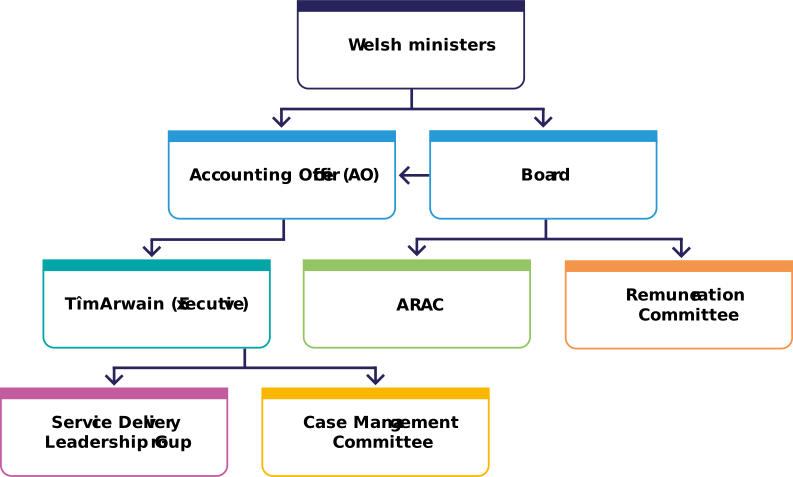
Welsh ministers
Set our objectives and priorities.
Accounting Officer (AO)
Takes objectives and priorities from Welsh ministers and provides assurance on:
- standards of governance
- financial management
- corporate risks
The AO is supported by the Board.
Our Board
Provides leadership, support and challenge.
Audit and Risk Assurance Committee (ARAC)
Provides assurance and scrutiny on:
- risk management
- control
- financial management and governance
Reports to the Board.
Remuneration Committee
Provides support and challenge on senior appointments and succession. The Remuneration Committee reports to the Board.
Tîm Arwain (Executive Committee)
Sets strategic direction in line with the corporate plan and oversees transformation.
Reports to the Accounting Officer.
Service Delivery Leadership Group
Delivers current services and provides assurance on:
- operational performance
- control and risk
Reports to Tîm Arwain.
Case Management Committee
Provides assurance on and supports:
- operational decision-making
- policy development
Reports to Tîm Arwain.
Our Board
Our Board consists of a majority of non-executive to executive members, and includes the Chief Executive Officer, Chief Operating Officer, Strategy and Capability Director and a staff-elected member.
Board members (which includes the Chief Executive Officer) are collectively accountable for the WRA, and they provide leadership to ensure an effective standard of governance:
- The functions for devolved taxes we manage are delegated to the Chief Executive Officer. The Chief Executive Officer delegates through an executive committee structure, taking decisions as per the current corporate plan.
- The Board provides challenge and advice on our strategy, capability and performance, and is, alongside the Accounting Officer, supported by:
- ARAC
- The Remuneration Committee
The Board also includes a board associate role. Two associates were part of a pilot scheme in 2023 and is in line with our current corporate plan commitment to: “… create a healthy, fair and inclusive environment by ensuring our organisation is inclusive of all, allowing everyone to feel valued and able to succeed”.
This scheme:
- created an opportunity for people who might otherwise be discounted for board roles to gain experience
- trialled different criteria and application processes that could be developed and reused, potentially in future ministerial appointments by Welsh Government
- provided a supportive space for an introduction to a board environment, allowing full contribution and ensuring a sense of belonging
- increased diversity of thought on our Board and for the future of our organisation in line with our corporate plan commitment relating to inclusivity
To note, board associates are not formal Board members in statute and have no associated voting rights.
This scheme:
- created an opportunity for people who might otherwise be discounted for board roles to gain experience
- trialled different criteria and application processes that could be developed and reused, potentially in future ministerial appointments by Welsh Government
- provided a supportive space for an introduction to a board environment, allowing full contribution and ensuring a sense of belonging
- increased diversity of thought on our Board and for the future of our organisation in line with our corporate plan commitment relating to inclusivity
To note, board associates are not formal Board members in statute and have no associated voting rights.
ARAC
ARAC scrutinises governance, risk management, the control environment and the integrity of the Annual Report and Accounts.
Number of meetings in 2024 to 2025: 5
Chair: Mary Champion
Members: 3 non-executive members, including the Chair. The Chair of our Board also has an open invitation to attend meetings.
Ymgynghorwyr (Advisers) to ARAC:
- Chief Executive Officer
- Chief Operating Officer
- Chief Finance Officer
- Head of Finance
- Internal Audit Service (IAS) representative
- Chief of Staff
- Audit and Risk Secretariat
Representatives from Welsh Government and Audit Wales regularly attend meetings.
ARAC meets quarterly, approximately 1 week before each Board meeting. Over the past year, ARAC has scrutinised and given assurances on a range of matters.
These include strategic processes for managing risk, the risk appetite framework, the effective application of internal controls, cyber security arrangements and several WRA policies. The effectiveness of ARAC is also monitored and reported on every 2 years.
Remuneration Committee
This committee (formerly called the People Committee) was set up to provide assurance and scrutiny on the effectiveness of succession planning, recruitment and remuneration.
Number of meetings in 2024 to 2025: 3
Chair: Ruth Glazzard
Members: 3 non-executive members (including the Chair) and the:
- Chief People and Communications Officer
- Chief Executive Officer
- Head of Human Resources
Board and committee meeting attendance
| Members | Board [footnote 1] | ARAC | Remuneration Committee |
|---|---|---|---|
| Number of meetings held | 4 | 5 | 3 |
| Non-executive members: | |||
| Ruth Glazzard | 4 | 2 | 3 |
| Jocelyn Davies | 3 | 4 | 1 |
| Mary Champion | 4 | 4 | 0 |
| Rheon Tomos | 4 | 5 | 0 |
| Jim Scopes | 4 | 1 | 3 |
| Executive members: | |||
| Dyfed Alsop | 4 | 5 | 3 |
| Rebecca Godfrey | 4 | 4 | 1 |
| David Matthews (from September 2024) | 3 | 0 | 0 |
| Staff-elected member: | |||
| Zoe Curry (until March 2025) | 3 | 4 | 0 |
[footnote 1] Board meetings are held quarterly. The Board also meets for update conversations monthly and undertakes strategic planning days twice a year.
Strategic risk: roles
- The Accounting Officer covers risk management and reporting.
- The Board ensures that risk management systems are robust and defensible and provide a clear steer on the desired risk appetite.
- ARAC looks at risk management and provides advice. It also assists and provides scrutiny of Tîm Arwain.
How we review corporate risks
Tîm Arwain regularly monitors and reviews corporate risk in line with our risk management policy and risk appetite statement. We follow the principles of The Orange Book Management of Risk – Principles and Concepts in its approach to corporate risk identification, evaluation and reporting.
Overview of the process
- Both Tîm Arwain and the Service Delivery Leadership Group hold separate risk registers.
- New corporate risks are identified by Tîm Arwain from regular strategic reviews.
- The Board notes observations of potential risks at the end of every quarterly meeting and also identifies new risks during biannual strategy away days.
- Risks are escalated and de-escalated between the Service Delivery Leadership Group and Tîm Arwain.
- The corporate risk register is reviewed quarterly by Tîm Arwain, then reported to and scrutinised by ARAC and our Board.
Internal control
Senior managers provide the Accounting Officer with their annual self-assessments of internal control, governance and risk management arrangements. We use an internal control questionnaire (ICQ) to audit this every year.
We remain assured in our governance around our delegated powers. We’ll continue to build closer links with wider Welsh Government and partner organisations to support the Programme for government’s focus on devolved taxes. There were a couple of minor areas identified in the 2024 to 2025 ICQ that are being addressed.
Internal audit
During the year, the Welsh Government Internal Audit Service (IAS) issued 3 reports.
Two reports gave reasonable assurance regarding our business continuity and risk management, respectively. In its Q3 audit of business continuity, the WRA received:
“Reasonable Assurance that governance, risk management and control processes are suitably designed and applied effectively. Some matters require attention with moderate risk exposure until resolved.”
One report gave a substantial assurance on the WRA’s risk management, control and governance arrangements in respect of enquiries and penalty inaccuracies. Here is an extract from the report: “[There is] Substantial Assurance that governance, risk management and control processes are suitably designed and applied effectively. Either no, or very minor, matters exist with low-risk exposure which may not need to be resolved.”
A representative from IAS attended all ARAC meetings. The overall annual internal audit opinion was reasonable.
External audit
We’re audited by Audit Wales, which is responsible for the review and audit of financial controls and the reliability of our financial accounts.
Audit Wales issues an audit report and presents its findings to ARAC and the Board. Its report for the year can be found in the Resource accounts and Tax statement sections.
How we manage information and governance
We continued to actively promote a culture of best practice in data and information management to maintain our high standards of information governance. We operate a hybrid model of working so it was important to ensure our people were always mindful of data and information security.
We achieved this through:
- mandatory induction training
- biennial refresher training
- the roll-out of information security updates and process reviews
- internal communication to ensure our people raised queries about information governance with their information asset owners and information governance colleagues
We continued to build on our positive working relationship with the Information Commissioner’s Office (ICO) and used its resources and toolkits to ensure we remained compliant with data protection legislation.
Our Data Protection Officer did not receive any complaints about our use of personal data, and nor did the Information Commissioner.
The top 3 information governance risks we actively managed were:
- cyber resilience
- phishing emails
- supplier cyber risk
We recorded 11 ‘near misses’ – an improvement on last year. Near misses are minor information security incidents where no personal data was disclosed, so are not an actual data breach. We actively record and investigate them to help find possible ways to prevent future data breaches.
We had 15 data breaches – a slight improvement on last year’s figure (16). They were all minor, with a low risk to the data subjects. We had no data breaches that had to be referred to the ICO. Most of our data breaches were a result of human error. We continued to work with our staff to educate and remind them of their responsibilities concerning information security.
We have a supportive culture that encourages our people to report information security incidents. We aim to learn from such incidents and, where possible, stop them happening again.
Cyber resilience
Cyber security is a key priority because we’re a fully cloud-based organisation holding taxpayer data. We keep improving our cyber resilience to protect our external digital service users, such as taxpayers and agents, as well as our own people.
We have a cyber resilience strategy to support this work. This covers our ability to withstand cyber incidents and how we can recover from them as quickly as possible. Our approach is led by the National Cyber Security Centre (NCSC) guidance on IT infrastructure, devices, data and applications.
To further strengthen our cyber resilience this year, we:
- security-tested our digital infrastructure using an independent third party accredited by NCSC
- trained all our new and existing people in cyber security awareness
- renewed our Cyber Essentials Plus certification
- continued to ask suppliers we issued with new contracts some security questions to increase assurance based on the type of contract
- worked with our third-party incident response provider to complete an audit of our technical cyber controls and made improvements to them
- implemented a full backup solution for our corporate data
- held a full incident response exercise that covered both business and technical aspects of how we would handle a major security incident
- conducted a full review of our cyber strategy with our Board before drafting a new strategy for 2024 to 2026
- improved the security of external user accounts by mandating multi-factor authentication (MFA) for all logins to our tax system by agents
- continued to test our people through regular exercises to spot ‘phishing’ as well as promoting cyber awareness more generally
Freedom of information
We received 15 freedom of information (FOI) requests. We responded to each one within the Freedom of Information Act time limits.
We did not receive any complaints about our handling of FOI requests and the ICO did not carry out any investigations into how we managed them.
Whistleblowing
Our whistleblowing policy and guidance give staff clear advice on how to raise any concerns. We have a nominated officer who deals with concerns people disclose.
We’re also a prescribed body for devolved Welsh taxes. This means that a person in any organisation with a whistleblowing concern about devolved Welsh taxes can make a ‘protected disclosure’ to us and can’t be penalised by their employer for voicing their concerns.
There’s information on our website about ways to contact us. This also explains how we’ll respond to any disclosures made by external whistleblowers. We did not receive any disclosures during the year.
Welsh language standards
We are not currently subject to Welsh language standards, but we voluntarily comply with Welsh ministers’ standards if they’re appropriate and proportionate. We continued to prepare for the Welsh language standards, set to apply to the WRA from May 2026, following legislative changes in February 2025.
During the year we continued to fulfil our first Welsh language strategy, developed in 2020. We focused our resources on:
- developing our bilingual culture
- increasing the learning and development we offer
- encouraging our people and customers to use Welsh as their language of choice
We built on our partnership with Welsh Government’s central learning and development team to continue to build on our Welsh learning offering. As a result, 14% of our people had formal Welsh language training during the year. This is our highest level since we started operating in 2018. In our latest Welsh language skills survey, 56% of our people said they could hold at least a basic conversation in Welsh.
Wellbeing of future generations
This year we developed our first set of wellbeing objectives so we’re ready to come under the Well-being of Future Generations (Wales) Act 2015 from April 2025.
To ensure the wellbeing of future generations is built into everything we do, our latest corporate plan strategic objectives for 2025 to 28, and published on 1 April (2025), are also our wellbeing objectives. Briefly, these are for us to be:
- easy: we’ll make it easy to do the right thing
- fair: we’ll be fair and consistent in the way we deliver our services
- sustainable: we’ll be a sustainable and future-focused organisation
In line with the Social Partnership Duty, under the Social Partnership and Public Procurement (Wales) Act, we worked with our trade union partners to create our objectives, taking on board their feedback to refine our approach.
We’ll review these objectives as part of our corporate planning cycle and share details of our progress in future annual reports.
Conclusion
As the Accounting Officer for the WRA, I confirm that the statements made in this report are correct for the period 1 April 2024 to 31 March 2025.
There have been no significant internal control or governance issues.
I can also confirm that sound systems of internal control are in place to help meet the organisation’s policy aims and objectives.
Rebecca Godfrey
Interim Chief Executive Officer and Accounting Officer
22 July 2025
Remuneration and people report
Remuneration report
Service contracts
Our employees are civil servants, and under the Constitutional Reform and Governance Act 2010 Civil Service appointments must be made on merit and based on fair and open competition. The Civil Service Commission’s recruitment principles specify some ‘exceptions’, which are usually temporary appointments.
The senior officials featured in this report hold open-ended appointments, either with us or their home Civil Service department if they are seconded to the WRA. If we or the home department terminates someone’s appointment early, other than for misconduct, they would get compensation through the Civil Service Compensation Scheme. You can find further details of the commission’s work on the Civil Service Commission website.
Remuneration policy
The remuneration of members of the Senior Civil Service (SCS) is not delegated, unlike the remuneration of staff below SCS level. This means that the WRA implements SCS pay in accordance with the rules set out in Chapter 7.1, Annex A of the Civil Service Management Code and annual guidance produced by the UK government, following recommendations from the Senior Salaries Review Body (SSRB).
In reaching its recommendations, the SSRB considers:
- the need to recruit, retain, motivate and promote suitably able and qualified people to carry out certain responsibilities
- regional/local variations in labour markets and their effects on the recruitment, retention and promotion of staff
- government policies to improve public services, including the requirement to meet output targets for delivering departmental services
- the funds available to departments as set out in the UK government’s departmental expenditure limit and inflation target
- evidence the SSRB receives about wider economic considerations and the affordability of its recommendations
See more about the SSRB on the SSRB website.
Remuneration Committee
Our Remuneration Committee is chaired by a non-executive member.
The committee has chosen to broadly align its approach to that of Welsh Government, which has flexibility to operate within the guidance set by the UK Cabinet Office. For example, we did not make any performance-related bonus payments to SCS members during 2024 to 2025.
The remuneration of our non-SCS employees mirrors Welsh Government’s approach. For more details, see Welsh Government’s pay policy.
Our Board’s non-executive members get fees for duties on behalf of the WRA, such as attendance at Board and committee meetings. Fees are paid at a daily rate as set out in their letters of appointment and are as follows:
| Daily rate (£) | |
|---|---|
| Non-executive Chair | 400 |
| Non-executive Deputy Chair | 350 |
| Non-executive members | 300 |
Expenses necessarily incurred in carrying out these duties are also reimbursed.
We offered 2 board associate roles. Board associates are paid £200 per day pro rata.
Remuneration disclosure
The following disclosure provides information about the remuneration and pension interests of the WRA’s Board members. This includes both non-executive members and senior officials but does not include the Board’s staff-elected member.
Salary covers both pensionable and non-pensionable amounts and includes gross salaries, overtime, recruitment and retention allowances, or other allowances or payments if members are subject to UK taxation, and any severance or discretionary payments. Reimbursement of legitimate expenses is not included in salary. This report is based on accrued payments made by us.
The monetary value of ‘benefits in kind’ covers any benefits provided by us and treated by HMRC as taxable.
To balance reporting requirements against individual privacy, we mostly report remuneration figures in bands of £5,000 (for example, £65,000 to £70,000).
Non-executive remuneration
| Non-executive member | 2024-25 £000 | 2023-24 £000 |
|---|---|---|
| Ruth Glazzard Non-executive Chair | 15-20 | 15-20 |
| Jocelyn Davies Deputy Chair | 5-10 | 5-10 |
| Mary Champion Non-executive member | 5-10 | 5-10 |
| Jim Scopes Non-executive member | 5-10 | 5-10 |
| Rheon Tomos Non-executive member | 5-10 | 5-10 |
| Laura Kent (from September 2023) Board Associate | 0-5 | 0-5 |
| Neil Mukerji (from September 2023) Board Associate | 0-5 | 0-5 |
This table is subject to audit.
In addition to their fees, non-executive members are reimbursed for travel and other expenses under our travel and subsistence policy. We meet the tax liability from this reimbursement.
Non-executive members are not employees of the WRA and do not receive pension benefits.
Senior officials’ remuneration and pension benefits
| Senior officials | Salary in bands of £5,000 | Pension benefits to the nearest £1,000 | Benefits in kind to the nearest £100 | Total in bands of £5,000 | ||||
| 2024-25 | 2023-24 | 2024-25 | 2023-24 | 2024-25 | 2023-24 | 2024-25 | 2023-24 | |
| Dyfed Alsop Chief Executive Officer | 110,000-114,999 | 105,000-109,999 | 65,000 | 35,000 | 500 | 500 | 175,000-179,999 | 140,000-144,999 |
| Rebecca Godfrey Chief Operating Officer | 90,000-94,999 | 85,000-89,999 | 51,000 | 39,000 | 0 | 0 | 140,000-144,999 | 125,000-129,999 |
David Matthews Strategy and Capability Director (from September 2024) | 50,000-54,999 | - | 37,000 | - | 0 | - | 90,000-94,999
| - |
This table is subject to audit.
Notes
- No bonuses were paid in 2024 to 2025 or 2023 to 2024.
- Benefits in kind relate to the taxable value of a car through salary sacrifice.
- David Matthews' full time equivalent, banded salary in 2024 to 2025 would have been £125,000-£129,999 (2023-2024 £120,000-£124,999).
| Senior officials | Accrued pension at pension age as at 31 March 2025 and related lump sum £000 | Real increase in pension and related lump sum at pension age £000 | CETV* at £000 | CETV* at £000 | Real increase in CETV* £000 |
|---|---|---|---|---|---|
| Dyfed Alsop Chief Executive Officer | 35 - 40 plus a lump sum of 80 - 85 | 2.5 - 5 plus a lump sum of 2.5 - 5 | 721 | 640 | 47 |
| Rebecca Godfrey Chief Operating Officer | 30 - 35 | 2.5 - 5 | 506 | 451 | 32 |
David Matthews Strategy and Capability Director (1 Sept 2024 to present) | 25-30 | 0 - 2.5 | 476 | 435 | 25 |
This table is subject to audit.
*CETV = cash equivalent transfer value.
Other staff
Civil Service pensions
Pension benefits are provided through the Civil Service pension arrangements. Before 1 April 2015, the only scheme was the Principal Civil Service Pension Scheme (PCSPS), which is divided into a few different sections – classic, premium, and classic plus provide benefits on a final salary basis, whilst nuvos provides benefits on a career average basis. From 1 April 2015 a new pension scheme for civil servants was introduced – the Civil Servants and Others Pension Scheme or alpha, which provides benefits on a career average basis. All newly appointed civil servants, and the majority of those already in service, joined the new scheme.
The PCSPS and alpha are unfunded statutory schemes. Employees and employers make contributions (employee contributions range between 4.6% and 8.05%, depending on salary). The balance of the cost of benefits in payment is met by monies voted by Parliament each year. Pensions in payment are increased annually in line with the Pensions Increase legislation. Instead of the defined benefit arrangements, employees may opt for a defined contribution pension with an employer contribution, the partnership pension account.
In alpha, pension builds up at a rate of 2.32% of pensionable earnings each year, and the total amount accrued is adjusted annually in line with a rate set by HM Treasury. Members may opt to give up (commute) pension for a lump sum up to the limits set by the Finance Act 2004. All members who switched to alpha from the PCSPS had their PCSPS benefits ‘banked’, with those with earlier benefits in one of the final salary sections of the PCSPS having those benefits based on their final salary when they leave alpha.
The accrued pensions shown in this report are the pension the member is entitled to receive when they reach normal pension age, or immediately on ceasing to be an active member of the scheme if they are already at or over normal pension age. Normal pension age is 60 for members of classic, premium, and classic plus, 65 for members of nuvos, and the higher of 65 or State Pension Age for members of alpha. The pension figures in this report show pension earned in PCSPS or alpha – as appropriate. Where a member has benefits in both the PCSPS and alpha, the figures show the combined value of their benefits in the 2 schemes but note that the constituent parts of that pension may be payable from different ages.
When the Government introduced new public service pension schemes in 2015, there were transitional arrangements which treated existing scheme members differently based on their age. Older members of the PCSPS remained in that scheme, rather than moving to alpha. In 2018, the Court of Appeal found that the transitional arrangements in the public service pension schemes unlawfully discriminated against younger members (the “McCloud judgment”).
As a result, steps are being taken to remedy those 2015 reforms, making the pension scheme provisions fair to all members. The Public Service Pensions Remedy [footnote 3] is made up of 2 parts. The first part closed the PCSPS on 31 March 2022, with all active members becoming members of alpha from 1 April 2022. The second part removes the age discrimination for the remedy period, between 1 April 2015 and 31 March 2022, by moving the membership of eligible members during this period back into the PCSPS on 1 October 2023.
The accrued pension benefits, Cash Equivalent Transfer Value and single total figure of remuneration reported for any individual affected by the Public Service Pensions Remedy have been calculated based on their inclusion in the PCSPS for the period between 1 April 2015 and 31 March 2022, following the McCloud judgment. The Public Service Pensions Remedy applies to individuals that were members, or eligible to be members, of a public service pension scheme on 31 March 2012 and were members of a public service pension scheme between 1 April 2015 and 31 March 2022. The basis for the calculation reflects the legal position that impacted members have been rolled back into the PCSPS for the remedy period and that this will apply unless the member actively exercises their entitlement on retirement to decide instead to receive benefits calculated under the terms of the alpha scheme for the period from 1 April 2015 to 31 March 2022.
The partnership pension account is an occupational defined contribution pension arrangement which is part of the Legal & General Master trust. The employer makes a basic contribution of between 8% and 14.75% (depending on the age of the member). The employee does not have to contribute but, where they do make contributions, the employer will match these up to a limit of 3% of pensionable salary (in addition to the employer’s basic contribution). Employers also contribute a further 0.5% of pensionable salary to cover the cost of centrally provided risk benefit cover (death in service and ill health retirement).
Further details about the Civil Service pension arrangements can be found at the website www.civilservicepensionscheme.org.uk.
[footnote 3] www.gov.uk/government/collections/how-the-public-service-pension-remedy-affects-your-pension
Cash Equivalent Transfer Values
A Cash Equivalent Transfer Value (CETV) is the actuarially assessed capitalised value of the pension scheme benefits accrued by a member at a particular point in time. The benefits valued are the member’s accrued benefits and any contingent spouse’s pension payable from the scheme. A CETV is a payment made by a pension scheme or arrangement to secure pension benefits in another pension scheme or arrangement when the member leaves a scheme and chooses to transfer the benefits accrued in their former scheme. The pension figures shown relate to the benefits that the individual has accrued as a consequence of their total membership of the pension scheme, not just their service in a senior capacity to which disclosure applies.
The figures include the value of any pension benefit in another scheme or arrangement which the member has transferred to the Civil Service pension arrangements. They also include any additional pension benefit accrued to the member as a result of their buying additional pension benefits at their own cost.
CETVs are worked out in accordance with The Occupational Pension Schemes (Transfer Values) (Amendment) Regulations 2008 and do not take account of any actual or potential reduction to benefits resulting from Lifetime Allowance Tax which may be due when pension benefits are taken.
Real increase in CETV
This reflects the increase in CETV that is funded by the employer. It does not include the increase in accrued pension due to inflation, contributions paid by the employee (including the value of any benefits transferred from another pension scheme or arrangement) and uses common market valuation factors for the start and end of the period.
Fair pay disclosure
This section is subject to audit.
Reporting bodies must disclose the relationship between the remuneration of the highest-paid director in their organisation and the lower quartile, median and upper quartile remuneration of their people.
Total remuneration includes salary, non-consolidated performance-related pay and benefits in kind. It does not include severance payments, employer pension contributions and the CETV of pensions. The WRA did not pay any performance-related pay or bonuses in 2024 to 2025 or 2023 to 2024.
The banded remuneration of the highest-paid director in the WRA in the financial year 2024 to 2025 was £110,000 to £115,000 (2023 to 2024: £105,000 to £110,000). This was 2.5 times the median remuneration of the workforce, which was £44,866 (2023 to 2024: 2.5 times, £43,785) using the midpoint of the banded salary range for the highest-paid director.
In 2024 to 2025 the percentage pay increase for SCS staff was brought in line with other staff. This accounts for the nil ratio change in the median remuneration.
In 2024 to 2025, the percentage change from the previous financial year in respect of the highest-paid director was 4.7% (2023 to 2024 was 4.9%). Average pay in the organisation increased by 1.9% (2023-2024 was 4.4%).
In 2024 to 2025 and 2023 to 2024, no staff received remuneration more than the highest-paid director. Remuneration ranged from £24,420 to £112,500 (banded midpoint) (2023 to 2024: £23,258 to £107,500 (banded midpoint).
| Year | 25th percentile pay | 25th percentile pay ratio | Median pay | Median pay ratio | 75th percentile pay | 75th percentile pay ratio |
|---|---|---|---|---|---|---|
| 2024 to 2025 | £33,748 | 3.3:1 | £44,866 | 2.5:1 | £64,742 | 1.7:1 |
| 2023 to 2024 | £32,141 | 3.3:1 | £43,785 | 2.5:1 | £63,614 | 1.7:1 |
People report
| Permanently employed staff | Contract and agency staff | Total | Total | |
|---|---|---|---|---|
2024-25 £100 | 2024-25 £100 | 2024-25 £100 | 2023-24 £100 | |
| Salaries | 4,429 | 363 | 4,792 | 4,012 |
| Social security costs | 486 | 3 | 489 | 444 |
| Other pension costs | 1,271 | 3 | 1,274 | 1,072 |
| Total | 6,186 | 369 | 6,555 | 5,528 |
This table is subject to audit.
The permanently employed staff in this table include people who are on loan to us from other Civil Service employers, but who remain permanently employed by that Civil Service employer.
Salary includes gross salaries, overtime, recruitment and retention allowances, and other allowances or payments to the extent that they are subject to UK taxation.
Pension scheme contributions
The PCSPS is an unfunded multi-employer defined benefit scheme in which the WRA is unable to identify its share of the underlying assets and liabilities. A full actuarial valuation was carried out as at 31 March 2020. Details can be found in the resource accounts of the Civil Service Pensions Scheme Cabinet Office: Civil Superannuation.
For 2024 to 2025, employers’ contributions of £1,270,904 were payable to the PCSPS based on 28.97% of pensionable pay (2023 to 2024: £1,064,471 in the range 26.6% to 30.3%, based on salary bands). The scheme’s actuary reviews employer contributions every 4 years following a full scheme valuation. The contribution rates reflect benefits as they are accrued, not when the costs are actually incurred, and reflect experience of the scheme.
Employees can opt to open a partnership pension account, which is a stakeholder pension with an employer contribution. Employers’ contributions of £2,528 (2023 to 2024: £7,461) were paid to 1 or more of the panel of 3 appointed stakeholder pension providers. In addition, 0.5% of pensionable pay is payable to the PCSPS to cover the cost of the future provision of lump sum benefits on death in service and ill health retirement of these employees. Employers also match employee contributions up to 3% of pensionable pay.
No persons (in either 2024 to 2025 or 2023 to 2024) retired early on ill health grounds. The total additional accrued pension liabilities in the year were therefore nil.
SCS by pay band
| Pay band | 31 March 2025 | 31 March 2024 |
|---|---|---|
| SCS 2 | 1 | 1 |
| SCS 1 | 2 | 2 |
Our organisation does not have any roles at grades SCS3 or SCS4.
Number of persons employed
| 2024 -25 | 2023 -24 | |
|---|---|---|
| Permanent staff | 89 | 78 |
| Loan staff | 0 | 0 |
| Fixed-term staff | 1 | 3 |
| Total | 90 | 81 |
This table is subject to audit.
Fixed-term staff included roles such as cover for existing people’s parental leave or other time away from their role, or where the need for the role was temporary.
In addition to employed people as above, the FTE for agency people was:
| 2024-25 | 2023-24 | |
|---|---|---|
| Agency staff | 5 | 0 |
People composition
We’re committed to offering a great place to work for all our employees. As part of our commitment, we:
- hold and review equality information on our people to inform our decision-making
- have policies to ensure equal treatment and consider the impact on individuals and groups with characteristics protected by the Equality Act 2010 (for example, disability, age and sex)
- ensure oversight of equality by our Board and Tîm Arwain
- published our equality report in March 2025, covering the 2023 to 2024 period
| As of 31 March 2025 | As of 31 March 2024 | |||
|---|---|---|---|---|
| Female | Male | Female | Male | |
| SCS | 1 | 2 | 1 | 2 |
| Other people | 52 | 47 | 42 | 38 |
Wider activity
We carried out various activities to promote equal treatment. This included:
- maintaining our Living Wage Employer accreditation
- promoting our ‘Happy to Talk Flexible Working’ commitment on our recruitment pages, advertising all roles as available flexibly by default
- promoting our Disability Confident Leader status
- offering a guaranteed interview scheme for disabled applicants meeting the essential requirements for a role
- considering gender bias in the language we use for our recruitment campaigns
- applying ‘name-blinding’ to recruitment applications to remove references to personal details and names of educational establishments, which reduces potential bias
- proactively asking all applicants if they needed adjustments during the recruitment process
- offering candidate information sessions for each recruitment campaign
- offering pre-interview accessibility chats to disabled candidates
- ensuring mixed-gender recruitment panels are trained in undertaking non-biased recruitment
- offering anti-discrimination training to all our people, including on understanding discriminatory behaviour, microaggressions and safe space conversations
- signing the Menopause Workplace Pledge and offering training on this to all staff
- providing occupational health services and an employee assistance programme for all our people
- offering a range of wellbeing events for our people through the Wellbeing Group aligned with our wellbeing strategy
- offering display screen risk assessments for our people to identify any adjustments and equipment needed to work safely from home and in the office
Sickness absence
Sickness absence figures are typically expressed as annual working days lost (AWDL).
AWDL per staff year equals the total number of working days lost across the year divided by the total number of potential staff years.
We believe this formula more accurately shows the true available days lost than other ways of calculating AWDL, because it excludes weekends and public and privilege holidays. Using total years also correctly accounts for part-time people, new entrants and leavers. For example, someone working half the full-time number of hours per week would have a year of 0.5.
Our level of sickness absence was 2.87 AWDL for the year ending March 2025. This is much lower than the latest Civil Service figure available of 7.8 AWDL for the year ending March 2024.
Turnover
Turnover figures in the Civil Service are calculated in 2 ways:
- turnover, which means staff leaving the Civil Service as a whole
- departmental turnover, which means staff leaving the WRA but transferring to another Civil Service department or employer
The turnover figure is calculated as the number of leavers divided by the average number of people in post.
In 2024 to 2025, 14.3% of staff left the WRA. Of those, 2.2% left the Civil Service and 12.1% moved to other government departments on either a lateral move or promotional basis
Civil Service People Survey
The Civil Service People Survey is a cross-government employee engagement survey. Around 300,000 civil servants from over 100 organisations take part each year.
It uses an engagement index that is an average of the responses to these 5 statements, which are strong indicators of employee engagement:
- I am proud when I tell others I am part of the WRA.
- I would recommend the WRA as a great place to work.
- I feel a strong personal attachment to the WRA.
- The WRA inspires me to do the best in my job.
- The WRA motivates me to help it achieve its objectives.
The results can range from 0% to 100%. A score of 0% is all respondents giving a rating of ‘strongly disagree’ to all 5 statements. A score of 100% is all respondents giving a rating of ‘strongly agree’ to all 5 statements.
| 2024 | 2023 | |
| Engagement index | 76% | 76% |
Our overall score of 76% shows a high level of employee engagement and is significantly higher than the Civil Service average of 64% in 2024 and 64% in 2023.
We ranked sixth in 2024 for employee engagement. Our full results from each year’s survey can be found on our website at WRA People Survey.
Consultancy costs
2024-25 £000 | 2023-24 £000 | |
|---|---|---|
| Consultancy costs | 333 | 612 |
Where there is a need for specialist skills at the WRA, this work is undertaken either by specialist individuals or consultancy organisations.
In 2024 to 2025, most of these costs were due to discovery work on the national registration and visitor levy for Wales. Other consultancy costs were for specialist skills in network services, cyber security and a review of the finance system.
Off-payroll disclosures
Off-payroll arrangements apply to individuals (contractors) who are either self-employed or acting through an intermediary or a service company, rather than being directly employed by us. From 6 April 2017, reforms to legislation (known as IR35) changed the rules for off-payroll people working in the public sector. It moved the obligation to decide their tax status from the contractor to the employer.
All off-payroll arrangements with individuals have been subject to an IR35 assessment to determine the nature of the working arrangements and ensure transparency and compliance with tax regulations.
| Number of existing engagements | 7 |
| Of which: | |
| Less than 1 year | 5 |
| For between 1 and 2 years | 0 |
| For between 2 and 3 years | 0 |
| For between 3 and 4 years | 2 |
| For 4 or more years | |
| Number of temporary off-payroll workers engaged during the year | |
| Of which: | |
| Not subject to off-payroll legislation | 9 |
| Subject to off-payroll legislation and determined as in scope of IR35 | 5 |
| Subject to off-payroll legislation and determined as out of scope of IR35 | 4 |
| Number of engagements reassessed for compliance or assurance purposes during the year | 0 |
| Of which: Number of engagements that saw a change to IR35 status following review | 0 |
| Any off-payroll Board members and/or senior officials with significant financial responsibility | 0 |
| Total number of on-payroll and off-payroll Board members, and/or senior officials with significant financial responsibility | 11 |
Civil Service and other compensation schemes – exit packages
The number of redundancies and other agreed departures during 2024 to 2025 and 2023 to 2024 was nil. There were no exit packages agreed during the year to 31 March 2025.
We pay redundancy and other exit costs in line with the Civil Service Compensation Scheme (CSCS) under the Superannuation Act 1972. If we agree early retirements, the additional costs are met by us and not the Principal Civil Service Pension Scheme. Ill health retirement costs are met by the pension scheme.
Wellbeing
We value our people’s wellbeing and recognise that, by doing so, we can offer a positive and productive workplace environment. We supported our people in a number of ways during the year. This included:
- encouraging our people to make use of a paid wellbeing hour each week
- support through our Wellbeing Group, which is made up of representatives from across our organisation
- creating wellbeing opportunities throughout the year that align with our 5 key areas of wellbeing: connecting with each other, being physically active, learning new skills, being present in the moment and giving to others
- promoting and encouraging our people to join staff networks and support groups
- offering personalised health checks to all staff
- offering an employee assistance programme as well as a healthcare management platform
Rebecca Godfrey
Interim Chief Executive Officer and Accounting Officer
22 July 2025
Audit report: resource accounts
The certificate and report of the Auditor General for Wales to the Senedd
Opinion on financial statements
I certify that I have audited the financial statements of the Welsh Revenue Authority for the year ended 31 March 2025 under the Tax Collection and Management (Wales) Act 2016.
The financial statements comprise the Statement of Comprehensive Net Expenditure, Statement of Financial Position, Statement of Cash Flows, Statement of Changes in Taxpayers Equity and related notes, including the material accounting policies. The financial reporting framework that has been applied in their preparation is applicable law and UK adopted international accounting standards as interpreted and adapted by HM Treasury’s Financial Reporting Manual.
In my opinion, in all material respects, the financial statements:
- give a true and fair view of the state of the Welsh Revenue Authority’s affairs as at 31 March 2025 and of its net expenditure, for the year then ended;
- have been properly prepared in accordance with UK adopted international accounting standards as interpreted and adapted by HM Treasury’s Financial Reporting Manual;
- have been properly prepared in accordance with Welsh Ministers’ directions issued under the Tax Collection and Management (Wales) Act 2016.
Opinion on regularity
In my opinion, in all material respects, the income and expenditure recorded in the financial statements have been applied to the purposes intended by the Senedd and the financial transactions recorded in the financial statements conform to the authorities which govern them.
Basis for opinions
I conducted my audit in accordance with applicable law and International Standards on Auditing in the UK (ISAs (UK)) and Practice Note 10 ‘Audit of financial statements and regularity of public sector bodies in the United Kingdom’. My responsibilities under those standards are further described in the auditor’s responsibilities for the audit of the financial statements section of my certificate.
My staff and I are independent of the body in accordance with the ethical requirements that are relevant to my audit of the financial statements in the UK including the Financial Reporting Council’s Ethical Standard, and I have fulfilled my other ethical responsibilities in accordance with these requirements. I believe that the audit evidence I have obtained is sufficient and appropriate to provide a basis for my opinions.
Conclusions relating to going concern
In auditing the financial statements, I have concluded that the use of the going concern basis of accounting in the preparation of the financial statements is appropriate.
Based on the work I have performed, I have not identified any material uncertainties relating to events or conditions that, individually or collectively, may cast significant doubt on the body’s ability to continue to adopt the going concern basis of accounting for a period of at least twelve months from when the financial statements are authorised for issue.
My responsibilities and the responsibilities of the Accounting Officer with respect to going concern are described in the relevant sections of this certificate.
The going concern basis of accounting for the Welsh Revenue Authority is adopted in consideration of the requirements set out in HM Treasury’s Government Financial Reporting Manual, which require entities to adopt the going concern basis of accounting in the preparation of the financial statements where it anticipated that the services which they provide will continue into the future.
Other information
The other information comprises the information included in the annual report other than the financial statements and other parts of the report that are audited and my auditor’s report thereon. The Accounting Officer is responsible for the other information in the annual report. My opinion on the financial statements does not cover the other information and, except to the extent otherwise explicitly stated in my report, I do not express any form of assurance conclusion thereon. My responsibility is to read the other information and, in doing so, consider whether the other information is materially inconsistent with the financial statements or knowledge obtained in the course of the audit, or otherwise appears to be materially misstated. If I identify such material inconsistencies or apparent material misstatements, I am required to determine whether this gives rise to a material misstatement in the financial statements themselves. If, based on the work I have performed, I conclude that there is a material misstatement of this other information, I am required to report that fact.
I have nothing to report in this regard.
Opinion on other matters
In my opinion, the part of the Remuneration and People Report to be audited has been properly prepared in accordance with Welsh Ministers’ directions made under the Tax Collection and Management (Wales) Act 2016.
In my opinion, based on the work undertaken in the course of my audit:
- the parts of the Accountability Report subject to audit have been properly prepared in accordance with Welsh Minsters’ directions made under the Tax Collection and Management (Wales) Act 2016; and
- the information given in the Performance Overview, Accountability Report and Governance Statement for the financial year for which the financial statements are prepared is consistent with the financial statements and is in accordance with the applicable legal requirements.
Matters on which I report by exception
In the light of the knowledge and understanding of the body and its environment obtained in the course of the audit, I have not identified material misstatements in the Performance Overview, Accountability Report and Governance Statement.
I have nothing to report in respect of the following matters which I report to you if, in my opinion:
- I have not received all of the information and explanations I require for my audit.
- proper accounting records have not been kept or returns adequate for my audit have not been received from branches not visited by my team;
- the financial statements and the audited part of the Accountability Report are not in agreement with the accounting records and returns;
- information specified by Welsh Ministers regarding remuneration and other transactions is not disclosed;
- certain disclosures of remuneration specified by HM Treasury’s Government Financial Reporting Manual are not made or parts of the Remuneration and People Report to be audited are not in agreement with the accounting records and returns; or
- the Governance Statement does not reflect compliance with HM Treasury’s guidance.
Responsibilities of the Accounting Officer for the financial statements
As explained more fully in the Statement of Accounting Officer’s Responsibilities, the Accounting Officer is responsible for:
- maintaining proper accounting records;
- the preparation of the financial statements and Annual Report in accordance with the applicable financial reporting framework and for being satisfied that they give a true and fair view;
- ensuring that the Annual Report and financial statements as a whole are fair, balanced and understandable;
- ensuring the regularity of financial transactions;
- internal controls as the Accounting Officer determines is necessary to enable the preparation of financial statements to be free from material misstatement, whether due to fraud or error;
- assessing the body’s ability to continue as a going concern, disclosing, as applicable, matters related to going concern and using the going concern basis of accounting unless the Accounting Officer anticipates that the services provided by the body will not continue to be provided in the future.
Auditor’s responsibilities for the audit of the financial statements
My responsibility is to audit, certify and report on the financial statements in accordance with the Tax Collection and Management (Wales) Act 2016.
My objectives are to obtain reasonable assurance about whether the financial statements as a whole are free from material misstatement, whether due to fraud or error, and to issue an auditor’s report that includes my opinion. Reasonable assurance is a high level of assurance but is not a guarantee that an audit conducted in accordance with ISAs (UK) will always detect a material misstatement when it exists. Misstatements can arise from fraud or error and are considered material if, individually or in the aggregate, they could reasonably be expected to influence the economic decisions of users taken on the basis of these financial statements.
Irregularities, including fraud, are instances of non-compliance with laws and regulations. I design procedures in line with my responsibilities, outlined above, to detect material misstatements in respect of irregularities, including fraud.
My procedures included the following:
- Enquiring of management, the head of internal audit and those charged with governance, including obtaining and reviewing supporting documentation relating to the Welsh Revenue Authority’s policies and procedures concerned with:
- identifying, evaluating and complying with laws and regulations and whether they were aware of any instances of non-compliance;
- detecting and responding to the risks of fraud and whether they have knowledge of any actual, suspected or alleged fraud; and
- the internal controls established to mitigate risks related to fraud or non-compliance with laws and regulations.
- Considering as an audit team how and where fraud might occur in the financial statements and any potential indicators of fraud. As part of this discussion, I identified potential for fraud in the following areas: posting of unusual journals and;
- Obtaining an understanding of the Welsh Revenue Authority’s framework of authority as well as other legal and regulatory frameworks that the Welsh Revenue Authority operates in, focusing on those laws and regulations that had a direct effect on the financial statements or that had a fundamental effect on the operations of the Welsh Revenue Authority;
- Obtaining an understanding of related party relationships.
In addition to the above, my procedures to respond to identified risks included the following:
- reviewing the financial statement disclosures and testing to supporting documentation to assess compliance with relevant laws and regulations discussed above;
- enquiring of management and the Audit and Risk Committee about actual and potential litigation and claims;
- reading minutes of meetings of the Board and Audit and Risk Committee;
- in addressing the risk of fraud through management override of controls, testing the appropriateness of journal entries and other adjustments; assessing whether the judgements made in making accounting estimates are indicative of a potential bias; and evaluating the business rationale of any significant transactions that are unusual or outside the normal course of business; and I also communicated relevant identified laws and regulations and potential fraud risks to all audit team members and remained alert to any indications of fraud or non-compliance with laws and regulations throughout the audit.
The extent to which my procedures are capable of detecting irregularities, including fraud, is affected by the inherent difficulty in detecting irregularities, the effectiveness of the Welsh Revenue Authority’s controls, and the nature, timing and extent of the audit procedures performed.
A further description of the auditor’s responsibilities for the audit of the financial statements is located on the Financial Reporting Council's website. This description forms part of my auditor’s report.
Other auditor’s responsibilities
I am required to obtain evidence sufficient to give reasonable assurance that the expenditure and income recorded in the financial statements have been applied to the purposes intended by the Senedd and the financial transactions recorded in the financial statements conform to the authorities which govern them.
I communicate with those charged with governance regarding, among other matters, the planned scope and timing of the audit and significant audit findings, including any significant deficiencies in internal control that I identify during my audit.
Report
I have no observations to make on these financial statements.
Adrian Crompton
Auditor General for Wales
1 Capital Quarter
Tyndall Street
Cardiff
CF10 4BZ
22 July 2025
The maintenance and integrity of the Welsh Revenue Authority’s website is the responsibility of the Accounting Officer; the work carried out by auditors does not involve consideration of these matters and accordingly auditors accept no responsibility for any changes that may have occurred to the financial statements since they were initially presented on the website.
Resource accounts
| Note | 2024-25 £000 | 2023-24 £000 | |
|---|---|---|---|
| Staff costs | 2 | 6,555 | 5,528 |
| Other staff-related costs | 2 | 201 | 163 |
| Other operating costs | 2 | 1,784 | 2,049 |
| Depreciation | 3.1 | 74 | 59 |
| Amortisation | 3.2 | 66 | 55 |
| Net operating expenditure | 8,680 | 7,854 | |
| Total comprehensive expenditure for the year | 8,680 | 7,854 |
| Note | 2024-25 £000 | 2023-24 £000 | |
|---|---|---|---|
| Non-current assets | |||
| Plant and equipment | 3.1 | 207 | 201 |
| Intangible assets | 3.2 | 170 | 210 |
| Total non-current assets | 377 | 411 | |
| Current assets | |||
| Prepayments and other accrued income | 4 | 113 | 148 |
| Cash and cash equivalents | 5 | 1,313 | 1,118 |
| Total current assets | 1,426 | 1,266 | |
| Current liabilities | |||
| Trade and other payables | 6 | (1,021) | (947) |
| Total current liabilities | (1,021) | (947) | |
| Total assets less current liabilities | 782 | 730 | |
| Taxpayers’ equity | |||
| General fund | 782 | 730 |
Rebecca Godfrey
Interim Chief Executive and Accounting Officer
22 July 2025
| Note | 2024-25 £000 | 2023-24 £000 | |
|---|---|---|---|
| Cash flows from operating activities | |||
| Net operating expenditure | (8,680) | (7,854) | |
| Adjustments for non-cash transactions | |||
| Decrease/(increase) in trade and other receivables | 35 | (44) | |
| (Decrease)/increase in trade and other payables | 74 | 53 | |
| Depreciation and amortisation | 3.1, 3.2 | 140 | 114 |
| Net cash (outflow) from operating activities | (8,431) | (7,731) | |
| Cash flows from investing activities | |||
| Additions of plant and equipment | 3.1 | (80) | (96) |
| Additions of intangible assets | 3.2 | (26) | (238) |
| Net cash (outflow) from investing activities | (106) | (334) | |
| Cash flows from financing activities | |||
| Funding from Welsh Government | 8,732 | 8,217 | |
| Net increase/(decrease) in cash and cash equivalents | 5 | 195 | 152 |
| Cash and cash equivalents at the beginning of the period | 5 | 1,118 | 966 |
| Cash and cash equivalents at the end of the period | 5 | 1,313 | 1,118 |
| General fund £000 | |
|---|---|
| Balance as at 31 March 2023 | 367 |
| Changes in taxpayers’ equity 2023 to 2024 | |
| Revenue funding from Welsh Government | 7,867 |
| Capital funding from Welsh Government | 350 |
| Total comprehensive expenditure for the year | (7,854) |
| Balance as at 31 March 2024 | 730 |
Changes in taxpayers' equity 2024 to 2025 | |
| Revenue funding from Welsh Government | 8,612 |
| Capital funding from Welsh Government | 120 |
| Total comprehensive expenditure for the year | (8,680) |
| Balance as at 31 March 2025 | 782 |
Notes to the resource accounts
1. Statement of accounting policies
1.1 Basis of accounting
These accounts are prepared in accordance with:
- a direction issued by Welsh ministers, in accordance with Section 29(1)(b) of the Tax Collection and Management (Wales) Act 2016
- the Government Financial Reporting Manual (FReM) issued by HM Treasury
- International Financial Reporting Standards (IFRS) adapted or interpreted for the public sector context
- the accounting policies detailed in subsequent notes
The WRA has considered the impact of standards and interpretations that have been issued but are not yet effective. It is not expected that these will have a material impact on the financial statements.
The financial information contained in the statements and in the notes is rounded to the nearest £1,000.
1.2 Accounting convention
These accounts have been prepared under the historical cost convention, modified according to the requirements of relevant accounting standards and subject to the interpretations and adaptions of FReM standards. Expenditure has been accounted for on an accrual basis. Accounting for funding has been set out in accounting policy 1.7.
1.3 Going concern
These accounts have been prepared on a ‘going concern’ basis, as the WRA is a non-ministerial department of Welsh Government and receives its revenue funding from the government to meets its liabilities. The WRA expects to remain in existence for the foreseeable future.
1.4 Use of judgement
In preparing these financial statements, management has made judgements that affect the application of the accounting policies and the reported amounts of assets, liability and expenses. Actual results may differ from these estimates and are recognised prospectively.
Information about judgements made in applying accounting policies that have the most significant effects on the amounts recognised in the financial statements is included in the following:
No right of use assets exist within the WRA. The office space allocated to the WRA for use is directed by the Cabinet Secretary for Finance and Welsh Language, alone.
1.5 Annual leave accrual
Staff annual leave accrual is accounted for within other staff costs. Only the movement in year is charged. The accrual is a calculation to reflect the annual leave owed or owing to staff at the year end.
1.6 Value added tax (VAT)
The WRA is registered for VAT and recovers some elements of VAT for business services and contracted-out services. Other goods and services expenditure is recorded inclusive of VAT in accordance with the HM Revenue and Customs (HMRC) internal government VAT manual.
1.7 Funding
The WRA receives funding from Welsh Government (known as the ‘grant allocation’) to finance its revenue and capital expenditure. In accordance with FReM, these amounts are recorded as financing rather than income and are credited to the general fund. FReM also confirms that this financing is to be accounted for on a cash basis, which we have complied with.
1.8 Cash and cash equivalents
Cash and cash equivalents solely include the balances WRA holds with financial institutions.
1.9 Segment reporting
IFRS 8 requires entities to disclose information about their operating segments and geographical areas. The WRA operates in one segment and exclusively in Wales. No additional reporting is therefore considered necessary.
1.10 Leases
For 2024 to 2025, the WRA is not party to any lease arrangements (as either the lessor or lessee) under IFRS 16.
1.11 Financial instruments
A financial instrument is a contract that gives rise to a financial asset in one entity and a financial liability or equity instrument in another. IFRS 7 requires disclosure of the role that financial instruments have had during the period in creating or changing the risks an entity faces in undertaking its activities. As the WRA is directly funded by Welsh Government, the only financial instruments within the accounts are financial assets, in the form of trade and other receivables, and financial liabilities, in the form of trade and other payables. The WRA is not considered to be exposed to any significant level of credit, liquidity or interest rate risk.
1.12 Non-current assets
Equipment
Equipment is carried at fair value. Depreciated historic cost is used as a proxy for the fair value of these assets.
All equipment purchased directly by the WRA costing £5,000 or more is capitalised.
Depreciation is provided for in the month following acquisition and is calculated to write off the value, less estimated residual value, on an equal instalment basis over its expected useful life, shown as follows.
| Equipment category | Expected useful life |
|---|---|
| Fixtures and fittings | 10 years |
| ICT equipment | 3 to 5 years |
| Other equipment | 5 years |
Intangible assets
As no active market exists due to the bespoke nature of intangible assets, they are stated at historic costs and amortised on a straight-line basis over the estimated useful life or term of the licence. Amortisation is provided for in the month after the asset is acquired.
Intangible assets under development relate to system developments for user account security. The costs for these are separately reported in note 3.2. Costs are accumulated until the asset is available for use, whereupon it is transferred to the relevant assets class and amortisation is charged.
| Category of Intangible asset | Estimated useful life |
|---|---|
| Licences and software | 3 years to 5 years |
1.13 Accounting standards that have been issued but not yet been adopted
The following accounting standards have been issued and/or amended by the IFRS International Accounting Standards Board (IASB) and IFRS Interpretations Committee (IFRIC) but have not been adopted because they are not yet required to be adopted by the FReM.
IFRS 14 Regulatory Deferral Accounts: Applies to first-time adopters of IFRS after 1 January 2016. Therefore, it is not applicable to the WRA.
IFRS 17 Insurance Contracts: Application required for accounting periods beginning on or after 1 January 2023. Standard is UK endorsed and adopted by the FReM. The date of initial application is the beginning of the annual reporting period in which IFRS 17 is first applied. In central government the date of initial application is 1 April 2025.
IFRS 18 Presentation and Disclosure in Financial Statements: Application required for accounting periods beginning on or after 1 January 2027. Standard is not yet UK endorsed and not yet adopted by the FReM. Early adoption is not permitted.
IFRS 19 Subsidiaries without Public Accountability. Disclosures: Application required for accounting periods beginning on or after 1 January 2027. Standard is not yet UK endorsed and not yet adopted by the FReM. Early adoption is not permitted.
2. Expenditure
2024-25 £000 | 2023-24 £000 | |
|---|---|---|
| Staff and related costs | ||
| Wages and salaries | 4,459 | 4,012 |
| Pensions costs | 1,274 | 1,072 |
| Social security costs | 489 | 444 |
| Agency costs | 333 | 0 |
| 6,555 | 5,528 | |
| Other staff-related costs | ||
| Training and development | 82 | 111 |
| Travel and subsistence | 42 | 27 |
| Other employee-related expenses | 77 | 25 |
| 201 | 163 | |
| Other operating costs | ||
| Administration and other office costs | 85 | 90 |
| Board and related costs | 73 | 81 |
| External audit fee | 33 | 36 |
| ICT-related costs | 1,244 | 1,523 |
| Internal audit fee | 13 | 13 |
| Other professional costs | 336 | 306 |
| 1,784 | 2,049 | |
| Amortisation and depreciation | 140 | 114 |
| Total comprehensive expenditure for the year | 8,680 | 7,854 |
Further analysis of staff and related costs is provided in the Remuneration and people report.
3. Non-current assets
| ICT equipment £000 | Plant and equipment £000 | Total £000 | |
|---|---|---|---|
| Cost or valuation | |||
| Cost at 1 April 2024 | 366 | 60 | 426 |
| Additions | 80 | 0 | 80 |
| Disposals | 0 | 0 | 0 |
| At 31 March 2025 | 446 | 60 | 506 |
| Depreciation | |||
| Depreciation at 1 April 2024 | 220 | 5 | 225 |
| Charge for the year | 67 | 7 | 74 |
| Disposals | 0 | 0 | 0 |
| At 31 March 2025 | 287 | 12 | 299 |
| Net book value at 31 March 2024 | 146 | 55 | 201 |
| Net book value at 31 March 2025 | 159 | 48 | 207 |
| Cost or valuation | |||
| Cost at 1 April 2023 | 270 | 71 | 341 |
| Additions | 96 | 0 | 96 |
| Disposals | 0 | (11) | (11) |
| At 31 March 2024 | 366 | 60 | 426 |
| Depreciation | |||
| At 1 April 2023 | 167 | 10 | 177 |
| Charge for the year | 53 | 6 | 59 |
| Disposals | 0 | (11) | (11) |
| At 31 March 2024 | 220 | 5 | 225 |
| Net book value at 31 March 2023 | 103 | 61 | 164 |
| Net book value at 31 March 2024 | 146 | 55 | 201 |
| Licences £000 | Software £000 | Asset under development £000 | Total £000 | |
|---|---|---|---|---|
| Cost or valuation | ||||
| Cost at 1 April 2024 | 137 | 2,540 | 101 | 2,778 |
| Additions | 0 | 26 | 0 | 26 |
| Transfer | 0 | 101 | (101) | 0 |
| Disposals | 0 | 0 | 0 | 0 |
| At 31 March 2025 | 137 | 2,667 | 0 | 2,804 |
| Amortisation | ||||
| Amortisation at 1 April 2024 | 30 | 2,538 | 0 | 2,568 |
| Charge for the year | 46 | 20 | 0 | 66 |
| Disposals | 0 | 0 | 0 | 0 |
| At 31 March 2025 | 76 | 2,558 | 0 | 2,634 |
| Net book value at 31 March 2024 | 107 | 2 | 101 | 210 |
| Net book value at 31 March 2025 | 61 | 109 | 0 | 170 |
| Cost or valuation | ||||
| Cost at 1 April 2023 | 64 | 2,540 | 0 | 2,604 |
| Additions | 137 | 0 | 101 | 238 |
| Disposals | (64) | 0 | 0 | (64) |
| At 31 March 2024 | 137 | 2,540 | 101 | 2,778 |
| Amortisation | ||||
| Amortisation at 1 April 2023 | 57 | 2,520 | 0 | 2,577 |
| Charge for the year | 38 | 17 | 0 | 55 |
| Disposals | (64) | 0 | 0 | (64) |
| At 31 March 2024 | 31 | 2,537 | 0 | 2,568 |
| Net book value at 31 March 2023 | 7 | 20 | 0 | 27 |
| Net book value at 31 March 2024 | 106 | 3 | 101 | 210 |
4. Prepayments and other accrued income
| 2024-25 £000 | 2023-24 £000 | |
|---|---|---|
| Prepayments and other accrued income | 113 | 148 |
| Balance at 31 March | 113 | 148 |
5. Cash and cash equivalents
| 2024-25 £000 | 2023-24 £000 | |
|---|---|---|
| Balance at start of period | 1,118 | 966 |
| Net change in cash and cash equivalent balances | 195 | 152 |
| Balance at 31 March | 1,313 | 1,118 |
6. Trade and other payables
| 2024-25 £000 | 2023-24 £000 | |
|---|---|---|
| Trade payables | (848) | (792) |
| Other payables | (173) | (155) |
| Balance at 31 March | (1,021) | (947) |
The majority of the amount in other payables relates to the annual leave accrual.
7. Related-party transactions
The WRA is a non-ministerial department of Welsh Government. Welsh Government is a related party. Material transactions during the year with Welsh Government were as follows:
- revenue funding of £8.61 million was received in the year (2023 to 2024: £7.87 million)
- capital funding received in the year was £120,000 (2023 to 2024: £350,000)
- payments of £6.27 million were made to Welsh Government during 2024 to 2025, mainly in relation to payroll costs (2023 to 2024: £5.60 million)
Neither Board members, senior officers, nor any of their related parties, undertook any material transactions with the WRA.
8. Capital commitments
There were no capital commitments as at 31 March 2025.
9. Contingent assets and liabilities
There were no contingent assets and liabilities as at 31 March 2025.
10. Losses and special payments (this information is subject to audit)
The WRA had one loss in 2024 to 2025 the value of which is below the reporting threshold, (none in 2023 to 2024). No special payments were made in 2024 to 2025 or 2023 to 2024.
11. Events after the reporting period
There are no reportable events after the reporting period.
Audit report: tax statement
The certificate and report of the Auditor General for Wales to the Senedd
Opinion on financial statements
I certify that I have audited the Welsh Revenue Authority’s Tax Statement for the year ended 31 March 2025 under the Tax Collection and Management (Wales) Act 2016.
The Tax Statement comprises the Statement of Revenue, Other Income and Expenditure and related notes, including the material accounting policies.
The financial reporting framework that has been applied in their preparation is applicable law and UK adopted international accounting standards as interpreted and adapted by HM Treasury’s Financial Reporting Manual.
In my opinion in all material respects, the financial statements:
- give a true and fair view of the state of affairs of the Welsh Revenue Authority’s Tax Statement as at 31 March 2025 and of the net revenue for the year then ended;
- have been properly prepared in accordance with UK adopted international accounting standards as interpreted and adapted by HM Treasury’s Financial Reporting Manual; and
- have been properly prepared in accordance with Welsh Ministers’ directions issued under the Tax Collection and Management (Wales) Act 2016
Opinion on regularity
In my opinion, in all material respects, the expenditure and income recorded in the Tax Statement have been applied to the purposes intended by the Senedd and the financial transactions recorded in the Tax Statement conform to the authorities which govern them.
Basis for opinions
I conducted my audit in accordance with applicable law and International Standards on Auditing in the UK (ISAs (UK)) and Practice Note 10 ‘Audit of financial statements and regularity of public sector bodies in the United Kingdom’. My responsibilities under those standards are further described in the auditor’s responsibilities for the audit of the financial statements section of my certificate.
My staff and I are independent of the Welsh Revenue Authority in accordance with the ethical requirements that are relevant to my audit of the financial statements in the UK including the Financial Reporting Council’s Ethical Standard, and I have fulfilled my other ethical responsibilities in accordance with these requirements. I believe that the audit evidence I have obtained is sufficient and appropriate to provide a basis for my opinions.
Conclusions relating to going concern
In auditing the Tax Statement, I have concluded that the use of the going concern basis of accounting in the preparation of the Tax Statement is appropriate.
Based on the work I have performed, I have not identified any material uncertainties relating to events or conditions that, individually or collectively, may cast significant doubt on the body’s ability to continue to adopt the going concern basis of accounting for a period of at least twelve months from when the financial statements are authorised for issue.
My responsibilities and the responsibilities of the Accounting Officer with respect to going concern are described in the relevant sections of this certificate.
The going concern basis of accounting for the Welsh Revenue Authority’s Tax Statement is adopted in consideration of the requirements set out in HM Treasury’s Government Financial Reporting Manual, which require entities to adopt the going concern basis of accounting in the preparation of the financial statements where it anticipated that the services which they provide will continue into the future.
Other information
The other information comprises the information included in the annual report other than the Tax Statement and my auditor’s report thereon. The Accounting Office is responsible for the other information. My opinion on the Tax Statement does not cover the other information and, except to the extent otherwise explicitly stated in my certificate, I do not express any form of assurance conclusion thereon. My responsibility is to read the other information and, in doing so, consider whether the other information is materially inconsistent with the Tax Statement or knowledge obtained in the course of the audit, or otherwise appears to be materially misstated. If I identify such material inconsistencies or apparent material misstatements, I am required to determine whether this gives rise to a material misstatement in the Tax Statement itself. If, based on the work I have performed, I conclude that there is a material misstatement of this other information, I am required to report that fact.
I have nothing to report in this regard.
Opinion on other matters
In my opinion, based on the work undertaken in the course of my audit the information given in the Performance Overview, Accountability Report and Governance Statement for the financial year for which the Tax Statement is prepared is consistent with the Tax Statement in accordance with Welsh Ministers’ guidance.
Matters on which I report by exception
In the light of the knowledge and understanding of the Welsh Revenue Authority’s Tax Statement and its environment obtained in the course of the audit, I have not identified material misstatements in Performance Overview, Accountability Report and Governance Statement.
I have nothing to report in respect of the following matters which I report to you if, in my opinion:
- I have not received all of the information and explanations I require for my audit;
- adequate accounting records have not been kept or returns adequate for my audit have not been received from branches not visited by my team;
- the financial statements and the audited part of the Accountability Report are not in agreement with the accounting records and returns;
- information specified by Welsh Ministers regarding remuneration and other transactions is not disclosed;
- certain disclosures of remuneration specified by HM Treasury’s Government Financial Reporting Manual are not made or parts of the Remuneration and People Report to be audited are not in agreement with the accounting records and returns; or
- the Governance Statement does not reflect compliance with HM Treasury’s guidance.
Responsibilities of the Accounting Officer for the financial statements
As explained more fully in the Statement of Accounting Officer’s Responsibilities, the Accounting Officer is responsible for:
- maintaining proper accounting records;
- the preparation of the Welsh Revenue Authority’s Tax Statement and Annual Report in accordance with the Tax Collection and Management (Wales) Act 2016 and Welsh Ministers’ directions made there under, and for being satisfied that they give a true and fair view;
- ensuring that the Annual Report and Welsh Revenue Authority’s Tax Statement as a whole are fair, balanced and understandable;
- ensuring the regularity of financial transactions
- internal controls as the Accounting Officer determines is necessary to enable the preparation of financial statements that are free from material misstatement, whether due to fraud or error;
- assessing the ability of the Welsh Revenue Authority’s Tax Statement to continue as a going concern, disclosing as applicable, matters related to going concern and using the going concern basis of accounting unless the Accounting Officer anticipates that the services provided by the Welsh Revenue Authority Tax Statement will not continue to be provided in the future.
Auditor’s responsibilities for the audit of the financial statements
My responsibility is to audit, certify and report on the Welsh Revenue Authority’s Tax Statement in accordance with the Tax Collection and Management (Wales) Act 2016.
My objectives are to obtain reasonable assurance about whether the financial statements as a whole are free from material misstatement, whether due to fraud or error, and to issue a certificate that includes my opinion.
Reasonable assurance is a high level of assurance but is not a guarantee that an audit conducted in accordance with ISAs (UK) will always detect a material misstatement when it exists. Misstatements can arise from fraud or error and are considered material if, individually or in the aggregate, they could reasonably be expected to influence the economic decisions of users taken on the basis of these financial statements.
Irregularities, including fraud, are instances of non-compliance with laws and regulations. I design procedures in line with my responsibilities, outlined above, to detect material misstatements in respect of irregularities, including fraud.
My procedures included the following:
- Enquiring of management, the head of internal audit and those charged with governance, including obtaining and reviewing supporting documentation relating to the Welsh Revenue Authority’s policies and procedures concerned with:
- identifying, evaluating and complying with laws and regulations and whether they were aware of any instances of non-compliance;
- detecting and responding to the risks of fraud and whether they have knowledge of any actual, suspected or alleged fraud; and
- the internal controls established to mitigate risks related to fraud or non-compliance with laws and regulations.
- Considering as an audit team how and where fraud might occur in the financial statements and any potential indicators of fraud. As part of this discussion, I identified potential for fraud in the following areas: posting of unusual journals;
- Obtaining an understanding of the Welsh Revenue Authority’s framework of authority as well as other legal and regulatory frameworks that the Welsh Revenue Authority operates in, focusing on those laws and regulations that had a direct effect on the financial statements or that had a fundamental effect on the operations of the Welsh Revenue Authority;
- Obtaining an understanding of related party relationships.
In addition to the above, my procedures to respond to identified risks included the following:
- reviewing the financial statement disclosures and testing to supporting documentation to assess compliance with relevant laws and regulations discussed above;
- enquiring of management and the Audit and Risk Committee about actual and potential litigation and claims;
- reading minutes of meetings of the Audit and Risk Committee and the Board;
- in addressing the risk of fraud through management override of controls, testing the appropriateness of journal entries and other adjustments; assessing whether the judgements made in making accounting estimates are indicative of a potential bias; and evaluating the business rationale of any significant transactions that are unusual or outside the normal course of business; and I also communicated relevant identified laws and regulations and potential fraud risks to all audit team members and remained alert to any indications of fraud or non-compliance with laws and regulations throughout the audit.
The extent to which my procedures are capable of detecting irregularities, including fraud, is affected by the inherent difficulty in detecting irregularities, the effectiveness of the Welsh Revenue Authority’s controls, and the nature, timing and extent of the audit procedures performed.
A further description of the auditor’s responsibilities for the audit of the financial statements is located on the Financial Reporting Council's website. This description forms part of my auditor’s report.
Other auditor’s responsibilities
I am also required to obtain sufficient evidence to give reasonable assurance that the expenditure and income recorded in the Welsh Revenue Authority’s Tax Statement have been applied to the purposes intended by the Senedd and the financial transactions recorded in the Welsh Revenue Authority’s Tax Statement conform to the authorities which govern them.
I communicate with those charged with governance regarding, among other matters, the planned scope and timing of the audit and significant audit findings, including any significant deficiencies in internal control that I identify during my audit.
Report
I have no observations to make on these financial statements.
Adrian Crompton
Auditor General for Wales
1 Capital Quarter
Tyndall Street
Cardiff
CF10 4BZ
22 July 2025
The maintenance and integrity of the Welsh Revenue Authority website is the responsibility of the Accounting Officer; the work carried out by auditors does not involve consideration of these matters and accordingly auditors accept no responsibility for any changes that may have occurred to the financial statements since they were initially presented on the website.
Tax statement
| Note | 2024-25 £000 | 2023-24 £000 | |
|---|---|---|---|
| Revenue | |||
| Taxes and duties | |||
| Land Transaction Tax (LTT) | 2.1 | 340,612 | 269,893 |
| Landfill Disposals Tax (LDT) | 2.2 | 34,138 | 29,718 |
| Total taxes and duties | 374,750 | 299,611 | |
| Other income | |||
| Penalties | 2.3 | 658 | 417 |
| Interest | 2.3 | 1,161 | 263 |
| Total penalties and interest | 1,819 | 680 | |
| Total revenue | 376,569 | 300,291 | |
| Expenditure | |||
| Interest paid | 3.1 | (1,063) | (719) |
| Revenue losses | 3.2 | (517) | 119 |
| Total expenditure | (1,580) | (600) | |
| Net revenue for the Welsh Consolidated Fund | 374,989 | 299,691 | |
There were no recognised gains or losses accounted for outside the statement of revenue, other income and expenditure.
| Note | 2024-25 £000 | 2023-24 £000 | |
|---|---|---|---|
| Current assets | |||
| Receivables | 4.1 | 5,575 | 2,874 |
| Accrued taxes receivable | 4.1 | 16,685 | 15,405 |
| Cash | 5 | 10,769 | 11,805 |
| Total current assets | 33,029 | 30,084 | |
| Payables and on-account balances | 6 | (1,899) | (304) |
| Provision for tax at tribunal | 7 | (2,150) | (1,789) |
| Total current liabilities | (4,049) | (2,093) | |
| Total net assets | 28,980 | 27,991 | |
| Represented by | |||
| Balance due to the Welsh Consolidated Fund | 9 | 28,980 | 27,991 |
Rebecca Godfrey
Interim Chief Executive and Accounting Officer
22 July 2025
| Note | 2024-25 £000 | 2023-24 £000 | |
| Net cash flow from operating activities | A | 372,964 | 300,270 |
| Cash paid to the Welsh Consolidated Fund | (374,000) | (298,000) | |
| Increase/(decrease) in cash in this period | B | (1,036) | 2,270 |
Notes to the statement of cash flows
| 2024-25 £000 | 2023-24 £000 | |
|---|---|---|
| Net revenue for the Welsh Consolidated Fund | 374,989 | 299,691 |
| Decrease/(increase) in non-cash assets | (3,981) | 573 |
| (Decrease)/increase in liabilities | 1,595 | (232) |
| (Decrease)/increase in provision for liabilities | 361 | 238 |
| Net cash flow from operating activities | 372,964 | 300,270 |
| 2024-25 £000 | 2023-24 £000 | |
|---|---|---|
| Increase/(decrease) in cash in this period | (1,036) | 2,270 |
| Net funds at 1 April (opening bank balance) | 11,805 | 9,535 |
| Net funds as at 31 March (closing bank balance) | 10,769 | 11,805 |
Notes to the tax statement
1. Statement of accounting policies
1.1 Basis of accounting
These accounts are prepared in accordance with:
- the accounts direction issued by Welsh ministers, in accordance with section 30(1) of the Tax Collection and Management (Wales) Act 2016
- the Government Financial Reporting Manual (FReM) issued by HM Treasury
- International Financial Reporting Standards (IFRS) adapted or interpreted for the public sector context
- the accounting policies detailed in later notes
The WRA has considered the impact of standards and interpretations that have been issued but are not yet effective. It is not expected that these will have a material impact on the financial statements.
The income and any associated expenditure contained within these statements are those flow of funds that the WRA handles on behalf of the Welsh Consolidated Fund and where it is acting as agent rather than as principal.
The financial information contained in the statements and in the notes is rounded to the nearest £1,000.
1.2 Accounting convention
The tax statement has been prepared in accordance with historical cost convention. Taxes, including repayments, are accounted for on an accrual basis.
1.3 Revenue recognition
Taxation
Taxes are measured in accordance with ‘IFRS 15 Revenue from Contracts with Customers’. They are measured at the fair value of amounts received or receivable, net of repayments. Revenue is recognised when:
- a taxable event has occurred, the revenue can be measured reliably, and it is probable that the economic benefits from the taxable event will flow to the Welsh Consolidated Fund
- a taxable event occurs when a liability arises to pay a tax
Any amendments, including higher-rate refunds, are recognised when a claim is authorised and submitted to the finance system.
Penalties and interest
Penalties and interest are measured in accordance with IFRS 15. They are measured at the fair value of amounts received or receivable.
Revenue is recognised when:
- the penalty or interest charge is validly imposed and becomes receivable by the WRA
Recognised penalty revenue is reversed in the account:
- when a penalty is cancelled following correction of a tax return arising from a minor error by the taxpayer or agent
- when a penalty is cancelled following review by the WRA
- when, on appeal or for other legal reasons, the penalty is cancelled
Where penalty or interest revenue recognised in a previous financial year is later considered to be uncollectable for reasons other than given here, this is recorded as an expense at the date it is considered uncollectable.
The WRA does not recognise the tax gap in the tax statement. This is the difference between the amount of tax that should, in theory, be collected by the WRA (the ‘theoretical liability’) and what is collected. This theoretical tax liability is the tax that would be paid if all taxpayers followed both the letter of the law and the WRA’s interpretation of the intention of Welsh Parliament in setting law (referred to as the ‘spirit of the law’).
Deferrals
A deferral occurs when a land transaction has several stages of purchase price setting, and one or more of these stages is due in the future and is conditional on an event occurring. The WRA does not recognise the tax revenue on these future payments until that event occurs and the additional purchase price is payable. An example of a deferral is where land is bought with an additional amount being payable once planning permission is obtained. In this instance tax revenue is recognised on the additional payment at the point in time when the planning is granted.
Enquiries and tribunals
In line with FReM, tax revenue, along with tax or penalty refunds arising from enquiry or tribunal cases, is not recognised in the accounts until the decision or judgement is issued. Disclosures in the accounts relating to enquiries or tribunals are only made if they lead to a material financial impact.
1.4 Use of judgement
In preparing these financial statements, management has made judgements that affect the application of the accounting policies and the reported amounts of revenue, assets, liability and expenses. Actual results may differ from these estimates and are recognised prospectively.
Information about judgements made in applying accounting policies that have the most significant effects on the amounts recognised in the financial statements is included in the following:
- The disclosure of the contingent liability for refund of higher-rate LTT in the accounts is modelled by the WRA. Part of this calculation uses an estimate of the percentage of additional higher rate LTT that is expected to be reclaimed, this input is provided by Welsh Treasury and validated by the Office for Budget Responsibility.
1.5 Financial instruments
A financial instrument is a contract that gives rise to a financial asset in one entity and a financial liability or equity instrument in another. ‘IFRS 7 Financial Instruments: Disclosures’ requires disclosure of the role that financial instruments have had during the period in creating or changing the risks an entity faces in undertaking its activities. The only financial instruments within the accounts are financial assets, in the form of receivables, and financial liabilities, in the form of payables. Because of this there is no exposure to significant liquidity, interest rate risk and foreign currency risk.
1.6 Taxpayer confidentiality
The WRA takes taxpayers’ confidentiality seriously and will not show any taxpayers’ confidential details within the financial statements that are prohibited under Section 17 of the TCMA 2016 unless there is an overriding legal requirement to do so.
1.7 Receivables
FReM does not require the WRA to decide impairments in accordance with ‘IFRS 9 Financial Instruments’, as the standard relates to financial instruments. Taxes arise from statute and not a contract, but impairments have been measured applying the credit loss model set out in IFRS 9. The impairment model in IFRS 9 is based on the premise of providing for expected losses, applying information available and considering the probability of collection.
The value of WRA receivables is reviewed individually at each reporting period date to decide whether there is any sign of impairment. If such a sign exists, the values in the statement of financial position are reported after impairment to reflect the amount that is likely to be collected.
Revenue losses occur when the WRA formally ceases collection activity. The vast majority of these cases are driven by individual and business insolvencies. Revenue losses are made up of remissions and write-offs. Remissions are debts capable of recovery where the WRA has decided not to pursue the liability on the grounds of value for money. The WRA only writes off debts that it considers to be irrecoverable when there are no practical means for pursuing the liability.
Further accounting policies are explained under the relevant notes.
1.8 Related Party Transactions
Due to the nature of WRA business, we have transactions, relating to taxation income, with other government departments and other central government bodies.
Neither Board members, senior officers, nor any of their related parties, undertook any material transactions with the WRA (i.e. transactions of £0.1 million or more) Conflicts of interest forms are required for any transactions of this nature regardless of value.
1.9 Accounting standards that have been issued but not yet been adopted
The following accounting standards have been issued and or amended by the IFRS International Accounting Standards Board (IASB) and IFRS Interpretations Committee (IFRIC) but have not been adopted because they are not yet required to be adopted by the FReM.
IFRS 14 Regulatory Deferral Accounts: Applies to first-time adopters of IFRS after 1 January 2016. Therefore, it is not applicable to the WRA.
IFRS 17 Insurance Contracts: Application required for accounting periods beginning on or after 1 January 2023. Standard is UK-endorsed and adopted by the FReM. The date of initial application is the beginning of the annual reporting period in which IFRS 17 is first applied. In central government the date of initial application is 1 April 2025.
IFRS 18 Presentation and Disclosure in Financial Statements: Application required for accounting periods beginning on or after 1 January 2027. Standard is not yet UK-endorsed and not yet adopted by the FReM. Early adoption is not permitted.
IFRS 19 Subsidiaries without Public Accountability: Disclosures: Application required for accounting periods beginning on or after 1 January 2027. Standard is not yet UK-endorsed and not yet adopted by the FReM. Early adoption is not permitted.
2. Revenue and other income
| 2024-25 £000 | 2023-24 £000 | |
|---|---|---|
| Residential | 251,849 | 202,595 |
| Non-residential [footnote 1] | 88,763 | 67,298 |
| Total Land Transaction Tax | 340,612 | 269,893 |
[footnote 1] This includes mixed-use transactions of £19.57 million in 2024 to 2025 and £10.61 million in 2023 to 2024.
This figure has been reduced to account for higher-rate refunds of £22.40 million (2023 to 2024: £18.80 million) that are now treated as main residential rates where taxpayers have successfully claimed a refund.
The taxable event for LTT is the purchase of land or property. Higher residential rates of LTT are payable on the purchase of additional properties in Wales. The higher rate is repayable to the taxpayer when the taxpayer’s main residence is sold within 3 years of the purchase of the additional property. A longer period for the sale of the taxpayer's previous main residence may apply in certain situations. This is recognised when the taxpayer or agent claim is amended on the Tax Manager System, which creates the obligating event.
| 2024-25 £000 | 2023-24 £000 | |
|---|---|---|
| Landfill Disposals Tax | 34,138 | 29,718 |
| Total Landfill Disposals Tax | 34,138 | 29,718 |
LDT is paid when waste is disposed of to landfill and is charged by weight and type of waste.
| 2024-25 | 2023-24 | ||
|---|---|---|---|---|
| Penalty £000 | Interest £000 | Penalty £000 | Interest £000 | |
| Land Transaction Tax | 657 | 298 | 415 | 197 |
| Landfill Disposals Tax | 1 | 863 | 2 | 66 |
| Total penalties and interest | 658 | 1,161 | 417 | 263 |
Penalties are charged on the late receipt of tax returns and late payments, or for other reasons allowed under the Tax Collection and Management (Wales) Act 2016. Interest is charged on the late payment of tax returns or penalties.
Due to the nature of the penalty/interest payments there will be fluctuations year on year, and they are not predictable in numbers or amount.
3. Expenditure
| 2024-25 £000 | 2023-24 £000 | |
|---|---|---|
| Land Transaction Tax | (1,063) | (719) |
| Landfill Disposals Tax | 0 | 0 |
| Total interest paid | (1,063) | (719) |
Interest is payable by the WRA on the repayment of any tax liabilities or penalties.
| 2024-25 | 2023-24 | ||
|---|---|---|---|---|
| (Increase)/ decrease in tax impairments £000 | Debt written off £000 | (Increase)/ decrease in tax impairments £000 | Debt written off £000 | |
| Land Transaction Tax | (517) | 0 | 159 | (40) |
| Landfill Disposals Tax | 0 | 0 | 0 | 0 |
| Total revenue losses | (517) | 0 | 159 | (40) |
Revenue losses are made up of debt write-offs and the movement in the provision for tax impairment (see note 4.2).
Write-offs are debts that, following all reasonable action being undertaken and after careful consideration, are irrecoverable.
4. Receivables and accrued revenue receivable
| 2024-25 | 2023-24 | ||
|---|---|---|---|---|
| Receivables £000 | Accrued revenue receivable £000 | Receivables £000 | Accrued revenue receivable £000 | |
| Land Transaction Tax | 6,798 | 10,759 | 3,579 | 10,232 |
| Landfill Disposals Tax | 0 | 5,926 | 0 | 5,173 |
| Totals before impairment | 6,798 | 16,685 | 3,579 | 15,405 |
| Less impairment (note 4.2) | (1,223) | 0 | (705) | 0 |
| Total | 5,575 | 16,685 | 2,874 | 15,405 |
Receivables are taxpayer liabilities where the amounts owed by the taxpayer, including financial penalties and interest, have been incurred in the reporting period, but the amounts have not been received by the balance sheet date.
Accrued revenue receivables are amounts due in relation to tax returns where the tax liability has been proven at the balance sheet date but not returned at the balance sheet date.
| 2024-25 | 2023-24 | ||
|---|---|---|---|---|
| Land Transaction Tax £000 | Landfill Disposals Tax £000 | Land Transaction Tax £000 | Landfill Disposals Tax £000 | |
| As at 1 April | 705 | 0 | 893 | 0 |
| Increase/(decrease) in impairment | 518 | 0 | (160) | 0 |
| Utilisation of impairment | 0 | 0 | (28) | 0 |
| Balance at 31 March | 1,223 | 0 | 705 | 0 |
An impairment provision is made when it is probable that tax or penalties due will not be received in full. An impairment is the value of a debt that we consider likely to be irrecoverable in the longer term. Receivables in the statement of financial position are reported after the deduction of the estimated value of impairments. The impairment provision is based on many factors, such as situations when, unfortunately, a taxpayer is about to go into administration or when legal action has been started.
5. Cash
| 2024-25 £000 | 2023-24 £000 | |
|---|---|---|
| Government Banking service | 10,769 | 11,805 |
| Balance at 31 March | 10,769 | 11,805 |
The WRA pays funds to the Welsh Consolidated Fund as instructed by Welsh Government. The above balance stands for funds received from taxes that were not requested prior to 31 March.
6. Payables and on-account balances
| 2024-25 £000 | 2023-24 £000 | |
|---|---|---|
| Land Transaction Tax | 1,899 | 304 |
| Landfill Disposals Tax | 0 | 0 |
| Total | 1,899 | 304 |
Payables and on-account balances are amounts recorded as owed by the WRA and where payment has not yet been made. Returns can be amended up to 12 months from the filing date. In some circumstances this will result in a repayment. These balances include outstanding repayments of tax, penalties or interest, including higher-rate refund claims.
7. Provision for tax at tribunal
| 2024-25 £000 | 2023-24 £000 | |
|---|---|---|
| Land Transaction Tax | 229 | 119 |
| Landfill Disposals Tax | 1,921 | 1,670 |
| Total | 2,150 | 1,789 |
As stated in accounting policy note 1.3, revenue relating to tribunal cases is not recognised in the accounts until the decision or judgement is issued. The provision has been set up to recognise that the WRA has received payments where the taxpayer has appealed to a tribunal in respect of the tax owed.
8. Contingent assets and liabilities
8.1 Contingent assets
We have the power to open an enquiry into anything contained, or required to be contained, in a tax return that relates to:
- whether the taxpayer is liable to pay tax
- the amount of tax payable
- whether the person who made the tax return is entitled to a tax credit claimed in the tax return
At the conclusion of the enquiry WRA will advise the taxpayer of the outcome and whether an amendment to the tax return and/or the tax due is being made. When the enquiry is completed and a closure notice issued, any additional tax or reduction in tax is recognised in the financial statements at the date of closure.
We have a number of open enquiries into LTT and LDT, but it is our opinion that:
- some of these are at an early stage and it is not yet possible to assess with certainty the amount of tax subject to enquiry
- to disclose any information on the nature and value may result in the disclosure of protected taxpayer information
For these reasons, a value for contingent assets relating to enquiries has not been disclosed in these financial statements.
8.2 Contingent liabilities
Taxpayers who have paid higher rates on their residential transaction have the right to claim main residential rates on their new main residence if their previous main residence is disposed of within 3 years of the purchase date of the replacement. The taxpayer must send a claim to receive the refund.
This potential refund of higher-rate tax is shown as a contingent liability for the tax statement due to the uncertainty of reclaims and their timings. For 2024 to 2025, the estimated amount is £17.2 million (2023 to 2024: £20.0 million), calculated based on guidelines issued by the Office for Budget Responsibility.
9. Balance due to the Welsh Consolidated Fund account
| 2024-25 £000 | 2023-24 £000 | |
|---|---|---|
| Balance on Welsh Consolidated Fund as at 1 April | 27,991 | 26,300 |
| Net revenue for the Welsh Consolidated Fund | 374,989 | 299,691 |
| Less amount paid to the Welsh Consolidated Fund | (374,000) | (298,000) |
| Balance due to the Welsh Consolidated Fund | 28,980 | 27,991 |
10. Events after the reporting period
There are no reportable events after the reporting period.
Glossary
Agent
We refer to solicitors and/or conveyancers as agents when we discuss LTT matters.
Amortisation
The apportionment of the cost of an intangible asset over its useful life.
Depreciation
The apportionment of the cost of a tangible non-current asset.
Government Financial Reporting Manual (FReM)
HM Treasury technical accounting guide to the preparation of the financial statements.
International Financial Reporting Standards (IFRS)
These are issued by the International Accounting Standards Board, and financial statements from government use them as the basis of preparation for their accounts.
Mixed use
A ‘mixed’ property (also known as mixed use) has both residential and non-residential elements.
Non-current assets (also called fixed assets)
An asset that is held by the organisation. These can be tangible assets with physical substance or intangible assets – identifiable non-monetary assets without physical substance, for example, licences and software.
Payables
Amounts due for payment to suppliers of goods and services at the end of the reporting period.
Receivables
Amounts owing to the WRA at the end of the reporting period.
Risk profile
A collection of tax returns that have a set of common characteristics that potentially indicate an error in the tax due.
Taxpayers’ equity
The net assets of the organisation.
Tax protection
Where a claim to refund overpaid tax is found not to be valid and is rejected by the WRA, the amount of tax that would otherwise have been returned to the taxpayer is termed ‘tax protected’.
Tax recovery
The process of recouping the shortfall where the tax amount that was self-assessed (for example, in a tax return) is proven incorrect and more tax is due.
Unauthorised disposals
A disposal of material made outside of an authorised landfill site.
Welsh Consolidated Fund
The fund used by the Senedd to hold sums voted by Welsh Parliament that are then allocated via a budget motion. A budget motion and resolution is the mechanism proposed in the Government of Wales Bill to ensure that expenditure for the Welsh Consolidated Fund is regular. There must be at least one annual budget motion (the main budget motion), which may be augmented by supplementary budget motions.