
Youth Engagement and Progression Framework (YEPF): guidance on data sharing
This guidance brings together relevant information about data sharing so that YEPF partner organisations can make informed decisions about their data sharing arrangements.
In this page
Introduction
This guidance brings together relevant information about data sharing from the YEPF Handbook and the related guidance on identifying young people at risk of becoming NEET or homeless. This will enable YEPF partner organisations to make informed decisions about their data sharing arrangements.
Under the YEPF, data sharing takes place for the purpose of:
- identifying young people at risk of becoming not in education, employment or training (NEET) or who are NEET
- supporting young people who are at risk of becoming NEET or who are NEET
- identifying young people at risk of becoming homeless
- providing appropriate support to young people at risk of youth homelessness
- identifying whether the support provided is reducing young people’s risk of being NEET or homeless
Strong partnerships and collaborative working are vital to providing young people with a safety net to keep them engaged or re-engage them in education, employment or training (EET), or to prevent them from becoming homeless.
Local authority engagement and progression coordinators (EPCs) and youth homelessness coordinators (YHCs) work together to help identify young people who may be at risk in order to put suitable support in place.
For NEET prevention activity, or supporting young people who are NEET, YEPF partnerships might involve:
- other local authority departments (for example, Housing, Social Services)
- Careers Wales
- learning providers, including schools, further education colleges, work-based learning providers, contracted providers delivering the Jobs Growth Wales+ programme, voluntary sector, including voluntary youth work organisations, and Communities for Work Plus (delivered by local authorities on behalf of Welsh Government)
- Department for Work and Pensions (DWP) including Job Centre Plus
- Local Health Boards
- Police
For youth homelessness prevention, YEPF partnerships are more likely to be comprised of local authority departments, including housing.
Background to this guidance
Under the YEPF, young people with significant barriers to engagement are assigned a lead worker. In 2023 to 2024, as part of their annual remit, Estyn carried out a review of the lead worker role.
This review included a recommendation for the Welsh Government, Careers Wales, local authorities and all other partners involved in supporting young people through lead workers to:
- support better data sharing about the circumstances of individual young people to facilitate stronger collaboration between all partners, including education and training providers, and enable young people to receive relevant and timely support.
Estyn’s review recognised that organisations across Wales continue to encounter a number of challenges around data sharing and that more clarity was needed to help strengthen the delivery of the YEPF.
Data protection
The Welsh Government may process or require disclosure of data where it is necessary to exercise functions laid down in law, however this does not apply to the Youth Engagement and Progression Framework which is non-statutory. Consequently, in making decisions on data protection, organisations must act in line with relevant UK data protection laws.
The Information Commissioner’s Office (ICO) is the independent authority, established to uphold information rights. Information and guidance on UK GDPR is available on the ICO website, including detailed guidance on data sharing and children.
The Wales Accord on the Sharing of Personal Information (WASPI) is a tool to help organisations across a number of sectors to share personal information effectively and lawfully. Guidance to help organisations determine what type of data sharing agreement is required in specific circumstances is available on the WASPI website.
When personal data is being shared within YEPF partnerships, including with external partners, this should be underpinned by a WASPI agreement, and organisations should satisfy themselves they are complying with UK GDPR.
WASPI agreements will either be:
- Data Disclosure Agreements (DDA) where personal data is to be disclosed (that is passed one way) from 1 data controller to another for a specific purpose
- Information Sharing Protocols (ISP) which record practices involving the regular, reciprocal sharing (that is information flowing back and forth between organisations) of personal information between data controllers
It is important that WASPI agreements are regularly reviewed and updated to ensure they reflect all the partners involved.
Privacy Notices
Individuals must be informed which personal information will be processed and why, where, how and when, and who it is shared with. This information is usually provided via a privacy notice, ideally at the first point of contact with an individual or at the first point their data is being collected and processed. It can be part of a registration or consent form or a standalone document.
Local authority maintained schools are expected to issue a privacy notice to their learners and (or) parents, carers and guardians, which reflect DDAs and ISPs that are in place.
The privacy notice should also set out:
- the identity of the data controller and the contact details of the data protection officer
- the lawful basis for processing personal data
- how and why the personal data is being processed
- how long the personal data will be retained
- the rights of the individuals under data protection legislation
The data controller is the organisation (legal body) that makes decisions on why, what, how and when data is collected, what it is used for, how it is kept and for how long. The data controller is the main decision-maker when it comes to how people’s personal information is handled, and how it is kept safe. Careers Wales is the data controller for the information it stores on Atlas.
With the appropriate processes in place, the progression of young people can be monitored so that when a young person is at risk of not making a successful transition into EET, they can be identified, and offered support.
Data sharing
The delivery of the YEPF relies on data sharing, underpinned by relevant WASPI agreements. EPCs and YHCs co-ordinate and draw together multi-agency partnerships to support the delivery of the YEPF.
Data sharing encompasses the following:
Local authority departments
Within local authorities, EPCs and YHCs work with housing, social services and other local authority colleagues. These can include local authority officials for example:
- elective home education coordinators
- education welfare officers
- counselling leads
- family engagement officers
Elective home education (EHE)
There is a package of support that has been agreed with all local authorities in respect of families who have chosen to home educate their child(ren). This is referenced in section 4.9 of the Home education: handbook for home educators.
YEPF support and careers advice forms part of the offer. Elective home education (EHE) coordinators and education welfare officers are able to advise families of the offer and liaise with EPCs and YHCs where parents and carers have indicated they would like engagement with YEPF.
Local Authorities are able to share data with Careers Wales where they have a legal right to do so (as set out in the previous section on data protection).
EHE coordinators can also liaise with parents and carers who have chosen to remove their child from school to find out if they are willing to share their contact details with Careers Wales.
EHE coordinators can provide parents and carers with relevant Careers Wales contact details so they can have access to information on the support available for their child.
Schools
For the transfer of data from schools to happen, appropriate data sharing arrangements must be in place. These arrangements must be in line with the guidance for schools on managing school data and compliance with UK GDPR.
Schools are also part of multi-agency meetings to discuss young people identified as at risk of becoming NEET or homeless.
Schools should recognise the importance of the Year 10 careers check-in opportunities, conducted by Careers Wales. If the data held by Careers Wales is not up to date and accurate, young people may not receive an offer of support where they need it.
Third sector organisations
YEPF partnerships will include third sector organisations who attend multi agency meetings for pre and post 16. Third sector partners may include organisations that offer support for housing and youth homelessness; support for employability and support for families at risk of de-registering from education.
Careers Wales
Careers Wales has WASPI data-sharing agreements in place with:
- schools
- local authorities
- further education institutions
- work-based learning providers
- the Welsh Government
- Medr (Medr will be data controller for LLWR from April 2026)
Careers Wales has a separate WASPI agreement (ISP) in place with each local authority in Wales. These WASPI agreements allow for reciprocal sharing of information. Information from local authorities feeds into the Careers Wales data hub.
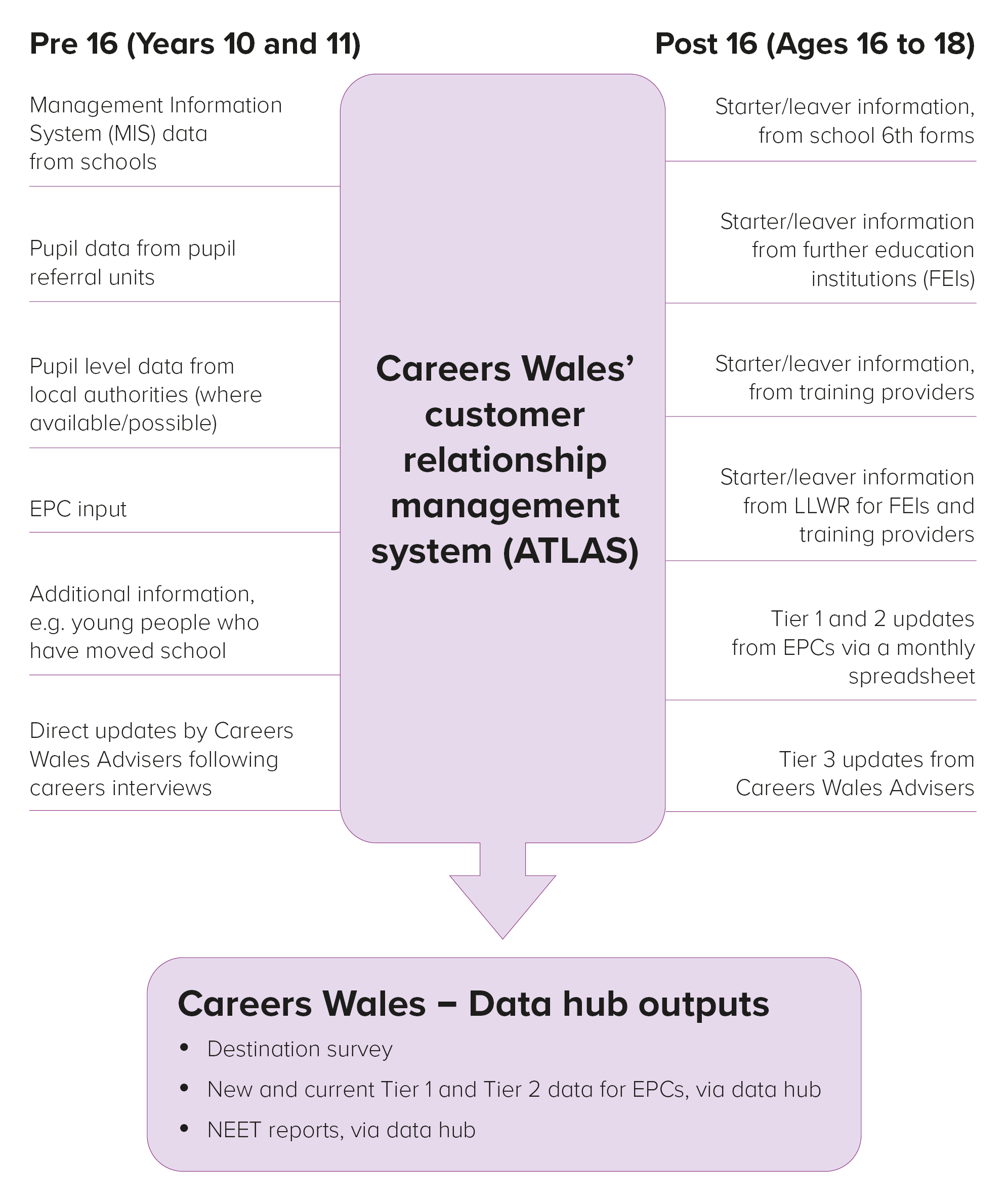
This diagram sets out the data flow into and out of Careers Wales’ customer relationship management system (Atlas):
Overview
Data from pre 16 and post 16 sources flows into Atlas, Careers Wales’ customer relationship management system. Information from Atlas then flows into the Careers Wales Data Hub, which produces various outputs. This process is set out below.
Pre-16 data inputs
- Management Information System (MIS) data from schools.
- Pupil data from pupil referral units.
- Pupil level data from local authorities (where available/possible).
- EPC input.
- Additional information Other relevant details such as data for young people who have moved school.
- Direct updates by Careers Wales Advisors following careers interviews.
Post-16 data inputs
- Starter and leaver information from school sixth forms.
- Starter and leaver information from further education institutions (FEIs).
- Starter and leaver information from training providers.
- Starter and leaver information from LLWR for FEIs and training providers.
- Tier 1 and Tier 2 updates from EPCs.
- Tier 3 updates from Careers Wales advisers.
Careers Wales Data Hub: Outputs
- Destination survey.
- Tier 1 and Tier 2 data for EPCs.
- NEET reports.
EPCs can use the Careers Wales data hub to access data on young people in Tier 1 and Tier 2 of the Careers Wales 5-tier model of engagement for learners aged 16 to 18. EPCs can also ensure the data hub is updated for young people in Tiers 1 and 2 by completing ‘keeping in touch (KIT) notes’ and returning them to Careers Wales.
Under the YEPF, Careers Wales has responsibility for supporting young people who are in Tier 3 of the Careers Wales 5-tier model of engagement for learners aged 16 to 18 to progress into education, employment or training (EET). Working Wales advisers are the lead workers for young people in Tier 3. Advisers follow internal case-loading guidelines, with regular reviews between advisers and their managers (focusing on those who have been in Tier 3 for 30, 60, 90 days or more). Advisers will also share themes, patterns or trends as part of their regular engagement with EPCs.
Information on the number of young people in Tier 3 is available to EPCs via the data hub, though not the actual data on young people in that tier.
Examples of data sharing
- The EPC and YHC at the Isle of Anglesey County Council work together to support young people who are disengaged to get them back into school. This joint working and sharing of data provides better value for money and better use of resources. Roles aren’t duplicated and support from other agencies is used in the most effective way. More information can be found in the Isle of Anglesey County Council case study on Hwb.
- Carmarthenshire County Council has recognised that services need to work together to intervene early to support individuals and prevent them getting to crisis point. This approach benefits individuals and, over time, reduces pressures on services. More information can be found in the Carmarthenshire County Council case study on Hwb.
- Monmouthshire County Council has built YEPF partnerships at pre-16 and post-16 to work together to prevent young people from becoming homeless or not in education, employment or training (NEET).YEPF partners share data and information to get a holistic view of individuals and the barriers they face, in order to provide support that meets their needs. More information can be found in the Monmouthshire County Council case study on Hwb.
- Torfaen County Borough Council has developed processes for sharing information between partner organisations to identify, support and monitor the progression of young people at risk of becoming not in education employment or training (NEET) or who are NEET. This helps support the transition of young people into post-16 education, employment and training (EET). More information can be found in the Torfaen County Borough Council case study on Hwb.
- Merthyr Tydfil County Borough Council explored whether they were able to access data on individuals in Tier 3. Having concluded there was no legal basis to do so, Merthyr Tydfil CBC, developed a mechanism to identify, at an early stage, young people that would be moving from Tier 3 to Tier 2. More information can be found in the Merthyr Tydfil CBC case study on Hwb.