
Private wire energy systems: guidance
Guidance to support the setting up of Private Wire renewable energy systems.
In this page
Purpose
A private wire is a direct electricity cable that connects a renewable generator to a nearby home, business, or community building, allowing them to use clean power without relying fully on the public grid. This guide is intended to provide practical, accessible information on the key design, financial, legal, and operational considerations involved in setting up such a system.
It provides the essential headlines to help you identify viable opportunities and take the first steps toward implementation. The guide explains common, proven models such as onsite and offsite generation, single and multi-entity arrangements, and highlights the strategic, financial, and environmental benefits, as well as potential risks and limitations.
Whether the goal is to reduce electricity costs, improve energy resilience, or support local clean energy generation, this guide is a practical starting point.
For further advice, practical support, or help turning your ideas into action, contact Ynni Cymru.
Summary
A private wire is a direct cable link between an electricity generator and a nearby consumer, avoiding the public grid. It works best when both are close together and can make a long-term agreement. These systems can save money for both sides by cutting grid and supplier costs. The generator can be onsite or offsite, and power can also be exported to the grid. Projects need upfront investment, legal setup, and planning approval, and a private wire is most suitable for large consumers with steady demand
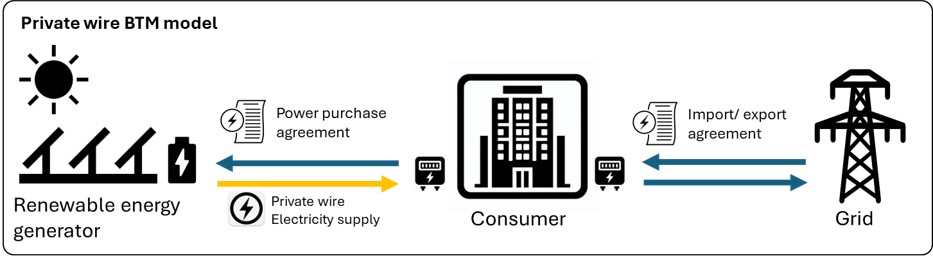
System design
- Direct cable link (underground or overhead).
- Generator can be onsite or nearby.
- One organisation or multiple working together.
- Electricity can go to both local consumer and the grid.
- Needs grid backup, meters, and may include batteries.
- Must meet safety rules and be certified.
Strategic suitability
- Best for large consumers with steady, long-term electricity needs.
- Works well when generator and consumer are close together.
- Needs long-term agreement (usually 15+ years).
- Financial success depends on costs, savings, and how long both parties will operate.
Benefits
- Financial: cuts grid charges and supplier costs; generator earns more, consumer pays less.
- Integration: works well with batteries, electric vehicle chargers, and heat pumps.
- Resilience: less reliance on public grid; supports local use and reduces energy losses.
- Environmental: enables use of renewables and lowers carbon emissions
Costs, limitations and risks
- Costs: high upfront investment and long development timelines.
- Limitations: needs nearby sites and steady demand; legal and planning can be complex.
- Risks: partner insolvency, rule changes, supply issues, and damage to the cable.
Case study: Cardiff Council’s Lamby Way Solar Farm
Cardiff Council’s Lamby Way solar farm shows how a private wire can work well. The 9MW solar farm sends electricity to both the grid and a nearby business using a 2km private wire. The Council funded the wire as part of a £9 million project and agreed a 20-year deal with the business to buy the power. The price is flexible and updated monthly. The system has two 5MW export connections and smart controls that switch between grid and private wire to get the best value. This setup shows how private wires can bring financial, operational, and environmental benefits.
1. Private wire overview
1.1 Description
A private wire energy system is most viable when the generator and a large, steady electricity consumer, such as a commercial or industrial site, are located within a few miles of each other. While a private wire can serve multiple consumers, doing so adds significant technical and legal complexity, which can increase project costs.
Developing a private wire can require significant capital investment and navigating complex agreements with landowners and planning authorities (depending on the circumstances of the project). The long-term savings can outweigh these initial challenges by avoiding certain grid supply costs and levies, with this benefit being shared between the generator (through achieving a higher electricity sale price compared to the wholesale market) and the consumer (by achieving a lower electricity purchase price compared to the retail market). These arrangements are typically formalised through a Private Wire Power Purchase Agreement (PPA), which sets out the terms of the deal between the generator and the consumer.
1.2 Models and variations
Onsite vs. offsite generation: In an onsite private wire scheme, the generation asset is located on the same site as the consumer. This model is generally simpler and more cost effective to implement due to shorter wiring and fewer logistical challenges (See our guide for Behind the Meter for more on this).
An offsite scheme, conversely, involves a generator located at a separate site, nearby the consumer. This requires greater capital investment and more complex planning, as it may involve securing land agreements and overcoming obstacles along the route the wire must travel between sites.
Single vs. multiple entity: A single-entity model involves the consumer owning the generation asset, meaning the generator and consumer are the same organisation or part of the same group. This arrangement is generally simpler, as it does not require a Private Wire Power Purchase Agreement (PPA). For public sector organisations, this model also allows them to claim carbon benefits under Welsh Government carbon accounting rules.
In a multiple-entity model, the generator and consumer are separate organisations. This structure requires a formal PPA to govern the supply and sale of electricity. More complex schemes may include multiple consumers, which significantly increases technical and legal complexity, as well as project costs.
Blended export: A blended export model enables the generator to supply electricity to multiple consumers or markets. Under this arrangement, part of the generated electricity is delivered to a consumer via a private wire, while the remainder is used for other purposes, such as on-site consumption or export to the public grid.
To export electricity to the grid, the generator must have an agreed export connection with the Distribution Network Operator (DNO) and a contractual arrangement with a counterparty to purchase the exported power. This model offers flexibility and can improve financial returns, as it allows the generator to choose the most profitable outlet for its electricity at any given time.
1.3 Key parties
Developing a private wire energy system requires collaboration between several organisations. The specific parties involved will vary based on the project’s location and commercial arrangements.
- Generator and consumer: the core participants in the scheme. They may be the same entity. Connecting a generator to multiple consumers is possible, but it adds technical and legal complexity and significantly increases costs.
- Planning authority: approval from the local planning authority is required before any construction begins.
- Landowners and route stakeholders: landowners along the proposed cable route must be engaged and may need to be compensated. In some cases, permissions will also be required from organisations responsible for roads, railways, utilities, waterways, parks, or environmental areas if the route crosses or affects their land or infrastructure.
- Distribution Network Operator (DNO): consulted for grid connections and network safety. The generator typically requires a small import connection for on-site facilities such as CCTV and lighting. The consumer generally maintains an import connection for backup supply and electricity balancing, which is particularly important for intermittent generation technologies (such as solar PV or wind). An export connection, at either the generator or consumer site, is recommended so unused electricity can be exported to the grid.
- High-voltage (HV) contractor: appointed to build, operate, and maintain the private wire and ensure compliance with all safety regulations.
Onsite private wire schemes are generally simpler to implement and involve fewer parties.
1.4 Commercial arrangements
Private wire schemes require long-term commercial arrangements to ensure the initial capital costs of the project are recovered and benefits for the generator and consumer can be achieved. The lifespan of these agreements is typically designed to match the operational lifetime of the generating asset (or cover a minimum 15-year period). This long-term commitment is formalised in a Private Wire PPA.
2. Case study
Cardiff Council’s Lamby Way solar farm is a pioneering project that highlights the benefits of a private wire connection to a large commercial consumer. The 9MW solar farm, built on a former landfill site, features a blended export model, supplying power to both the public grid and a nearby commercial consumer via a dedicated 2km private wire.
The Council provided the capital funding to develop the private wire, which was a strategic part of the overall £9 million project cost. This investment was made to secure a long-term, direct energy supply relationship with a nearby large commercial consumer. The resulting 20-year PPA with this consumer is a ‘take and pay’ agreement, with no minimum power supply commitment. The price is index-linked and updated monthly. This flexible structure gives the Council control over where the generated electricity is sent and provides a stable revenue stream, distinguishing it from a typical PPA with a minimum supply volume.
The Lamby Way solar farm has two distinct connection points, each with a 5MW export capacity. One connection is to the large commercial consumer via the private wire, while the second is to the public grid. The Council has a sophisticated digital system that automatically determines the best outlet for the electricity, switching the supply between these two consumers / markets. This automated control, which can also be manually overridden, ensures the Council can always sell its generated electricity and select the most profitable market between the two available options. An export PPA with Octopus Energy provides the commercial framework for supplying the grid.
3. Physical design
Implementing a private wire scheme requires specific infrastructure and careful design to ensure safety, reliability, and financial viability.
3.1 Infrastructure requirements
The infrastructure required includes the electricity generating assets, which can be located either on the consumer's site or offsite. Crucially, the wire itself, whether buried or overhead, forms the direct physical connection between the generator and consumer. If the electricity generating asset has not yet been built, it is recommended that the private wire is commissioned at the same time, although the private wire may take longer to build depending on its complexity.
A grid connection at both the generator and consumer sites is generally required. The generator site will require a small import grid connection to power on-site facilities such as CCTV and lighting. It is recommended the consumer site also maintains an import grid connection so that it can import electricity from the grid during supply interruptions or if an intermittent generation technology is used (such as solar PV or wind turbines). An export connection is also recommended so any unused electricity can be exported to the grid. An export connection can be created at either the generator or consumer sites. Electricity meters will need to be installed at both sites to measure grid imports and exports, and the quantity of electricity supplied via the private wire.
3.2 Design requirements
The primary design requirements are the generating asset and a consumer with a large, long-term demand for electricity. The generation and consumption profiles should be considered when designing the scheme; for instance, it wouldn't make sense for a solar farm to supply a consumer that primarily has night-time electricity demand.
The wire is another crucial design element, as the generator and consumer need to be typically within a few miles of each other to enable the installation to be financially viable. The route of the private wire must be carefully considered, as a simple path that avoids multiple landowners, roads, railways, or natural obstacles could reduce costs and complexities, and potentially increase the scheme’s financial viability. It may be advantageous for the wire to take a longer route if obstacles can be avoided. Furthermore, it is essential that the wire complies with all safety regulations, as this will be required for installation sign off and final certification.
Smart technologies can be integrated into private wire schemes to improve flexibility and efficiency. Examples include Distributed Energy Resource Management Systems (DERMS), which allow dynamic decision-making about where electricity should flow, and battery storage, which can store excess generation and release it when demand is high. Battery storage can be incorporated, at either the generating or consuming sites, to manage intermittent generation and better match the supply with the consumer's demand profile. These features help match supply with demand and optimise the use of available energy.
4. Commercial design
4.1 Legal and administrative considerations
Putting the right legal agreements in place early is important to make sure the private wire can be built and operated smoothly.
Most schemes will require a Private Wire Power Purchase Agreement (PPA), unless the generator and consumer are part of the same organisation. The PPA is the core contract that sets out how electricity is sold, how payments work, and how responsibilities and risks are shared over the long term. Private Wire PPAs often include a ‘take or pay’ clause, which ensures the generator can sell a minimum amount of electricity to the consumer or receive compensation if the consumer cannot take the agreed volume.
In cases where the generator has funded the construction of the private wire, the PPA will generally not include a minimum supply requirement. Electricity prices within the PPA are usually set on a flexible basis to reflect movements in wholesale market prices. Although standard templates can be used as a starting point, both parties typically need legal representation to ensure the agreement is fair. A key part of negotiations is making sure risk is shared appropriately between the generator and consumer. Separate PPAs will normally be required for any electricity imported from, or exported to, the public grid.
Where the private wire crosses third‑party land, easements, leases or other permissions will be required. Depending on the route, additional approvals may be needed from organisations responsible for roads, railways, utilities, waterways or environmental areas.
Insurance is also essential. Policies should cover risks such as accidental damage to the cable, supply interruptions and issues during construction. Securing the right contracts, permissions and protections early on helps avoid delays and gives both parties confidence in the long‑term success of the scheme.
4.2 Regulatory considerations
Developing and operating a private wire scheme requires compliance with planning and electricity supply regulations. A key step is obtaining planning approval from the relevant local authority. For longer routes, multiple planning authorities may need to be engaged. Environmental consents may also be required, typically administered by Natural Resources Wales (NRW), to ensure the project meets environmental standards.
In addition to planning and environmental approvals, the supply of electricity between the generator and consumer must comply with electricity supply laws or fall under an exemption in the Electricity Supply Act. Most private wire schemes qualify under the ‘small supplier’ exemption, which applies to generating assets with a total installed capacity of less than 5MW. See our Licence Exempt Supply Guide for more information about exemptions.
4.3 Future viability and replicability
Private wire schemes are usually designed around specific sites, but the core principles are widely applicable. If a generator can be located close to a consumer and permissions are in place to install the cable, the model can be repeated elsewhere.
The cost and complexity of each project depend on local factors such as the distance between sites and the route for the cable. These variables mean that no two schemes will cost the same.
5. Benefits
- Financial benefit: Well-designed private wire schemes can deliver significant cost reductions for both the generator and the consumer. By avoiding the public grid, charges, levies and supplier costs are reduced. These savings are shared: generators can sell electricity at a higher price than the wholesale market, while consumers pay less than standard retail rates.
- Integration and adaptability: Private wire schemes can work seamlessly with other technologies such as battery storage, heat pumps and EV charging. These technologies usually deliver the greatest benefit when installed at the consumer’s site. Battery storage can also be placed at the generator’s site to help manage intermittent generation and keep supply and demand in balance. Advanced control systems and energy management tools can make private wire schemes more flexible and efficient. Solutions such as Distributed Energy Resource Management Systems (DERMS) help optimise how and when electricity is used.
- Grid and resilience: Private wires reduce reliance on the public grid, allowing electricity to continue flowing between the generator and consumer even during grid outages. Private wire schemes also support the wider grid by reducing the need to connect new generation or meet the consumer’s full demand, easing pressure on infrastructure and improving overall system resilience.
- Environmental benefits: Using renewable generation such as solar panels or wind turbines helps cut carbon emissions. This is achieved by replacing electricity from the grid, which may otherwise be produced using fossil fuels.
6. Limitations and risks
6.1 Limitations, costs and complexities
- High Upfront Investment: private wire schemes require significant upfront investment, which varies depending on the design and complexity of the project.
- Long-term agreements: to recover the high upfront costs, private wire schemes require long-term commercial arrangements between the generator and consumer, typically 15 years or more.
- Lengthy timelines: the design, approval, and construction of a private wire can take years, especially for complex projects involving multiple planning and regulatory bodies.
- Route challenges: private wires are most viable when the cable route avoids major obstacles such as roads, rivers or multiple landowners. Navigating these can create complex stakeholder relationships and increase cost and risk.
- Intermittent generation: renewable sources like solar and wind do not produce power continuously. Battery storage can help manage this but adds cost and complexity.
6.2 Risks
- Counterparty Risk: Long-term agreements mean there is a risk of one party failing to meet obligations, for example due to insolvency. Contracts should include termination and compensation clauses.
- Design and Construction risk: Unexpected issues during planning or build can lead to delays and extra costs. Good project management and contingency planning are essential.
- Complex Stakeholder Environment: Routes often cross land owned by multiple parties or involve permissions from roads, railways, or utilities. Securing these approvals can be complex, take time and increase costs.
- Planning and Regulatory Risk: Planning delays or refusals can increase costs or stop the project, especially if the route crosses multiple landowners or sensitive areas. Regulatory changes, such as higher fixed charges or limits on supplier levy avoidance, may also reduce financial benefits.
- Carbon Accounting Limitations for Public Bodies: Public bodies may not be able to claim the carbon savings from the generation asset in multi‑entity arrangements, as only the asset owner can report these benefits.
- Supply Disruption: Outages can occur if the generator or private wire fails. Keeping a grid connection for backup supply and maintaining assets properly helps reduce this risk.
- Cable Strikes: Private wires can be damaged by excavation or construction works. The route should be registered so it appears in land searches, and insurance should cover repair costs and lost supply.
- Extreme Weather Events: Increasingly frequent and severe weather events due to climate change (such as storms, flooding, strong winds, or heatwaves) can damage both generation assets and cabling, leading to outages or costly repairs. Projects should consider climate resilience in their design and maintenance strategies, including appropriate insurance where possible.
7. Next steps
If you're interested in exploring private wire systems for your community organisation or business, you can:
- Consider local opportunities: Look at nearby locations for renewable generation potential. Proximity is key for private wire schemes.
- Review electricity use: Make sure there is demand large and consistent enough to support a long-term arrangement
- Think about the route: A straightforward cable route between the generator and consumer will help keep costs and complexity down.
- Speak to the right people early: Contact landowners to enquire about permission, your local authority about planning requirements, and your electricity network operator about grid backup needs: Who’s my electricity network operator? Energy Networks Association (ENA)
- Explore funding options: Check for grants or finance support that could help with upfront costs: Welsh Government Energy Service Grant Funding / Finance locator | Business Wales / Funding Wales
- Get expert advice: For free tailored guidance and practical support, contact Ynni Cymru: YnniCymru@localpartnerships.gov.uk
8. Conclusion
Private wire energy systems present a practical and strategic option for local, renewable electricity generation and supply, particularly for organisations with large, stable energy demand and a long-term outlook. They require careful planning, investment, and collaboration, but when well-designed, they can deliver significant financial, strategic, and environmental benefits.
This guide is intended as a starting point to help you understand the opportunities and challenges involved. The next step is to assess whether a private wire could work for your site or organisation. For more technical guidance, see the Best Practice Note on Private Wires produced by the Welsh Government Energy Service.
For further advice, practical support, or help turning your ideas into action, contact Ynni Cymru.