Guidance for public bodies to reach well-informed decisions about existing and future public commemorations.

First published: 14 March 2024
Last updated: 15 November 2024

Public commemoration in Wales: purpose and scope

Purpose and scope

The purpose of this guidance is to help local authorities, town and community councils, and other public bodies reach well-informed decisions about existing and future public commemorations. This will help them play their part in making Wales an anti-racist nation, and celebrate individuals from all parts of our society who have made an outstanding contribution to Welsh life. The background to this guidance is explained in the Annex.

'Public commemoration in Wales' sets out to help public bodies:

  • better understand the complex issues around public commemoration
  • establish a framework for inclusive decision-making
  • establish objectives for public commemoration
  • establish criteria to guide decisions for both existing and new commemorations
  • take action to ensure public commemoration is fit for present and future generations.

The focus is on permanent and deliberate public commemorations of people or events in the form of statues and other sculptures, plaques, murals and paintings in public buildings, and commemorative names for streets and public facilities. However, the principles and ideas set out may be helpful when considering other types of commemoration, including war memorials and semi-private commemorations with a public impact such as church monuments or private property, as well as commemorations such as performances, events, art installations, festivals and interpretive displays. 

The guidance builds on the findings of the Audit of Commemoration in Wales, and has a strong focus on the legacies of the slave trade and the British empire. Wales did not stand apart from slavery and colonial exploitation, both of which were embedded in the nation’s economy and society, and these issues are rightly the focus here. 

Decolonising public space is an important aspect of the commitment to an anti-racist Wales. This does not mean censoring or erasure of the historical record, but it does mean that historical injustice is acknowledged, reputations are open to debate and narratives that devalue human life do not go unchallenged. Decolonisation seeks to prevent the perpetuation of racist colonial myths about white superiority, but does not mean removing all evidence of the imperial past. 

The emphasis of this guidance is on anti-racism, but the approach to decision-making that it sets out is relevant when addressing other forms of discrimination, and in all areas where balance in commemoration may be an issue. One of these is Wales’s own experience of colonisation, which is the subject of one of the case-studies. 

This guidance sets out general principles for decision-making, but makes no specific recommendations on what decisions to make or action to take. Nor does it provide advice on all aspects of commemoration; for example, planning policies, the management of structures listed for their special architectural or historic interest, fundraising, health and safety, maintenance or public liability.

'Public commemoration in Wales' is divided into two parts. The first part will help public bodies to understand the issues and impact of public commemorations. The second part sets out four steps that public bodies should take when making decisions about new or existing commemorations. 

  1. Establish a framework for inclusive decision-making
  2. Set objectives for public commemoration
  3. Establish criteria for decision-making
  4. Take action

Case studies on contested commemorations help demonstrate the issues and impact of public commemorations and how these can be ameliorated through sensitive and collective decision-making. Many of the case studies draw on experience outside Wales, recognising common themes that underlie very different histories and identities. 

The guidance has benefitted from the views expressed at a series of facilitated workshops that brought together a broad spectrum of stakeholders (see Annex). The quotations that appear throughout the text are from participants in these workshops.

A public consultation on an earlier draft of this guidance was held between October 2022 and February 2023, and a summary of responses was published in September 2023. 
 

Introduction

Workshop participant:

Stories are never finished.

The commemoration of people and events in the public realm, especially as statues, sculptures, plaques and the naming of streets and buildings, is familiar to us all. Most of these commemorations add character to our surroundings and can help us understand aspects of our past. Although the great majority are uncontroversial, some commemorations are contentious. The virtue or relevance of some people or events has always been open to challenge, either when they were first commemorated or later as views have changed. Commemoration has always been a live issue.

It is not surprising that commemorations from the past occasionally have negative connotations. For example, the ‘winning’ sides in political or military conflicts may have sought to celebrate their heroes knowing that others may have feared or hated them. While voluntary groups and public subscriptions have sometimes led to commemorations of a more diverse range of people, more often there has been a bias towards commemorating only the powerful or wealthy. However, in recent times there has been greater recognition that public commemoration should be more wide-ranging. It should not insult or hurt fellow citizens and it should not represent contentious subjects in ways that divide society. For instance, the continuing celebration of figures known for their brutality, racism or links with the slave trade may be felt by present generations to continue their oppression and ignore the injustice of how those commemorated acquired their wealth or fame. In the words of the American novelist, William Faulkner: ‘The past is never dead. It's not even past.’ (William Faulkner, 'Requiem for a Nun', 1951)

Wales has a legacy of hundreds of commemorations in various forms. Although these commemorations may have historic or aesthetic interest in themselves, they may not represent the preferences or values of the present. New commemorations, however, can redress this balance and enrich the public realm by celebrating events and people who can stand as positive role models for everyone in Wales.
Public commemoration in Wales: understanding the issues

Part 1: understanding the issues

In both the past and present, people have created commemorations for a range of purposes. Generally, they have done so with honourable intentions; for example:

  • to add to the character and quality of public spaces
  • to contribute to local identity and place-making
  • to express pride in an individual or achievement
  • to respond to traumas such as persecution, conflicts or disasters
  • to mark outstanding sacrifices; for example, lives given in rescues or defence
  • to raise awareness of important historical events and places related to them
  • to aid understanding and reconciliation.

Whatever the original intention, commemorations may have a damaging impact if they are felt to dominate places on behalf of particular individuals or groups. This could include the glorification of controversial individuals or the assertion of one interpretation of past events above others. 

1.1: divisive commemoration and its impact

Workshop participant:

Commemorations are like bee stings – to me it could be just a bee sting, but to you it could be a horrific reaction.

Few public figures are viewed in the same way by everyone; some can be especially divisive. Politicians, in particular, are often controversial because of the impact of their policies on our daily lives, so people may react strongly for or against them. Similarly, military figures may be remembered by some for their bravery and sacrifice, and by others for the casualties of their campaigns. 

The extent to which these different perceptions become an issue for communities depends on the depth of feeling and hurt. Most of us would not want to see commemorations put up that could trigger individuals to relive traumas they had experienced. People who have been subjected to racial prejudice or racist attacks may find it traumatic to see figures who had known connections to racist policies or actions, celebrated prominently.

Divisive commemorations can have a serious negative impact on people who have to live with them. Statues of oppressive figures, for example, may provoke fear or hatred (intentionally or otherwise). 

Commemorations may have a particularly divisive impact in environments where there is no diversity of representation; for example, if in an ethnically mixed society people of only one heritage are acknowledged. Increasing the diversity of commemorations can therefore be an important way to reduce harm. 

Commemorations that provoke division are damaging to social cohesion. But provoking thought, or challenging attitudes can be a positive response to contentious commemorations. It may be very important to commemorate an event such as a riot or a war that some might wish to forget. Likewise, it may be useful to commemorate major historical figures who were guilty of abuses if we can draw out lessons from the past through context and interpretation. 

To note:

Decision-making needs to be sensitive to the ways in which commemorations may be perceived and the impact they may have right across society: diverse communities with different cultures, beliefs and views may be affected by public commemorations in different ways. 

Case study: confederate statues as propaganda

Image
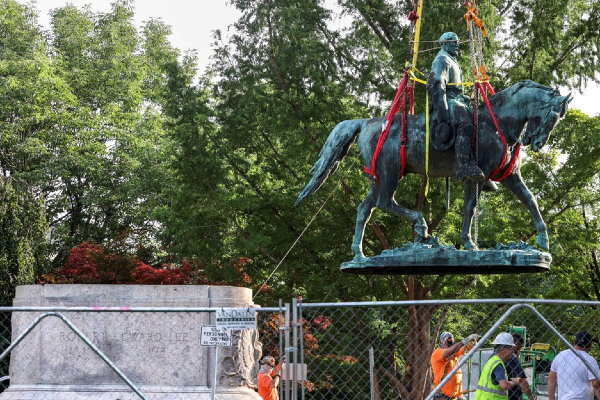
A statue of Robert E Lee being moved in Charlottesville USA
A statue of Robert E Lee being moved in Charlottesville USA (Evelyn Hockstein, Reuters).


Robert E. Lee (1807 to 1870) was an American plantation owner. During the civil war of 1861 to 1865, he led the forces of the Confederate States of America, which opposed the abolition of slavery. Long after the war, prominent public monuments were put up in southern states to Lee and other Confederate leaders, especially during the ‘Jim Crow’ era of racial segregation. The Lee monument in Charlottesville, Virginia, was installed in 1924 outside the public courthouse. In 2017 the city council voted to remove the statue after a violent rally, but this was delayed by legal challenges and protests involving white supremacists. The statue was defaced and finally moved to storage in 2021. Some 100 Confederate monuments have been removed since 2015 but 700 remain. Professor Ty Seidule of West Point Military Academy wrote in 2021 that the generation who built them had created ‘myths and lies’, which he and others had long believed, ‘to sustain a racial hierarchy dedicated to white political power reinforced by violence’. 

1.2: the impact of type, style and symbolism in commemoration

Workshop participant:

I just want to say that whatever commemoration is done, they should do it mindfully, tastefully and truthfully.

Some commemorations are about individual people, often idealising them in statue form by putting them on a pedestal - literally. Such commemorations tend to present the subject in a positive light and ignore any negative aspects of their actions. In contrast, commemorations of events may simply recognise that the events took place rather than celebrate them. For example, Admiral Nelson on top of his column in Trafalgar Square in London is presented as a noble leader commanding the heart of the capital; however, the memorial to the Battle of Trafalgar (1805) in Portsmouth, which incorporates an anchor from Nelson’s ship, could be seen as a record of a historical fact.

1.2.1: plaques

Plaques may be less contentious than monuments because they could be understood to mark, rather than honour, an event or the association of a person with a place. Indeed, some plaques highlight negative aspects of the past, such as the existence of a prison, the location of a riot or the birthplace of a controversial figure. Most plaques carry only brief factual information such as a person’s name, dates, occupation and association with a place. Nevertheless, more elaborate examples might assert in text or imagery a view of a person or event that could be divisive. Plaques may also be contentious for leaving out important details about a person or event. 

1.2.2: street and settlement names 

Street names may seem to have less of an impact on the consciousness than other kinds of commemoration, but can nevertheless affirm problematic values and associations. These may be less apparent when  they use a surname which could refer to many different people, though rare surnames or the names of foreign battles may be more distinguishable. The names of prominent town centre streets and squares, which are used by many people, have a much higher profile than those of residential streets and back roads. These may have been named quite casually, without fully appreciating that a name might have associations with a contested figure. On occasion, whole settlements can be named after individuals, although this is rare in Wales. Local Authorities are responsible for street name and numbering and are subject to statutory requirements.

1.2.3: building names 

Building names for premises owned by public bodies or charitable organisations imply that the person commemorated is being honoured in some way. The most prominent examples include schools, university buildings, public halls, community buildings and public offices. As the name is often given in full, the identity of the person is usually clear. In many cases, a plaque or information panel is also presented. Naming of educational institutions is especially sensitive because of the impact on young people.

1.2.4: pub names 

Although pubs are not publicly owned, they have a special prominence as buildings in public view. In many cases the origins of their names are obscure. Even when individuals are commemorated it can be hard to tell whether the name refers to a landed family or long-established title rather than a particular individual.

1.2.5: statues and sculptures 

Statues especially may be loaded with unspoken values. Traditionally, the ‘man on a pedestal’ was idealised in the classical manner and his formal dress or associated props delivered a particular message about his achievements or status. Equestrian statues, with the subject set high on a horse, further elevated the person commemorated above the ‘common people’. While the sponsors of statues may have wanted to give their subjects the ultimate respect, this can be offensive to people today who see them in a different light; for example, as aggressors who conquered peoples to expand the British Empire or industrialists who endangered and exploited their workers. Some more recent designers have taken non-traditional approaches to their subjects, aiming to bring out their individuality rather than idealise them. For example, the statue of Betty Campbell in Cardiff honours its subject but does not idealise her. 

The form of commemorations may raise particular issues for some cultural groups in Wales. For example, the portrayal of human figures is forbidden by Islam and some Jewish and Christian traditions. It is important to be aware of such views when making choices between statues, non-figurative sculptures, plaques or other forms of commemoration.

Sculptures other than statues may commemorate people or events in more subtle and ambiguous ways. Using symbols or abstraction can present narratives or ideas for audiences to interpret. They can offer more balanced or informative commemorations than conventional statues.

1.2.6: paintings in public places

While most painted portraits are privately owned or in museums, some should be considered as public commemorations because they hang in public places such as court rooms or council chambers. Artists may interpret people and events in subtle and sensitive ways, but some paintings have proved contentious. Formal portraits of the eighteenth and nineteenth centuries often used the same idealising approach as traditional statues; for example, showing soldiers proudly in their uniforms or politicians in robes of office. Paintings to commemorate events may also have oversimplified the past. 

Values may be communicated through the type and style of commemoration as well as the subject. This is relevant both when considering actions to address existing commemorations and mitigate any damaging impacts, and when considering new forms of commemoration

Case study: Teddy Roosevelt statue, New York

Image
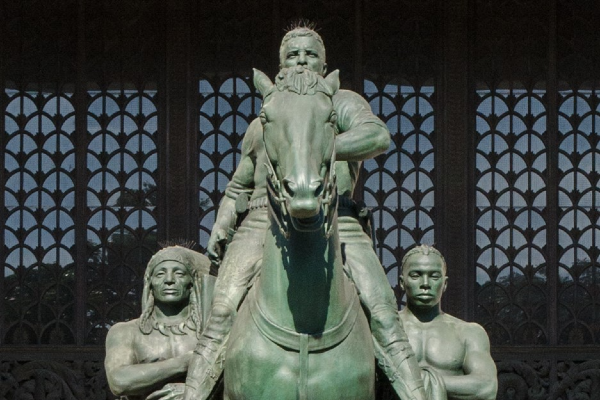
Statue of Teddy Roosevelt outside the New York Natural History Museum
Statue of Teddy Roosevelt outside the New York Natural History Museum (Edward H Blake  CC2.0)


Theodore Roosevelt is a generally well-regarded former president of the United States who held office between 1901 and 1909. Nevertheless, his statue of 1939 outside the Natural History Museum in New York was removed in 2022. This was not because of who was commemorated but he was represented. Roosevelt was depicted on horseback flanked by an African and a Native American who appeared subservient to him. The sculptor, James Earle Fraser, described the work as a ‘heroic group’ and explained the two accompanying figures as: 

… guides symbolizing the continents of Africa and America, and if you choose may stand for Roosevelt's friendliness to all races.

In the context of the museum, however, this imagery evoked so-called ‘scientific racism’ and historian James Loewen described it in 1999 as ‘a declaration of white supremacy.’ The earliest protests against the statue by native Americans were in 1971. African Americans also judged that it presented them as ‘primitive’ and in a hierarchy below the ‘civilized’ white man. In 2021, New York’s Public Design Commission voted unanimously to remove the statue, which is to be redisplayed with interpretation at Roosevelt’s Presidential Library in North Dakota.

1.3: location

Location is a key factor in the impact of a commemoration. For example, siting a plaque to mark where someone was born or erecting a monument where an event took place may be seen as highlighting a historical fact rather than celebrating the person or the occasion. A commemoration of the same subject in a less relevant location or in a community where the subject was controversial might not seem as neutral. 

Prominent statues in particular can be provocative, especially in city centres where they are seen more often. Some were deliberately positioned to assert the authority of one family or group over a place. In other words, the statue can be seen to say ‘this place belongs to us’ rather than ‘this place is for everyone’. Public spaces, such as town squares, or places that should treat everyone fairly and equally, such as law courts or town halls, are more sensitive locations than semi-private ones, such as the frontages of offices. A monument in a place explicitly devoted to honouring people, such as a ‘hall of heroes’, may be seen to give society’s unanimous approval to those commemorated unless there is accompanying interpretation to explain the monument and how perceptions may have changed since it was created.

To note:

  • The impact of location is an important factor, both when considering actions to address existing commemorations and when considering proposals for new ones. 

Case study: the locations of statues of Margaret Thatcher

Image
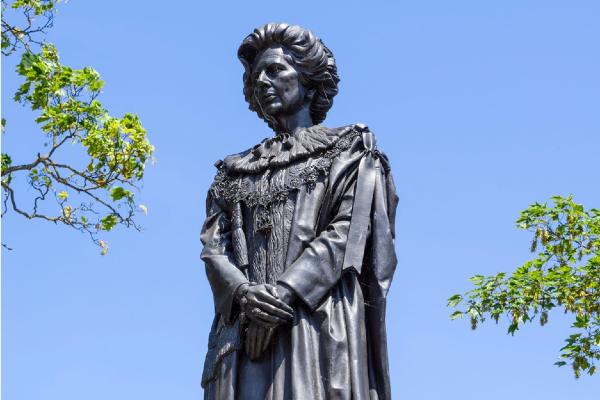
Statue of Margaret Thatcher in Grantham, England
Statue of Margaret Thatcher in Grantham, England (Eye35, Alamy)


Margaret Thatcher was a historically important figure, but people find it hard to view her objectively. As prime minister, between 1979 and 1990, she was both idolised and detested. She presided over unemployment and industrial strife, including a deeply divisive miners’ strike. Nevertheless, she was Britain’s first female prime minister; she won three general elections, she led the country during the Falklands Conflict and she was recognised worldwide as the ‘Iron Lady’.

Statues of Margaret Thatcher were planned soon after she left office but have proved difficult to site. One was decapitated in a gallery in 2002 and the temporary display of a large image of her in the Senedd in 2008 was strongly criticised and called ‘an insult to the people of Wales’. In 2017, Douglas Jennings completed a statue for Parliament Square but Westminster Council refused permission on several grounds, including the costs of policing. This has now been installed in her hometown of Grantham, where a consultation indicated it would be relatively uncontentious, though it was pelted with eggs soon after its unveiling.

There are, however, two statues of Margaret Thatcher in apparently suitable venues: the Members’ Lobby of the House of Commons and on the Falkland Islands.

1.4: perspective, the importance of hindsight and evidence

The understanding of people and events may change in hindsight or when new information comes to light. Decisions about whether to commemorate them can appear misjudged a few years later. Many local authorities and institutions have a rule that individuals cannot be considered for commemoration until at least 10 years after their deaths. Nevertheless, there can be pressure to act sooner, particularly following a high-profile disaster or if a popular figure dies unexpectedly. 

Jimmy Savile is one of the clearest examples of the risks of commemorating people prematurely. Evidence that he abused vulnerable adults and children became widely known soon after he died, but by that time a Glasgow swimming pool was displaying a statue of him and a plaque had been put on his house in Scarborough, calling him an ‘entertainer and philanthropist’. Both were taken down within months. 

Much longer periods may be required for the historical significance of people or events to be understood by researchers or appreciated by a wider public. For example, the failure until recently to acknowledge the sacrifices made by soldiers from British colonies in south Asia, Africa and the Caribbean in two world wars. These soldiers were neither depicted nor named on British war memorials until decades after their white comrades, alongside whom they fought. 

To note:

  • Unexpected challenges are more likely if commemorations are not informed by accurate historical information and ‘due diligence’.
  • Events and people’s actions have both short-term and long-term effects so that perceptions of commemorations can change dramatically over time.

Case study: Statue of a Girl for Peace, Seoul

Image
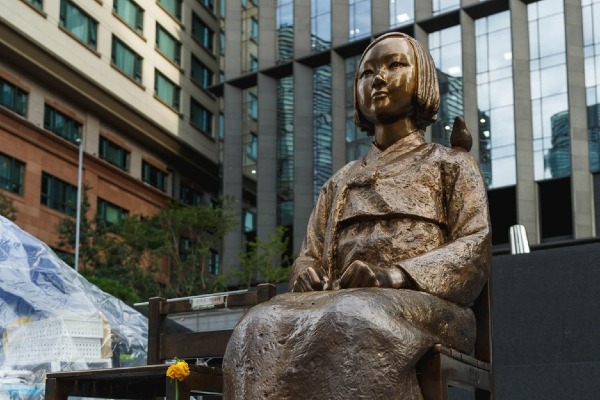
Pyeonghwaui sonyeosang, Seoul
Pyeonghwaui sonyeosang, Seoul (Maria S., Alamy)


The 'Pyeonghwaui sonyeosang' (평화의 소녀상, English: 'Statue of a Girl for Peace') bronze sculpture depicts a seated teenage girl in traditional Korean clothing with clenched fists. There is an empty chair next to her and a small bird is sat on her shoulder. On the ground behind her there is a representation of the shadow of a bent-backed older woman. The original sculpture in Seoul, South Korea, is located opposite the main entrance to the Japanese embassy. It was unveiled in 2011 by the Korean Council for the Women Drafted for Military Sexual Slavery by Japan.

From around 1932, during the Japanese wars of expansion, the Imperial Army worked with local agents to develop a network of military brothels. By the time Japan surrendered at the end of World War II, around 200,000 enslaved women had been trafficked into these ‘comfort stations’, most of them from Korea, which had been annexed by Japan in 1910. The fate of the so-called ‘comfort women’ was a taboo subject for decades but, with the democratisation of South Korea in the 1980s, it became possible to discuss the topic in print. This led to growing calls for Japan to apologise and compensate the now elderly survivors. 

An agreement was brokered in 2015 that would see Japan pay a large sum and acknowledge the direct involvement of the Japanese military in the brothels, but this was conditional on the removal of the 'Statue of a Girl for Peace'. The deal fell apart when a replica of the statue appeared near Japan’s consulate in Busan. Korean authorities have sought to remove both statues several times but have been prevented by protesters. Near replicas of the statue have also been commissioned by Korean expatriate communities in Germany, Australia and the USA. Although these replicas have been placed in public parks rather than near Japanese government offices, several in the USA have caused tension between local Korean and Japanese communities.

Public commemoration in Wales: decision making, principles and practice

Part 2: decision making, principles and practice

As Part 1, Public Commemoration in Wales: understanding the issues has shown, public commemoration is a highly visible part of the historical narrative and to honour this responsibility, public bodies should take four steps. 

  1. Put in place a framework for inclusive decision-making that hears and acts upon the experience of diverse communities.
  2. Set clear objectives for what public bodies want to achieve. 
  3. Agree criteria to inform decisions.
  4. Take action to ensure public commemoration is fit for present and future generations.

These steps are discussed in more detail below.

2.1 Step 1: inclusive decision making

Workshop Participant

It’s about empowering our communities to arrive at collective decisions relating to existing public commemoration … consultation and engagement processes should be followed to enable maximum inclusion.

Workshop Participant

I want to be walking down the street and see real change.

Inclusive decision making in which the voices of diverse communities, including Black, Asian and Minority Ethnic people, are actively sought and heard is vital if public commemoration is to help bring communities together. 

Inevitably, there will be times when people differ significantly in their opinions about public commemorations or in their responses to them, depending on their politics, religion, ethnic background, family, interests, local connections, or other lived experience. To promote social cohesion and create a fair, open and anti-racist Wales, we need ways of listening to differing opinions so that the best possible decisions can be made about how to treat existing commemorations and consider new projects.

Ideally, the choice of what history to commemorate in our public spaces and how we mark it will be an expression of values and ideals that are shared by everyone. Historically, such decisions were taken on behalf of society by the privileged few who held political influence and had the wealth to create commemorations. In twenty-first century Wales there should be no commemoration without representation for affected communities, who should have a voice whenever changes are proposed.

Case study: ‘We Are Bristol’ History Commission and the Colston Statue

Image
:  Statue of Edward Colston on display at the M-Shed Museum, Bristol
Statue of Edward Colston on display at the M-Shed Museum, Bristol (Adrian Boliston CC2.0)


Respondent quoted in The Colston Statue: What Next? by the ‘We are Bristol’ History Commission

Now it is removed I feel positive, but I disagree with the manner of its removal. An angry mob should not be allowed to take such decisions. It should have been taken down earlier by the council.

On 7 June 2020, amidst the worldwide Black Lives Matter protests against racism following the murder of George Floyd by police in the USA, the late nineteenth-century statue of slave trader Edward Colston in Bristol was toppled and thrown into the harbour. The statue was later recovered and used as the centrepiece for a temporary display at Bristol’s M Shed museum, which invited visitors to take part in an online survey on the future of the statue and its plinth. Nearly 14,000 responses were received. 65% of Bristolians said they felt positive about the statue being pulled down while 27% felt negative about it. 74% supported keeping the statue on display within a museum in Bristol. 12% wished to see the statue repaired and reinstated on its plinth while 4% hoped it would be destroyed or placed in storage out of public view. Members of both of these minorities accused their opponents of ‘whitewashing’ or seeking to ‘erase’ history. Amongst the respondents who felt negatively about the toppling, the special architectural or historic interest of the grade II listed statue was rarely mentioned: the concern was more around the ‘violent’ and ‘undemocratic’ nature of the action with older Bristolians especially concerned about ‘mob rule.’ One respondent urged Bristol City Council to ‘Put it back until there is proper consultation. It should not be decided by vandals.’ 

2.1.1: early engagement

‘Nothing about us, without us’ is a basic principle of inclusive decision-making, in which decision makers listen to and accommodate all affected communities. When there are decisions to be made about existing or new commemorations, or about creating policies for public commemoration, public bodies should involve diverse communities and hear a range of views from the outset. Engaging people early in the process and listening to dissenting voices will help to achieve a broad consensus. Projects are likely to have far better outcomes when communities are involved from the early stages of a project when many options remain open. It is too late to involve them when something that has already been designed without their input goes wrong. 

To note:

  • Early engagement is an important principle whenever a project is initiated, whether by public bodies, voluntary groups or private developers.
  • Public bodies should ensure that the voices of Black, Asian and Minority Ethnic people, and those with other protected characteristics, including those neglected in historical narratives of past and present, are amplified and celebrated.

2.1.2: knowing your community

Workshop participant:

The issue … that local authorities need to contend with is what do they mean by communities. They need to spell this out. Because it’s different when you deal with the locality or social space. There are two aspects of this that causes a lot of confusion - and I’m speaking as a sociologist now - what do they mean by communities, and what do they mean by neighbourhoods? … What is a nationality, what is an ethnicity and what is a race? …  Many people of colour [see themselves as] Welsh as a nationality and Welsh by ethnicity, because many of them are half Welsh … There are people of different skin colours who see themselves as Welsh and who are from third or fifth generations.

The term ‘community’ is used very widely and very loosely in different contexts. It might refer to a locality or neighbourhood (such as a community council area) or to a group of people linked in some other way; for example, by language, ethnicity, special interest, faith, or gender. Public commemoration touches many of these overlapping perceptions of community.

Commemorations can work on more than one level. They can be statements about the character and history of the local area, so local people may have the greatest stake in them. Understanding how the impact may be felt locally depends on having a good picture of the demographics in terms of age, language, race and gender, for example. This is a valuable baseline for establishing effective ways of engagement. 

But commemorations are also statements about the area’s relationship to much wider histories. They may be ‘about’ a great many people who live well beyond the local area. Personalities and events commemorated in Wales may have an international dimension. Local areas have porous borders so public commemorations may be experienced by many people from outside the immediate area; for example, people coming to work or use services, and visitors. This means it is also important to consider what message is being communicated to these wider audiences.

Decisions about commemoration can therefore have impacts far beyond the immediate neighbourhood. Engagement in decision-making may need to encompass not only different communities within the locality, but also special interest groups beyond it (for example, descendants, civic and history societies, veterans’ associations and organisations related to relevant protected characteristics). Where there are clear international connections, there may also be opportunities to work with international partners with a shared interest in exploring these historical links honestly. 

To note:

  • Public bodies should have a good understanding of the character and make-up of the multiple communities where the impact of public commemorations may be felt.
  • They should consider whether their decisions will have an impact on people beyond the immediate area and identify appropriate means of engagement with them. 

2.1.3: building relationships

To be successful, inclusive decision-making depends on strong and enduring relationships between the public body and its local communities. Building these relationships needs to develop depth; for example, working closely with a particular group and also breadth, such as reaching out to several communities within the area and beyond it. 

There are many communities who remain invisible in traditional methods of consultation. Public bodies can broaden their engagement by working with; for example, faith groups, associations of voluntary organisations, special interest societies and other third sector organisations. They also have their own community cohesion officers who can identify and provide links to new partners. 

To note:

  • Public bodies should build inclusive relationships from the beginning in the decision-making process.
  • They should be aware of whose voices are not being heard and engage with the community in its broadest sense, remembering people of all heritages and ethnicities.
  • They should be creative in the consultation process by reaching out to new groups.

2.1.4: reaching the community

Consultation can be both complicated and costly, but reaching out to the community to establish consensus through inclusive processes contributes to community cohesion and helps deliver positive change. Decisions on what to do with contested commemorations or agreeing criteria for new ones are worth investing in. Nevertheless, the methods of engagement should be in proportion to the sensitivity and impact of the subject. 

Sources of formal and informal knowledge 

Workshop Participant:

… people on the ground have a lot of knowledge that maybe the experts wouldn’t have … the experts would probably not be privy to that knowledge.

Workshop Participant:

It’s important we care for the research, the people that we want to celebrate, and we make sure that it fits into the present view of what we’re doing … I think it’s very important that the education, that the research and learning from past mistakes and past experiences are taken into consideration very seriously.

Decision making about public commemoration needs to be both responsive to community concerns and informed by specialist knowledge. The understandings within communities and specialist expertise are both invaluable in the decision making process and can be brought together in forums or panels set up to canvas views and find consensus.

Specialists, such as sociologists and historians, can contribute a lot to the process but a second opinion is always valuable. Historians, for example, may have different interpretations or different sources of evidence but not different facts. Their interpretations of history may be deeply personal, linking facts to feelings and to their own sense of identity dependent on their backgrounds. It is worth bearing in mind that the relative preponderance of white historians over other identities can skew  understanding. Ways of supporting more research produced within minority communities should therefore be considered.

Engagement: depth

For engagement in depth, working with a small number of people representing different interests may be valuable. There are many ways to form a group to evaluate issues and propose solutions, but recruiting by invitation may be more effective than an open call, particularly for reaching out to sections of the community who do not normally engage. 

When working directly with representatives from different communities, it is important to be clear about who is being represented and how. One or two people are unlikely to be able to speak for complex communities, let alone represent whole ethnic groups or continents, or civilisations with thousands of years of history. As one workshop participant put it: ‘I only can say that I am gathering our community’s voices.’ Public bodies will always be vulnerable to the charge of failing to consult the right people but demonstrating a willingness to understand whose history and culture is at stake and to appreciate the complexity of affected communities is an important starting point.

Public bodies will need to recognise and address barriers to involvement, ranging from cynicism about the value of consultation to constraints of time and money and issues of venue and language. 

Engagement: breadth

Online engagement, using social media networks to disseminate and gather information, has the potential to reach many people cheaply and quickly regardless of location. Short polls on social media, for example, may reach younger audiences and remote communities of interest. But the openness of the digital world risks overwhelming local voices and there are also risks of digital exclusion. 

To mitigate these risks, there is a complementary role for more traditional methods such as long response questionnaires, short surveys or leaflets delivered through letterboxes or left at community facilities. Face-to-face interviews, where people can express themselves verbally, or public meetings are also valuable. These should always be facilitated so that participants feel comfortable about taking part in challenging and potentially emotional discussions.

Public bodies will also need to reach out to non-engagers who live alongside the commemoration. They may not ally themselves with any ethnically or culturally defined group, but they nonetheless interact with the commemorations around them in daily life. Posters on or around sites of commemoration, canvassing on the street, or local leafleting giving information and inviting participation should be considered. 

To note:

  • Clearly define roles at the outset to help build confidence in the process and ensure participants feel valued.
  • Consider covering expenses and payments for people who are volunteering their time.
  • Consider choice of venue and time for meetings.
  • Be prepared to work through multiple languages, not just Welsh and English. 
  • Use multiple methods of engagement to extend reach and encourage greater participation.
  • Work with Black, Asian and Minority Ethnic people to identify and lift barriers to engagement.

2.1.5: process of engagement

Broad and deep community engagement will inevitably raise expectations, which public bodies must be able to manage. Transparency about how decisions are reached and acknowledging differences in view are important elements in building the trust that will keep alive positive working relationships with community groups.

Public bodies need to be clear, realistic and honest about timescales. Community groups can be frustrated by delays or perceived inaction. Processes should be set out clearly so that everyone involved knows when and how their contributions will feed in, and how final conclusions will be reached.

Public bodies will also need to be mindful of the well-being of employees, who may be exposed to abusive language, threatening correspondence or distressing testimony in the course of working with contested heritage.

To note:

  • Public bodies should be transparent about the depth and breadth of community involvement in the decision making process.
  • They should be clear and open about the process and how decisions are made.
  • They should manage expectations by being open about the timescales and budgets.

2.2 Step 2: setting objectives for public commemoration

Public commemorations should have meaning and purpose in the present as well as in the past. This means that public bodies should be clear about what they want to achieve through commemoration. Setting clear objectives that define the role of commemoration in our public spaces is an important starting point and should align with the goals of the Anti-racist Wales Action Plan to promote authenticity and balance, and a clear and decolonised understanding of the world.

These objectives may offer opportunities to deepen understanding and create a more authentic historical narrative that explores challenging stories as well as celebrate the achievements of our diverse society. There may also be opportunities to encourage inclusion and representation. 

Whatever the agreed objectives, they should underpin the way public bodies respond to any proposals relating to existing or new commemorations, as well as any actions public bodies may wish to take themselves.

Commemorations can have clear community value and can contribute to well-being, but their role also needs to be considered in a broader context. This includes how stories are told elsewhere, for example in school teaching that reflects the multi-ethnic nature of Wales, and in museums, working to address inequality and considering how stories connected to slavery and empire can be told through their collections. It also includes the ways in which a commitment to equality and diversity is embedded in the policies and practices of the public body itself. 

Case study: Rhodes Must Fall movement at the University of Cape Town

Image
Statue of Cecil Rhodes being moved from the University of Cape Town
Statue of Cecil Rhodes being moved from the University of Cape Town. (Roger Sedres, Alamy).


On 9 March 2015 a statue of Cecil Rhodes on the campus of the University of Cape Town was pelted with faeces. Over the following weeks student protestors held marches and occupied administrative buildings, and in April the university voted to remove the statue. 

Rhodes (1853 to 1902) was born in England and sent to the Cape Colony in modern South Africa as a teenager. He believed in the superiority of an Anglo-Saxon race and saw British institutions as the vehicle for this race to control the world. He made a fortune in diamond and gold mining and established the British South Africa Company; he also became prime minister of the Cape Colony. He expanded British holdings in southern Africa to include a large new area named Rhodesia (now Zimbabwe and Zambia). He left considerable wealth to educational causes. The campus of the University of Cape Town is mostly on his former estate, which he bequeathed to the state of South Africa. The statue of Rhodes was unveiled in 1934. 

The University of Cape Town has a tradition of student protests and was often at odds with the apartheid regime that fell in 1990. 1994 saw South Africa’s first free elections and also the cathartic toppling of a statue of Prime Minister Hendrik Verwoerd, one of the architects of apartheid. Memorials to Rhodes were not targeted at this time. The more recent concern with commemorations of Rhodes is seen by many in South Africa as part of a campaign of student protest motivated by a sense that the promise of the 1990s Mandela years has not been fulfilled. There is a substantial overlap between the ‘Rhodes Must Fall’ and ‘Fees Must Fall’ campaigns, as university education is still unattainable for many South Africans from Black working-class backgrounds. Protestors are also concerned with colonialist biases in curricula and policies seen as favouring the Afrikaans language over Bantu languages. 

A related campaign at Oxford University has called for the removal of a Rhodes statue at Oriel College.   

2.2.1 Authentic: deepening understanding

Remembering the past and attempting to understand and learn from it are features of healthy societies. Over time, statues or place names become familiar reference points in the places where people live. They may become subjects for historical study and features of heritage value. In a sense, they ‘write’ the values, people and events of the past into the landscape and become historical documents we can read to learn about how earlier generations viewed the world.

Communities in the present may add new layers of interpretation or comment which can deepen understanding and help commemorations to be understood in new ways; for example, when earlier commemorations have revered individuals as ‘heroes’ but glossed over and misrepresented the past. This process can be an act of collectively engaging with the difficult issues posed by our history and is more constructive than erasing evidence of its more troubling aspects. 

To note:

  • Public bodies should engage deeply and truthfully with the issues that arise from commemorations and confront challenging stories, hear different voices, allow opportunities for diverse views to be expressed, and enable negative aspects of the past to be understood.
  • They should consider how commemorations may be used to deepen educational opportunities and public understanding of issues and events. 

Case study: Stolpersteine

Image
Stolperstein commemorating the actress Terka Csillag outside Bochum Theatre in Bochum, Germany
Stolperstein commemorating the actress Terka Csillag outside Bochum Theatre in Bochum, Germany.(Gisbert).


There are large memorials to the Holocaust all over the world, often located in the centres of capital cities or dedicated areas. The Stolpersteine (German: Stumbling stones) are a memorial to the victims on a different scale. They are 10cm concrete cubes with a brass plate bearing an inscription in one local official language. The short inscriptions vary in format but typically begin with ‘Here lived’ followed by the victim’s name, date of birth and fate: internment, suicide, exile or, in the vast majority of cases, deportation and murder. The stones are set into the pavement outside the last freely chosen address of the person commemorated. The research for Stolpersteine is often done by schools and local history groups. 

The stones are often set into the pavement by the artist Gunter Demnig in the presence of surviving relatives. Since the start of the project in 1995, over 75,000 Stolpersteine have been installed across Europe. Admirers of the Stolpersteine have praised them as being more effective as a memorial than larger monuments, which are seen by tourists and easily ignored by everyone else. These micro-monuments on the other hand bring the memory of the Holocaust into residential neighbourhoods and everyday spaces. Historian Aidan Turner-Bishop has suggested the Stolpersteine example of small-scale but widely distributed memorials as a possible model for the commemoration of slavery in the UK.

2.2.2 Balanced: addressing under representation

Workshop Participant:

There were a lot of Black people who fought for Britain, and they did and there wasn’t any history about them. They weren’t celebrated whatsoever. And I think it’s important that they are part of that history, because if I was walking down Swansea and I saw a statue of one Black soldier … it would make me feel really proud.

Workshop Participant:

We need more permanent representation by commemorating to celebrate and really appreciate the contributions and the sacrifices made by people that look like us, to the benefit of not just us, but to everybody.

Workshop Participant:

There are people who should be celebrated, and there are people who should not be celebrated who have been celebrated. Because we weren't part of that decision making, and now in the future, it's come back to haunt us.

Public commemorations in the past have not represented society equally. However, over the last few decades in Wales, as in many other countries, there has been a more egalitarian view of the contributions made to our communities by people who might not have been recognised in the past, including workers, women, disabled people, refugees, people from diverse ethnic backgrounds or others. 

We are a diverse society, but many characteristics of the population are hardly visible at all in public commemorations. In Wales, very few named women have been recognised by statues; it is difficult to find any representation of disabled people and only a handful of Welsh people of ethnic minority heritage have yet been publicly commemorated in any way. While future generations should be able to grow up with commemorations that reflect the diversity of the population today, the current imbalance means that many citizens see few relevant role models commemorated and may feel that people like them are not valued. This is a problem internationally and Wales is no worse than many other countries. In Melbourne, Australia, for example, a study of 525 monuments found that only three were related to people indigenous to the country.

It may be impossible to represent every characteristic or every single group that contributes to our society. But it is possible to express greater diversity and dispel the perception that the achievements that society considers noteworthy are those of powerful, older, able-bodied white men. For so long as discrimination continues in society, the messages given by public commemoration are important.

A list of some of the better-known people of Black heritage recorded in the current literature of Welsh history is included in The Slave Trade and the British Empire: An Audit of Commemoration, but communities will no doubt want to identify their own subjects for future commemoration.

Public bodies should explore new subjects for commemoration that achieve better representation for different parts of the population, and recognise the positive contributions to society by under-represented groups of all kinds, both in the past and present.

Case study: Mary Seacole statue, St Thomas’ Hospital

Image
Mary Seacole Statue outside St Thomas’ Hospital, London
Mary Seacole Statue outside St Thomas’ Hospital, London (Matt Brown CC2.0)


In 2016, a statue was installed at St Thomas’ Hospital in London to recognise the work of Mary Seacole, a Jamaican-Scottish doctress, a healer using natural remedies, who nursed British soldiers during the Crimean War (1853 to 1856). A vivid autobiography describes her experiences there. An appeal for a statue of Mary Seacole raised £500,000 over 12 years. It was one of the first statues in Britain to a Black woman, but it attracted criticism from some admirers of Florence Nightingale. Critics complained that Nightingale had a stronger connection to St Thomas’ and Seacole was being used to ‘replace’ her. A statue of Nightingale elsewhere in London was installed in 1915 and remains in place. 

The sculptor, Martin Jennings, made the figure of Seacole larger than life-size but placed it on a low plinth so that people can be on the same level. She carries a medical bag on her shoulder and strides into the wind. The bronze disk behind her depicts the rocky ground where she built facilities in the Crimea. It can be seen to symbolise the globe she travelled and the ‘stone wall’ of racism she met when her services as a nurse were rejected by the War Office; she eventually reached the war and helped the wounded without official help.

2.2.3 Decolonised: responding to changing values

Workshop Participant:

I think it’s very important that we celebrate people … who have made a positive difference to our community. So, when you put something up, everybody in the community recognises that this person has worked hard to make an impact on our community. And it should be diverse as well … it makes more sense to celebrate someone who has worked hard in their community to bring positive change.

Workshop Participant:

It’s so important to confront the problem of racial discrimination and [promote] social justice through a greater understanding of celebrating our giants. I’m glad we’ve got the likes of Betty Campbell, and we’ve got so many more in our communities … I want to see positivity of what our communities have contributed to Wales, giving our young people hope for the future.

Moral and ethical values may change over decades and centuries, affecting how we understand past actions. Views of past events can be radically revised over time and what was esteemed in one generation might be reviled in another, or vice versa. Slavery was once accepted by almost everyone of influence in western society but has since been recognised as a crime against humanity. For instance, the Bristol slave trader Edward Colston is a figure that most people in his city do not wish to celebrate today in the way the city’s elite had done in the nineteenth century. But slavery is not alone; there are many other behaviours that were once considered legitimate and are now abhorrent to most people. These include, for example, military attacks on civilians, persecution of people for their religion, or the physical abuse of children. 

On the other hand, our changing understanding of human liberty and diversity means that people who were once vilified in Britain because of their beliefs, ethnicity or sexual orientation are now valued. For example, in the early twentieth century the suffragettes were vilified by much of the contemporary press and political establishment, but are now widely celebrated and commemorated. It is certain that values will continue to change and people in the future will understand today’s attitudes and events in different ways.

Societies can change what and who they recognise in the public realm or how they present them to reflect their own values. They may increase representation of some subjects newly recognised for their importance, reduce the representation of those no longer deemed worthy of attention, or reinterpret subjects according to new evidence and current perspectives. It is especially important to consider the impacts of commemorations on younger people and to provide positive role models. 

In the course of efforts to protect the historic environment, Cadw and other heritage bodies have sometimes not given enough thought to alternative viewpoints and how attitudes to historic figures and events that are commemorated may have changed or be seen differently by different sections of the population. 

Whilst many commemorations are highly visible and continue to hold significance for local people, some slip from consciousness over the generations. This process of ignoring or forgetting may help to focus attention on commemorations with more meaning for the present.

To note:

  • Public bodies should use commemorations to convey strong messages about our values today to engage, inspire and bring communities together now and in the future. This might be achieved through re-evaluation and reinterpretation of existing commemorations, as well as through the introduction of new ones.

Case study: Belgium, Congo and King Leopold II

Image
Equestrian Statue of Leopold II, Place du Trone, Brussels
Equestrian Statue of Leopold II, Place du Trone, Brussels (Associated Press, Alamy).


After Denbigh-born explorer Henry Morton Stanley gained access to the interior of the Congo, a large area was bought under the rule of King Leopold II of Belgium in 1885. Locals were treated brutally on rubber plantations and even the other colonial empires were appalled at the loss of life. The king invested the enormous profits in beautifying Belgian cities, and he was commemorated with statues and the naming of buildings and streets. The Royal Museum for Central Africa in Tervueren, Brussels was set up in 1908 to celebrate Belgium’s ‘civilising mission’ in Africa. This colonial narrative was also taught in schools and many older Belgians still believe strongly in it. 

Black Belgian communities have long challenged this positive narrative. In 2018 the Tervueren Museum completed a difficult redevelopment to present a more balanced view of the imperial project and Black Belgian history. Following the global Black Lives Matter protests of 2020, the Brussels Hoofdstedelijk Gewest (Capital Region) appointed a working group to consider symbols associated with colonialism in public spaces. 

The panel of experts accepted that some colonialist sculptures should be destroyed but argued this should be the exception rather than the rule. Many depictions of Leopold II have been defaced with graffiti. The report acknowledged this as a justified act of protest and proposed adjusting byelaws to effectively legalise graffiti on such monuments. It recommended the creation of a dedicated statue park for relocated commemorations to be presented in one place with interpretation. The site chosen in Cinquantenaire Park already contains some contested monuments and was one of the locations of the Second Pan-African Congress in 1921. 

The group recommended two options for the contentious Leopold II equestrian statue on Place du Trône. The statue could either be relocated to the ‘statue park’ or melted down and recast as a monument to Leopold II’s Congolese victims. The group saw a pressing need for a prominent memorial to victims of Belgian colonialism in the nation’s capital.

2.3: Step 3: establishing criteria for decision making

Workshop Participant:

[Agreed criteria] will empower our communities to arrive at collective decisions. There needs to be more moral responsibility as well as accountability by those who are in those positions. We need to use criteria effectively for judging the appropriateness of acts of commemoration. And there needs to be clear benefits to designing those criteria. [These will] provide a good indication as to whether a commemoration is likely to be appropriate or not.

There is general agreement that all decisions about both past and future commemoration should be based on clear and specific criteria, developed through public consultation and kept under regular review. This is an important foundation for establishing consensus in the decision-making process. Having a set of criteria provides a useful checklist when making decisions about who gets remembered, and in what way.

Criteria should be agreed locally but some suggestions follow.

2.3.1: significance

Establishing significance is a multi-facetted process, and the four heritage values might provide a useful starting point for updating existing commemorations sensitively as well as considering the subject matter and form of new commemorations. These are explained in more detail in Cadw’s publication Conservation Principles for the sustainable management of the historic environment in Wales, but the four values are:

  • Evidential value
  • Historical value
  • Aesthetic value
  • Communal value

The evidential and historical value of commemorations are closely intertwined and encompass the stories commemorations may tell and the way in which they illuminate aspects of the past, including the recent past. Commemorations are by their nature about people and events and can have strong illustrative properties. The physical form of the monument may itself tell us something about the values attached to the figure or event that it commemorates, but behind every commemoration are individual qualities and actions, incidents and episodes that may have been influential.

It will be important to acknowledge that a person or event might be acclaimed not only at an international or national level, but also locally: Many stakeholders would like to see more commemorations of ordinary people who have contributed to their community in a way that has led to positive change. 

Aesthetic value is about visual qualities, and commemorations may have aesthetic value in their design and craftsmanship or in their contribution to townscape quality. Establishing aesthetic value can be quite a subjective process as tastes differ and change over time.  

Communal value is of particular relevance to commemoration, because it is about what assets mean to the people and communities who relate to them. Public commemoration might be connected to collective experience or memory, or might help to define a particular place.

Some existing commemorations may already have public value ascribed to them if they have been listed for their special architectural or historic interest.

2.3.2: impact

It may be helpful to think in terms of impact rather than achievements. Public bodies should not shy away from confronting all sides of a commemorated person. They should recognise complexity of character and the diverse ways past actions were experienced. Even at the time, not everyone would have shared the values expressed in public commemoration. Understanding who was responsible for the commemoration, asking what values it asserts and who is left unheard is important. Considering public figures from several perspectives, including those of different communities, both historically and in the present, will drive responses to existing commemorations and inform the approach to new ones.

2.3.3: values

It will be helpful to include criteria about what values to address in new commemorations. There is a strong appetite to acknowledge positive values and role models by commemorating figures who will inspire young people and embody community pride. Diversity of commemoration is particularly important in this context. So too is commemoration of actions that are free of partisan politics. 

Values-based criteria could also be used when considering what actions to take in respect of existing commemorations; for example, addressing discordant values through interpretation. 

Case study: community relations in Northern Ireland

Image
Hands across the divide statue by Maurice Harron, unveiled 1992 to mark the 20th anniversary of Bloody Sunday in Derry
Hands across the divide statue by Maurice Harron, unveiled 1992 to mark the 20th anniversary of Bloody Sunday in Derry.(Brian Jannsen, Alamy).


No part of the UK has had a more bitterly contested history than Northern Ireland. Here, public commemorations could be threatening and divisive, or potentially reconciliatory. The tumultuous period between 1912 and 1922, from the Home Rule crisis through World War I up to the partition of Ireland, is particularly sensitive. Historical memories of these events have shaped the sense of British and Irish identity in Northern Ireland. In 2010, in anticipation of this ‘Decade of Centenaries’, a partnership between the Community Relations Council and the Heritage Lottery Fund agreed principles for commemorative projects:

  • start from the historical facts
  • recognise the implications and consequences of what happened
  • understand that different perceptions and interpretations exist
  • show how events and activities can deepen understanding of the period

Using these principles, the anniversaries can be seen in the context of an 'inclusive and accepting society'.

A review of projects found that much had been achieved but: ‘what has not happened is a glorification of a troubled time, or community violence spawned by commemoration … The period has been one of genuine learning and understanding.’

2.4 Step 4: taking action

Public bodies need to take action to fulfil their objectives and address the issues set out in previous sections. This might be through actions they take themselves, or through advice they give on third-party proposals. 

Workshop participants were mostly united in their view that public commemorations should continue to be part of the shared public landscape, but traditional commemorations of political, military, or philanthropic figures which avoid a full exploration of their deeds or character, are not acceptable. It is worth actively reviewing how earlier commemorations could be presented and accessed so that they form part of the balanced, authentic and decolonised account of the past that public bodies are expected to promote. There are many ways in which this could be done, and this guidance is not intended to be exhaustive. The process of community engagement may yield new ideas on who and how to commemorate. 

2.4.1: evidence gathering

Any decision should be founded on a good evidence base so public bodies should make sure they are aware of what is commemorated already. The Slave Trade and the British Empire: an Audit of Commemoration in Wales is a useful starting point for the identification of contentious heritage, but there are other troubling and controversial aspects of our history that may be reflected in commemorations not included in this audit. Public bodies should also be mindful of the gaps in public commemoration - people and events of significance to their communities that are not yet publicly acknowledged. 

2.4.2: interpretation of existing commemorations

On-site interpretation

Workshop participant:

So typically on the bottom of a statue, you have one plaque, and that plaque was written in the 1960s and nobody knows who wrote it. But rather than to tear the plaque down or replace it, which is our habit, to actually build the representations around it so that we can walk around the statue, walk around the years, walk around the interpreters, and we can find or see for ourselves where you don't need it reinterpreted by somebody else. The original information is there. And to open up the space every once in a while, to have a statue that's been there for a while or space that's been there for a while, to be reinterpreted by a different community that is connected with the statue in the first place, that would be an ideal situation.

Existing commemorations are part of our legacy from the past so understanding the context in which they were made is important. This does not amount to condoning actions which society would now condemn, but it does present opportunities to learn and reinterpret, and to explore challenging stories. On-site interpretation is an immediately accessible way in which contextual information can be presented, providing depth and balance, and allow opportunities to reframe the historical narrative without erasure of evidence.

Some permanent public commemorations already include a few words of explanation as part of the original design. This information can be contentious if it appears to present subjects in a one-sided way. For example, the tablet below the statue of the slave trader, Edward Colston, claimed that it was: ‘Erected by the citizens of Bristol as a memorial to one of the most virtuous and wise sons of their city’. In such circumstances, an accompanying information panel may be used to present a more rounded picture that could include contradictory voices to express what the subject means to different segments of the community. For non-controversial subjects too, this kind of on-site interpretation can help audiences understand the past or think about the relevance of role models to their own lives. 

Opinions will vary whether it is more appropriate to tell the truth publicly about controversial commemorations or whether greater offence is caused by the addition of a panel. Much will depend on who or what is commemorated, and whose views are sought. The impact of a statue will not always be mitigated by on-site interpretation that can be easily overlooked. 

Telling the full story on site may not always be appropriate, and some of the more difficult or painful stories might need to be explained more fully elsewhere; for example, in a museum or educational context. Linking to information in other formats using digital media can also provide greater depth and context.

Case study: Thomas Picton memorial at Carmarthen

Image
The Picton Monument, Carmarthen with new interpretation panels (lower left).  (Cadw, Crown Copyright).
The Picton Monument, Carmarthen with new interpretation panels (lower left).(Cadw, Crown Copyright).


Thomas Picton (1758 to 1815), a professional soldier from Pembrokeshire was killed at the Battle of Waterloo in 1815. Previously, he was known chiefly for the public scandal caused by the brutal methods he used whilst military governor of Trinidad (1797 to 1803), including torture and summary execution. He also profited personally from owning and trafficking slaves. 

Concerns over his behaviour eventually led to his recall to Britain where he was put on trial for the torture of Luisa Calderón, a 14-year-old girl suspected of involvement in a theft. Initially found guilty, the verdict was overturned on appeal, but the controversy caused by the case contributed to the growing debate within Britain about the slave trade. Nevertheless, following his death at Waterloo, Picton was feted as a national hero and buried in St Paul's Cathedral. In Wales, he was commemorated with a large monument in Carmarthen, originally designed by John Nash and built in the late 1820s, but later replaced with the column that exists today in a much altered and truncated form on Picton Terrace.

Following the rise of the Black Lives Matter campaign in Britain, a petition signed by around 20,000 people asked for the Picton Monument to be taken down. In response, Carmarthenshire County Council set up a cross-party task group to consult the local community and other interested bodies, including the Race Council for Wales and Carmarthen Town Council. Out of over 2,300 responses, 1,613 were in favour of retention and 744 for removal, with a significant percentage supporting wider education about Picton. Based on this, the task group recommended that the memorial should remain, but that information boards should be placed in prominent positions explaining his links to slavery as well as his military career. Three information boards have now been installed around the monument giving much fuller information and a rounded account of Picton’s life and impact. 

Digital approaches to interpretation

Workshop Participant:

I think if you’ve got statues, I think it’s very important to have extra information. So, you may have the plaques, but then you could provide a QR code that takes you to a website which has more information about that person.

Workshop Participant:

With the younger generation, use more technology. We have different stories or even just the facts … it means different things to different people … Instead of having plaques, there could be QR codes where you just scan it and people can learn so much more and form their own opinions, because then you’re not being kind of led down one particular way by just hearing some person’s interpretation … Technology might tie in younger generations to that.

There are many ways in which existing or new commemorations can be interpreted other than brief texts or panels. Technology offers opportunities to reach out to new and younger audiences, as well as exciting older members of the community to engage in public heritage. It also offers the chance to enhance accessibility for disabled people or for those with language skills other than Welsh or English. 

Accessibility can be enhanced by the creative use of technology, ranging from the use of QR codes, heritage trails and interactive maps through to augmented reality. There may be a role for social media platforms in reaching young people, but they risk superficiality and may best be used only as a springboard to more in-depth content.

Using alternative media

Artistic events and interventions may help people think afresh about commemorations that they pass every day and may offer an alternative to a permanent physical commemoration. Linking events and activities to festivals and calendar events may increase resonance and encourage participation. 

Considering approaches to interpretation

Whatever method of interpretation is used, it should be underpinned by sensitive management of what is interpreted and by creativity in capturing people’s attention, and encouraging them to engage.

  • Choose the information displayed around a commemoration carefully. A plaque or interpretation panel will not necessarily be the most appropriate place for details of abuse. Some subjects need deeper exploration and will need different methods of interpretation.
  • Consider linking on-site interpretation to more detailed information elsewhere, using IT to share further details. 
  • Work with schools to explore how difficult stories can be shared with younger audiences.
  • Design and location are important - interpretation should be well integrated with the original commemoration.
  • Think about inclusion - how can commemorations and their interpretation be made accessible to all? In addition to Welsh and English, what languages should be used? What access is there for disabled people? 
  • Consider using QR codes. They offer opportunities to use multiple languages and provide greater depth of information. 
  • Consider augmented reality commemorations. Almost any type of commemoration can be presented in this way, providing opportunities to share multiple narratives on complex issues. 
  • Be creative. For example, art, poetry, literature, video, light and sound, and performance are all interpretive tools that offer opportunities to engage in different ways, offering new perspectives and challenging insights.
  • Use temporary commemorations - consider events and activities linked to calendar events such as Pride, Black History Month, South Asian Heritage Month and Gypsy, Roma and Traveller History Month.

Case study: ‘Statues Redressed’ in Liverpool

Image
Artist Larry Achiampong supervises wrapping a statue of William Gladstone in a flag representing Africa
Artist Larry Achiampong supervises wrapping a statue of William Gladstone in a flag representing Africa. (© Larry Achiampong. All rights reserved, DACS/Artimage 2023. Made with support from Sky Arts & Culture Liverpool. Courtesy the artist and Copperfield, London. Photography by David Edwards).


‘Statues Redressed’ was a project run by Liverpool City Council and Sky Arts television prompted by debates about public commemorations. During summer 2021, 50 of the city’s statues saw temporary artistic interventions, lasting between one day and four weeks, most involving ‘redressing’ statues with clothing or props. A documentary captured the project. The statues chosen included Victorian prime ministers, Benjamin Disraeli and William Gladstone, Queen Victoria and more recent figures such as The Beatles and Bill Shankly. The aim was to encourage people to ‘look again, think again, and gauge how we feel about the statues that surround us.’

Image
Artist Daniel Lismore with his redressed statue of Disraeli.
Artist Daniel Lismore with his redressed statue of Disraeli. (David Edwards, Image 61)


The statue of Queen Victoria was fitted with a satin patchwork cloak and a cotton and hessian dress inspired by the film, 'Gone with the Wind', set at a time when enslaved people were picking cotton, which played a crucial role in Liverpool’s trading activities. The upcycled hessian is also reminiscent of the sacks used to bring American goods to Liverpool. A statue of Gladstone, who had campaigned for the compensation of slave owners at abolition, was wrapped by Larry Achiampong in a flag incorporating 54 stars for the 54 nation states of Africa. At the empty plinth in Toxteth, formerly occupied by the statue of pro-slavery MP William Huskisson, Harold Offeh installed a sound work so that when people approached it, they could hear an eyewitness account of when the statue was toppled a year after the Toxteth riots of 1981.

2.4.3: removal and relocation

Stakeholders felt that contentious commemorations should always be fully interpreted whether in place or relocated. The removal of commemorations risks erasure of evidence and may itself be contentious, but, where there is a consensus, relocation to a less sensitive location could be considered.

Commemorations in the most prominent public spaces do not necessarily have a permanent claim on our public realm. Where commemorations have lost relevance and there is a democratic will, they could be moved to enhance a less prominent location to free key spaces for something of more value to the current community.

There is also an important role for museums in this context.

Workshop Participant:

If you take down the statue, you’re trying to remove or cover up history. But I think that potentially is where the role of museums could be really important because museums document history.

Workshop Participant:

I think it’s really important to put it in a museum. It needs to be somewhere because you need to see the whole picture. We keep talking about education. It’s really important to see two sides of it … the controversial figures … [they] need to be talked about, and it needs to be a narrative that people can understand whichever age group you are.

To note:

  • Public bodies should consider whether there are circumstances in which removal or relocation might be justified; identify the risks and potential mitigation.

Case study: statue parks

Image
Lenin and other sculptures at Szoborpark, Budapest
Lenin and other sculptures at Szoborpark, Budapest.(Gary Blake, Alamy)


In several countries, a response to statues that do not align with current values has been to move them into dedicated parks. 

With the dissolution of the Soviet Union (1988 to 1991), many countries of the former Communist Bloc were keen to rid themselves of the monuments to Lenin, Marx and other Communist leaders that had been put up in large numbers after 1947. In Hungary, the authorities decided to bring statues together at the Szoborpark or ‘Memento Park’ in Budapest, opened in 1993. When consulted, people were often content for statues to remain, but all parties in the new parliament agreed they were contrary to social and national renewal.

The park was designed to express the artistic as well as historical significance of the statues while rejecting their associated ideology. It is ‘not about Communism, but about the fall of Communism’. Some of the exhibits still bear graffiti from around 1989, saying, for example, ‘Russians, go home!’ and some are visibly damaged. The centrepiece is ‘Stalin’s Boots’, a replica of the city’s monumental sculpture of Stalin as it appeared after protestors had torn it down during the attempted revolution of 1956, leaving only the Soviet leader’s boots upstanding. The park has been viewed humorously by foreign tourists who make up the majority of visitors.

Image
Statues of George V and two Viceroys during maintenance work at Coronation Park, Delhi.
Statues of George V and two Viceroys during maintenance work at Coronation Park, Delhi.(Associated Press, Alamy).


In India’s capital, Delhi, some monuments related to the British Empire have been moved into Coronation Park, the site of the coronation Durbar of King George V in 1911. A statue of George V was moved to the park in 1968 joining several former British viceroys and civil servants. Many of the plinths, however, are empty: some of the statues have instead been given away to the UK and other countries, and some have been sold to private collectors.

2.4.4 New work: considering new commemorations

Workshop Participant:

Loads of different communities have helped to actually build Wales as a country. So, I think it’s really important that we have the representation for future generations to actually feel a sense of belonging….

Introducing new commemorations provides an opportunity to remember hitherto forgotten figures or events, to honour recent individuals or events and to extend public representation to the many communities who have contributed to the making of Wales.

There is an appetite for new forms of commemoration that will excite people not only in content, but also in form. New commemorations need to promote strong social values of identity, unity and belonging, and use creative ways to educate communities about their own people. In their type and style, they should be adapted to their subject.

New commemorations require varying resources. Naming public places may be nearly cost free and plaques cost a few hundred pounds but monuments and their installation may range from £10,000 to £500,000 or more.

To note:

  • Public bodies should actively consider the scope for introducing new commemorations, working closely with communities as they identify potential types, sites and subjects.

Case study: sculpture and Welsh castles

Image
“Legacy” sculpture by Rubin Eynon at Caernarfon Castle.
“Legacy” sculpture by Rubin Eynon at Caernarfon Castle.  (Cadw, Crown Copyright)


The Castles and Town Walls of Edward I in Caernarfon, Conwy, Harlech and Beaumaris are a World Heritage Site managed by Cadw on behalf of the Welsh Ministers. Described by UNESCO as “a masterpiece of human creative genius” they are important attractions for the Welsh tourism industry. Castell Caernarfon alone receives 195,000 visitors per year, many from England. 
Within Wales the castles are viewed with some ambivalence as they were built following the conquest led by Edward I. In recent years Cadw has commissioned several sculptures to try to promote the castles and address different aspects of this contested history. Professor Howard Williams has criticised Cadw’s approach as being one of: “Let’s bang in some art and claim it fosters new ways of thinking”. 

In 2017 proposals were unveiled for a giant sculpture in the form of an ‘iron ring’ in the shadow of Flint Castle. The sculpture was intended to reference the surrender of the crown of Richard II to Henry IV at the castle in 1399 and was to be inscribed with quotes from Shakespeare’s Richard II.   However, some parts of the Welsh public chose to interpret the sculpture in a very different way. Flint Castle was the first of those built by Edward I, encircling north Wales in what historians from the 19th century onwards called a “Ring of Iron”. This alternative interpretation of the artwork was, for some, far more compelling than the Shakespearean reference, and a petition opposing the sculpture as a celebration of the “subjugation and oppression of the Welsh people” quickly collected over 11,000 signatures. The plan was cancelled. 

More recently in 2023 Cadw installed eleven new pieces of artwork, including sculptures, in and around the main gatehouse of Caernarfon Castle. With a theme of “the hands that built the castle” the artwork  celebrates the many labourers and crafts people whose names are lost to history. The exception is the “Legacy” sculpture by Rubin Eynon, which resembles a pile of broken fragments of an imaginary statue of Edward I himself, with a Welsh-language poem carved into his cheek conveying the passing nature of power and the King’s own mortality. The accompanying interpretation presents a more rounded story of the castle, highlighting the resistance to English rule when the castle was built and also the more recent devolution of power.

Case study: Betty Campbell’s statue, Cardiff

Image
Statue of Betty Campbell by Eve Shepherd, Cardiff
Statue of Betty Campbell by Eve Shepherd, Cardiff.(Cadw, Crown Copyright)


Betty Campbell (1934 to 2017) was known as an activist and Wales' first Black head teacher. Enrolling at Cardiff Teacher Training College in 1960, as one of only six female students to be accepted, she went on to teach at Mount Stuart Primary School for 28 years, where she became head teacher. Here, she began teaching about slavery, Black history and apartheid which became a template for multicultural education in the UK. Her work directly inspired the establishment of Black History Month in the UK.

Following her retirement from teaching, she went on to become an independent local councillor representing Butetown, a board member for BBC Wales, a member of the Home Office’s Race Advisory Committee and a member of the Commission for Racial Equality. In each role, her influence on public life grew, as she played an important part in critical conversations on diversity and equality.

After her death in 2017, there were calls for a statue to be erected in her memory. At the time, the only statue of a named woman was that of Boudicca in Cardiff City Hall. To redress this imbalance a task force had already been set up in 2016, 'Monumental Welsh Women', and in 2019, the BBC ran the 'Hidden Heroines' campaign to decide who should be the subject of Wales’ first statue of a real Welsh woman, to be decided by a public vote. Five women were shortlisted and on 18 January 2019, it was announced that Campbell had won the vote, and that her statue would be erected in the plaza of Central Square, Cardiff. Her statue was unveiled on 29 September 2021.

Actions in summary

Workshop Participant:

I think leaving things as they are clearly isn’t an option.

Possible actions that might be considered in different circumstances are summarised below together with some of their advantages and disadvantages. This table is not exhaustive.

Action: create new commemorations

For example, new statues, sculptures, murals, plaques, street names or paintings in public buildings

Pros:

  • Contributes to regeneration and place-making with new artworks
  • New streets or buildings need names 
  • Plaques can be put up quite cheaply
  • Can identify role models from under-represented groups
  • Creates opportunities for learning/understanding

Cons:

  • Statues and sculptures require a lot of funding and time for planning and design 
  • Risk of cluttering up public spaces with poorly designed objects

Action: invest resources in temporary events

For example, community arts events, street parties, concerts, talks, drama productions and video.

Pros:

  • Events can be highly effective by including a lot of people and changing perceptions
  • Can draw people together around lively events
  • Can engage with programmes, for example, Pride, Black History Month, South Asian Heritage Month and Gypsy, Roma Traveller Month

Cons:

  • Events require funding and planning 

Action: conceal commemorations

Discretely box monuments or enclose them creatively in new artworks.

Pros:

  • Makes a visual statement about changing values
  • Retains historical features for study
  • Allows future generations to decide
  • Creative enclosure allows the telling of a different story

Cons:

  • Concealment may give the impression of hiding the problem rather than addressing it
  • Does not address the issues of negative figures or actions

Action: provide interpretation

On-site panels or off-site information linked through trails, QR codes and VR for example.

Pros:

  • Creates opportunities for learning about positive or negative aspects of the past
  • Can permit alternative views to be expressed

Cons:

  • Can focus even more attention on negative figures from the past
  • Unwanted commemoration may be left in place

Action: commission artistic interventions or responses

Dress monuments, offer literary responses, add sound or video,  use events or performance to interpret.

Pros:

  • Helps communities reflect on existing monuments in engaging ways
  • Can draw people together around lively events
  • Can use engaging new technologies such as VR

Cons:

  • May diminish the heritage value of commemorations
  • May upset or offend people
  • One-off events or performance may be limited in effect

Action: remove to store or museum display or other less sensitive location

Take down highly contentious monuments and place them in store or in museums, or relocate to less sensitive location.

Pros:

  • Removes offensive or unwanted items from public places
  • Allows items to be seen as objects in historical context rather than as commemorations
  • A highly visible action for change

Cons:

  • Museums may not have capacity or context to display items
  • Relatively high costs
  • Removes familiar features from the landscape
  • Exhaustive process advisable to consult affected communities. Planning and/or listed building consent may be needed

Action: change permanently or destroy after due process

Destroy monuments or repurpose them to commemorate events instead of individuals.

Pros:

  • Can remove offensive or unwanted commemorations 
  • Can be a high-profile creative act
  • Can shift perceptions of monuments from celebration to more objective history

Cons:

  • May remove familiar features from the landscape
  • Exhaustive process advisable to consult affected communities. Planning and/or listed building consent may be needed
  • May continue the perception of a biased history

Action: change street/building names 

Allocate new names to existing streets and public buildings or facilities.

Pros:

  • Can remove offensive or unwanted names 
  • Ends reputational damage to public bodies and negative associations for clients
  • Can identify role models from under-represented groups

Cons:

  • Changing street names can cause considerable disruption to residents and businesses
  • May revive associations with historical figures that were long forgotten

Public commemoration in Wales: summary and annex

Summary and conclusion

This best-practice guidance seeks to help local authorities, town and community councils and other public bodies reach well-informed decisions about existing and future public commemorations, and by doing so contribute to an anti-racist Wales. 

Part 1, Public Commemoration in Wales: understanding the issues, introduces the complex issues around public commemoration. Its focus is on the impact of commemorations on communities through subject matter, type, style and location. It also considers the importance of hindsight and evidence. 

Part 2, Public Commemoration in Wales: decision making, principles and practice, sets out four steps that public bodies should take to realise the opportunities that public commemoration offers to address the issues raised in Part 1, and make a positive contribution to an anti-racist Wales.

Step 1 is about inclusive decision making 

In recognition of their public impact, decision-making about public commemorations should be genuinely inclusive, and there should be no new commemoration without representation for all affected. The guidance identifies some general principles for inclusive decision making:   

  • involve diverse communities and listen to a range of views from the outset
  • consider where the impact of decisions may be felt, acknowledging remote communities of interest as well as the local area, and being responsive to diversity within the local area
  • build lasting relationships with local communities
  • respect local understandings as well as expert knowledge and opinion
  • consider the best ways of reaching out to diverse communities, and address barriers to engagement
  • ensure that the decision-making process is open and transparent.

Step 2 is about setting objectives for public commemoration

Public bodies should be clear about what they want to achieve from public commemoration. They should set objectives that define its role in line with the goals of the Anti-racist Wales Action Plan to promote authenticity and balance, and a clear and decolonised understanding of the world. This does not mean censoring or erasure of the historical record, but it does mean that historical injustice is acknowledged, reputations are open to debate and narratives that devalue human life do not go unchallenged. In setting objectives public bodies should:

  • engage deeply and truthfully with the stories that arise from commemorations, hearing different voices, and allowing diverse views to be expressed
  • consider how commemorations may be used to deepen educational opportunities and public understanding of issues and events
  • explore new subjects for commemoration that achieve better representation for different parts of the population, and recognise the positive contributions to society by under-represented groups of all kinds, both in the past and present
  • use commemorations to convey strong messages about our values today to engage, inspire and bring communities together now and in the future. 

Step 3 is about establishing criteria for decision making

Decisions about both past and future commemorations should be based on clear and specific criteria, developed through public consultation, and kept under regular review. This is an important foundation for establishing consensus in the decision making process. A set of criteria provides a useful checklist when making decisions about who gets remembered and in what way.

Criteria should be agreed locally, but it is suggested that a helpful framework would take into account significance, impact and values.

Step 4 is about taking action

Public bodies should be prepared to take action to meet their objectives and address the issues raised by public commemoration. Any action should be founded on a good evidence base. Public bodies should be aware of what is commemorated already and be mindful of what may be missing. Available actions include:

  • interpretation that enables public commemorations to form part of the balanced, authentic and decolonised account of the past that public bodies are expected to promote   
  • removal and relocation, where there is agreement that a less sensitive location might be more appropriate  
  • new work that provides an opportunity to remember hitherto forgotten figures or events in the past, to honour recent individuals or events, and to extend public representation to the many communities who have contributed to the making of Wales.

In taking these four steps, public bodies will be able to discharge their responsibility under the Anti-racist Wales Action Plan to ‘review and appropriately address the way in which people and events with known historical associations to slavery and colonialism are commemorated in our public spaces and collections, acknowledging the harm done by their actions and reframing the presentation of their legacy to fully recognise this.’ They will also be able to use public commemorations more generally to contribute to an anti-racist Wales, to deepen understanding of our past and its legacies, and to celebrate the achievements of our diverse society. 

Annex: background

In November 2020, the Welsh Government published The Slave Trade and the British Empire: An Audit of Commemoration in Wales. The audit was produced by a task and finish group led by Gaynor Legall. Its intention was to identify public monuments, street and building names in Wales associated with the slave trade and the British Empire, as well as touching on the historical contributions to Welsh life of people of Black heritage. 

Publication of the audit was followed by a report from the Culture, Welsh Language and Communications Committee of the Senedd ‘Set in Stone? A report on who gets remembered in public spaces’ published in March 2021. The Committee concluded that more needs to be done to raise awareness of some of the more difficult and painful legacies of our past. They concluded that although ultimate authority for decisions relating to contentious statues, monuments or commemorations should rest with local authorities and communities, the Welsh Government should provide leadership and guidance to local authorities and other public bodies. 

The Welsh Government published its Anti-racist Wales Action Plan in June 2022. Public bodies are charged with responsibility for ‘setting the right historic narrative, promoting and delivering a balanced, authentic and decolonised account of the past - one that recognises both historical injustices and the positive impact of ethnic minority communities.’ There is a specific action to ‘review and appropriately address the way in which people and events with known historical associations to slavery and colonialism are commemorated in our public spaces and collections, acknowledging the harm done by their actions and reframing the presentation of their legacy to fully recognise this.’

This guidance has been prepared as a next step following the audit by Gaynor Legall and in response to the recommendations of the Culture, Welsh Language and Communications Committee and to the Anti-racist Wales Action Plan. It has benefitted from a series of facilitated workshops bringing together a broad spectrum of stakeholders, and is informed by their opinions. These workshops included representation from Black, Asian and Minority Ethnic groups, education and academia, local government, the armed forces, faith groups, heritage conservation groups and LGBTQ+ people. Quotations from workshop participants appear throughout the text.

Further information

General

Commonwealth War Graves, 2021. 'Report of the Special Committee to Review Historical inequalities in Commemoration'. Maidenhead: Commonwealth War Graves Commission.

Rodney Harrison, 2013. 'Heritage: Critical Approache's. Oxon, Routledge

Olivette Otele, Luisa Gandolfo, Yoav Galai (eds), 2021. 'Post-Conflict Memorialization: Missing Memorials, Absent Bodies'. London: Palgrave Macmillan.

Ben Stephenson, Marie-Annick Gournet and Joanna Burch-Brown, 2021. 'Reviewing contested statues, memorials and place names: Guidance for public bodies'. Bristol, University of Bristol.

Welsh Government, 2021. The Slave Trade and the British Empire: an audit of commemoration in Wales. Cardiff, Welsh Government

Welsh Government, 2022. Anti-Racist Wales Action Plan, Cardiff: Welsh Government

Welsh Parliament Culture Welsh Language and Communications Committee, 2021. Set in Stone: a report on who gets remembered in public places, Cardiff, Senedd Commission.

Case Studies

Confederate statues, USA

Memorialization of Robert E. Lee and the Lost Cause, US National Park Service.

Southern Poverty Law Centre, 2019. ‘Whose Heritage? Public Symbols of the Confederacy’ by Southern Poverty Law Centre.

United Daughters of the Confederacy website

Ty Seidule, 2021. 'Robert E. Lee and Me: A Southerner's Reckoning with the Myth of the Lost Cause'. New York, St Martin’s Publishing group.

Teddy Roosevelt, New York

City of New York, 2018. 'Mayoral advisory commission on city art, monuments, and markers: Report to the City of New York'. New York, City of New York.

James Loewen, 1999. 'Lies across America: What our historic markers and monuments get wrong. New York', The New Press.

‘Addressing the statue’ pages on American Museum of Natural History Website.

Sinclaire Devereux Marber, 2019. ‘Bloody Foundation? Ethical and Legal Implications of (Not) Removing the Equestrian Statue of Theodore Roosevelt at the  American Museum of Natural History’.

Margaret Thatcher, UK

Dawn Foster, 2019. A statue of Margaret Thatcher? No plinth will be too high for the vandals. The Guardian.

Will it ever go up? Plinth still awaits Thatcher statue in Grantham in The Lincolnite (2021).

National Assembly for Wales, 2008. Summary of Petitions Committee consideration of P-03-142: Petition to remove artwork of Margaret Thatcher from the Senedd. Cardiff, Welsh Government.

Statue of a Girl for Peace, Seoul

Thomas J.Ward & William D.Lay, 2019. Park Statue Politics: World War II Comfort Women Memorials in the United States. Bristol, E-international Relations.

 David Shim, 2021. Memorials’ Politics: Exploring the material rhetoric of the Statue of Peace. Memory Studies. Thousand Oaks, SAGE Journals.

‘We are Bristol’ History Commission, Bristol

Cole, T. & Burch-Brown, J. et al. 2022. The Colston Statue: What Next? ‘We are Bristol’ History Commission Full Report. Bristol, Bristol City Council.

Bristol Museums information.

Planning application for a second plaque in 2018.

Bristol Live report ‘How the city failed to remove Edward Colston’s statue for years’.

Antonia Layard, 2021.  Listing Controversy II: Statues, Contested Heritage and the Policy of ‘Retain and Explain’. Bristol, University of Bristol Law School.

Rhodes Must Fall, University of Cape Town

Britta Timm Knudsen & Casper Andersen, 2019. Affective politics and colonial heritage, Rhodes Must Fall at UCT and Oxford. London, Taylor & Francis.

Amit Chaudhuri, 2016. The real meaning of Rhodes Must Fall. The Guardian.

Stolpersteine, Europe

Stolpersteine website.

Natalie Bennie, 2019. The rhetoric of counter-monumentality: The Stolpersteine Project.  Ann Arbor, Pro Quest.

Mary Seacole, London

Mary Seacole Trust website.

Nightingale Society website.

Adebayo, Dotun MBE, 2015. ‘What Did Mary Seacole Ever Do For Us As Black People?’.

Leopold II, Belgium

Gia Abrassart et al. 2022. For the decolonisation of public space in the Brussels-Capital Region: a framework for reflection and recommendations. Brussels, Brussels Regional Parliament.

Adam Hochschild, 2020. The fight to decolonize the museum. The Atlantic. Washington DC, The Atlantic.

Decade of Centenaries, Northern Ireland

Decade of Centenaries website from Community Relations Council, Belfast.

Jonathan Evershed, 2015. From Past Conflict to Shared Future?: Commemoration, peacebuilding and the politics of Loyalism during Northern Ireland’s "Decade of Centenaries". Cork, University College Cork.

Picton Monument, Carmarthen

Cadw List description.

Dylan Rees, 2020. Sir Thomas Picton (1758-1815): Hero and Villain? Carmarthen, Carmarthenshire Antiquarian Society.

Statues Redressed, Liverpool

Statues Redressed website.

Statue parks, Hungary and India

Szoborpark website.

Gitta Hammarberg, 1995. Dead Statues – or alive? Signs of Ambivalence in Transition-Era Hungary. Berkeley, Macalester. 

Matthew de Tar, 2015. National Identity After Communism: Hungary’s Statue Park. London, Taylor & Francis.

Tom Wilkinson, LSE blog 2019 ‘Coronation Park and the Forgotten Statues of the British Raj’.

Paul M. McGarr ,2015. ‘The Viceroys are Disappearing from the Roundabouts in Delhi’: British symbols of power in post-colonial India. Cambridge, Cambridge University press

Sculpture and Welsh castles

Cadw, 2023, ‘A king’s welcome to Caernarfon Castle’ in 'Heritage in Wales' issue 76, Cardiff, Welsh Government.

Howard M. Williams, 2017, The Art of Failure at Flint, published to authors blog ‘Archaeodeath’.

Howard M. Williams, 2023, Hands of Memory: Caernarfon’s New Heritage Art, published to authors blog ‘Archaeodeath’.

Betty Campbell, Cardiff 

Monumental Welsh Women website.

Links from this document 

Where this document contains links to other sites and resources provided by third parties, these links are provided for your information only. Linking should not be taken as endorsement of any kind. The Welsh Government has no control over the content or availability of linked pages and accepts no responsibility for them or for any loss or damage that may arise from your use of them.