Survey of agriculture and horticulture: June 2025
Data for agricultural land use, livestock on farms and the number of people working on agricultural holdings on 2 June 2025.
In this page
Introduction
The June Agricultural and Horticultural Survey has been carried out since 1867 to provide estimates of agricultural activity in Wales on an annual basis.
This bulletin provides the first estimates of the main variables from the June 2025 survey.
Main results
- Over 90% of the land area of Wales is given over to farming. The nature of this land means that it is mostly used for rearing sheep and cattle.
- Wales has 8.8 million sheep and lambs, slightly higher than the 8.7 million in 2024.
- There are 1.08 million cattle and calves in Wales, a small fall from 1.09 million last year. There was a contrast between the beef and dairy herd. The size of the beef herd fell by 5.0% whilst the size of the dairy herd rose by 1.1%.
- 58,000 hectares of cereals were grown in Wales in 2025, up 10% from 2024. This was mainly down to a significant increase in the area of wheat grown. To put it in context, the area of cereals accounts for around 3% of all agricultural land in Wales.
Survey response
The 2025 survey achieved a response rate of 50% - this represents a considerable increase from last year. It also ends a longer term series of diminishing response rates over a number of years.
In 2025 farmers were encouraged to complete the survey online wherever possible. However, the Welsh Government recognises that this may not always be possible. 60% of returns were completed online this year – an increase from 46% last year. The Welsh Government hopes that this proportion will continue to increase for future surveys.
As always, the Welsh Government is very grateful to all those farmers who took the time to complete the survey.
Comparison with previous years
The results presented in this release are the first main estimates from this year’s survey. In most cases these are compared with the estimates from the 2024 survey.
The historical context is often the most important perspective on today’s numbers, whether that be across several of the most recent years or over a longer period.
Therefore, there is a spreadsheet accompanying this release that contains:
- full variable list to 2025: a time series (1998 to 2025) showing how the main variables split into more detailed sub-categories; please note that some of this detail is not available for 2020 because of the scaled-down survey carried out last year (see 2020 Survey results release for more detail)
- historical context: a time series dating back to 1867 showing the trends in main indicators in the long-term
Agricultural land use in Wales
The landscape, soil quality and climate of Wales limit the use to which its land can be put. Most of Wales is hilly or mountainous and this, combined with relatively poor soil quality and a wet climate, means that much of the land is restricted to the grazing of sheep and cattle.
The Welsh Agricultural Survey collects information about land that is used on farms (either owned or rented). The information excludes the use of common land which amounts to some 180,000 hectares in Wales. Common land is excluded because it is used by groups of farms with rights on a particular common, rather than being used exclusively by one farm.
Latest data
Estimates for the 2025 survey for agricultural land use
- The total amount of land on holdings was 1,770,100 hectares in June 2025 which represents a 0.3% decrease from the previous year.
- When combined with the 180,300 hectares of common rough grazing, this means that land used for agricultural purposes accounts for 90% of the total land area of Wales.
- There were 110,100 hectares of arable crops in June 2025.
The use of land on holdings in Wales in 2025 is illustrated below.
Figure 1: split of land on agricultural holdings by usage, 2025
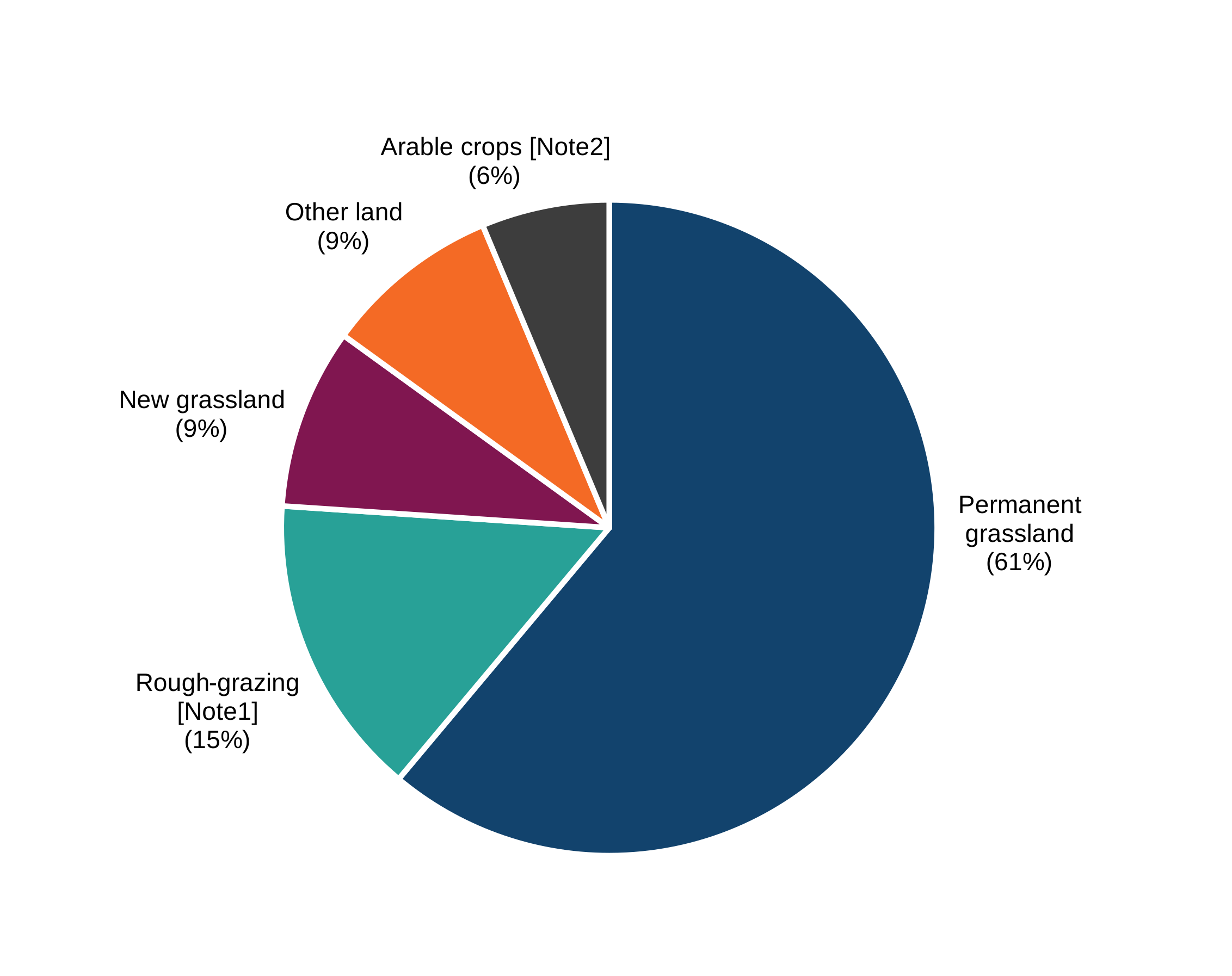
Description of figure 1: the chart shows that permanent grassland accounts for nearly two-thirds (61%) of the land on farms in Wales. The remaining land comprises new grassland (9%), rough grazing (14%), arable crops (6%) and other land (9%). Other land is made up of farm woodland, buildings and land not used for agricultural purposes.
Source: Survey of agriculture and horticulture, June 2025
[Note1] Rough grazing where holder has sole rights (i.e. excludes common rough grazing)
[Note2] Includes horticulture (vegetables and fruit grown in the open, hardy nursery stock and glasshouse)
The area of land on farms in Wales has fallen very slightly (0.3%), although in the longer historical series this has increased over recent years.
However, this data should be treated with caution due to potential limitations in the quality of the data. Farm land can be bought, sold, leased or rented and maintaining accurate records and updating the register of farms to reflect these changes can be challenging.
The quality of data on new farms is generally good - a farmer will need to be registered to obtain a Customer Reference Number (CRN) for payments purposes and a CPH (holding number) to allow movements of animals. Thus, we will become aware of new farms as they initially register.
When farming activity ceases the registration continues but the land is no longer farmed, is let out to another farmer or is sold on. This can result in the land being counted under its original registration and also when it begins to be farmed under its new registration for a period of time.
Sheep and lambs in Wales
Sheep are hardy animals, allowing them to be farmed throughout Wales, especially in upland regions where few other businesses are viable. Although their upkeep and capital costs are low, sheep farming brings modest returns, so on higher-quality land, farmers may pursue other activities.
Latest data
Estimates for the 2025 survey for sheep and lambs
- The total number of sheep and lambs in Wales was 8.81 million, up 0.7% on the previous year’s figure.
The number of sheep and lambs in Wales began to grow during the 1970s, reaching a peak of 11.8 million in 1999. There was a gradual drop in numbers over the following 10 years, possibly reflecting changes to the operation of the EU Common Agricultural Policy (CAP) when schemes based on the number of livestock kept where phased out.
Numbers then began to rise again for several years but for the last 10 or so years have fluctuated up and down. The figure of just under 8.7 million seen in 2023 was the lowest level since 2011. However the figure has risen slightly in the 2 subsequent years.
The historical statistics can be found in the spreadsheet that accompanies this release. A more detailed commentary on the trends can be found in the 2019 version of this release.
Cattle and calves in Wales
Cattle are raised primarily for milk or meat, leading to dairy and beef sectors. Most farms specialise in one type, with mixed operations being uncommon. Dairy farming tends to offer higher returns but needs better land and more investment. In Wales, beef farms often also keep sheep. Beef cattle may be raised from calves to slaughter, but in upland areas, they're frequently sold partway and finished on lowland Welsh or English farms.
Since 2004, cattle numbers have been available from the Cattle Tracing System (CTS) which is managed by the British Cattle Movement Service (BCMS), primarily for animal health purposes.
Latest data
Estimates for the 2025 survey for cattle
- The total number of cattle and calves in Wales was 1,079,500, this represents a decrease of 1.0% from the figure for June 2024.
- The number of dairy females aged 2+ years that had calved has risen by 1.1% compared to June 2024 to a figure of 254,100. This definition is generally accepted as a measure of the dairy herd.
- Using the equivalent definition, the size of the beef herd decreased by 5.0% over the last 12 months to a figure of 133,700.
The historical statistics can be found in the spreadsheet that accompanies this release. A more detailed commentary on the trends can be found in the 2019 version of this release.
Other livestock in Wales
Economically, the bulk of livestock production from commercial farms in Wales comes from cattle and sheep. The main other livestock groups are poultry and pigs but in each of these, production is concentrated in relatively few large units. The numbers kept by other, non-commercial keepers is relatively small.
Therefore, a large increase or decrease in numbers on a handful of units can have a significant effect on the overall estimates.
Latest data: pigs
Estimates for the 2025 survey
- There was a 0.7% increase in the number of pigs in Wales compared to 2024. The current total is 28,100. The majority (92%) of these animals are kept for fattening (meat production) with the remainder used for breeding.
Latest data: poultry
Estimates for the 2025 survey
- The total poultry in Wales was 12,092,100– the majority (94%) of these were either table chicken/broilers (6.9 million) or chicken kept for laying eggs (4.5 million).
Historical series for the numbers of pigs and poultry can be found in the spreadsheet that accompanies this release. A more detailed commentary on the trends can be found in the 2019 version of this release.
Horses and goats
Data on these livestock groups are not presented as part of this release although they are available in the accompanying spreadsheet.
Labour on agricultural holdings in Wales
The estimates for farm labour presented in this release are restricted to the numbers of principal farmers and those people employed to work on the farm. Please see the comments on data quality below for further information about why further details are not presented.
2025 estimates
- The number of principal farmers, directors, business partners and their spouses was 38,700, an increase of 3.6% since 2024.
- This number comprises 17,200 full-time principal farmers and 21,400 part-time. There may be a reporting issue with some individuals on some smaller units recording as full-time because that is their overall work pattern and not their work pattern just on the farm. The extent of this is currently unknown.
- The number of people employed on farms at 2 June 2025 was 9,400, a decrease of 23% since 2024. This figure is taken as a snapshot at the beginning of June so the series can be volatile from year to year.
The definition of principal farmers is broad: it includes business partners, company directors and any spouses of the farmer or their business associates. However, any spouse must undertake some work on the farm in order to be included.
In Wales, the routine operations on farms are predominantly managed by the farmer and their immediate family members. Typically, these individuals fall within the scope of principal farmers as previously defined. Additional labour is generally engaged only temporarily during peak periods, such as lambing or harvesting, or when specialised activities like shearing or dipping are required.
The specialist work will tend to be carried out by contractors who are not included in the Agricultural Survey labour count. The main reasons for this are that they are self-employed and are often farmers themselves (and thus already included in the survey estimate).
The survey is carried out as a snapshot on a single day at the beginning of June. The associated volatility thus makes it very difficult to establish any trend over a series of years. Factors such as the weather can often determine when people are engaged during the year for example.
The definitions of who is included and how they are categorised can be complex. Accordingly, the format of the labour questions has been revised twice in the past decade. While changes to the wording and presentation may improve clarity, they may also affect the consistency of reported figures.
Comparison with the rest of the UK
Comparable surveys are carried out in the other UK countries. Links to the results of the June 2025 Agricultural Survey for these countries are included below.
England
Structure of the agricultural industry (DEFRA)
Scotland
Results of the June Scottish Agricultural Census (Scottish Government)
Northern Ireland
Agricultural Census in Northern Ireland (Department of Agriculture, Environment and Rural Affairs)
Results for the United Kingdom are published by the Department of Environment, Food and Rural Affairs. These will be published on 11 December 2025.
Further information on agricultural statistics in Wales
This release provides headline results of the 2025 survey at an all-Wales level. More detailed results of the survey will be made available in separate future outputs.
Other main outputs relating to agricultural statistics
- StatsWales: A new StatsWales open data service has recently launched. We plan to publish a a new series of agricultural survey datasets on the new site by Summer 2026.
- Agricultural Small Area Statistics: this presents the most detailed results from the June Agricultural Census each year. This series has not been updated since 2022, though bespoke analyses have been provided upon request. We welcome user feedback on this release.
- Farm Incomes in Wales: this annual bulletin presents the results of the Farm Business Survey which is carried out by the University of Wales, Aberystwyth on behalf of the Welsh Government. Next release due January 2026
Agricultural statistics for Wales are available over a long historical record and this data has been made available in spreadsheet format to accompany this release. For further information on agricultural statistics for Wales, please contact us via one of the methods shown on the front page.
More general information relating to agriculture can be found on the Welsh Government website under the topic Farming and countryside.
Quality and methodology information
A comprehensive quality report which describes both of these aspects of the survey data was published in February 2021.
Official statistics status
All official statistics should show the standards of the Code of Practice for Statistics (UK Statistics Authority).
These are accredited official statistics. They were independently reviewed by the Office for Statistics Regulation in February 2013. They comply with the standards of trustworthiness, quality and value in the Code of Practice for Statistics.
It is Welsh Government’s responsibility to maintain compliance with the standards expected of accreditation. If we become concerned about whether these statistics are still meeting the appropriate standards, we will discuss any concerns with OSR promptly. Accreditation can be cancelled or suspended at any point when the highest standards are not maintained, and reinstated when standards are restored.
Accredited official statistics are called National Statistics in the Statistics and Registration Service Act 2007.
Statement of compliance with the Code of Practice for Statistics
Our statistical practice is regulated by the Office for Statistics Regulation (OSR). OSR sets the standards of trustworthiness, quality and value in the Code of Practice for Statistics that all producers of official statistics should adhere to.
All of our statistics are produced and published in accordance with a number of statements and protocols to enhance trustworthiness, quality and value. These are set out in the Welsh Government’s Statement of Compliance.
These accredited official statistics (OSR) demonstrate the standards expected around trustworthiness, quality and public value in the following ways.
Trustworthiness
These statistics are based on returns to the Agricultural and Horticultural Survey 2025. Figures are checked and queried where necessary by Welsh Government statisticians.
We continue to use clear, non-technical language to present the statistics and their context to as wide an audience as possible.
Quality
The published figures provided are compiled by professional analysts using the latest available data and applying methods using their professional judgement and analytical skillset.
A detailed quality report (published in February 2021) contains information on data quality and survey methodology.
Value
The purpose of the statistical release is to provide evidence for policy development.
You are welcome to contact us directly with any comments about how we meet these standards. Alternatively, you can contact OSR by emailing regulation@statistics.gov.uk or via the OSR website.
Well-being of Future Generations Act (WFG)
The Well-being of Future Generations Act 2015 is about improving the social, economic, environmental and cultural wellbeing of Wales. The Act puts in place seven wellbeing goals for Wales. These are for a more equal, prosperous, resilient, healthier and globally responsible Wales, with cohesive communities and a vibrant culture and thriving Welsh language. Under section (10)(1) of the Act, the Welsh Ministers must (a) publish indicators (“national indicators”) that must be applied for the purpose of measuring progress towards the achievement of the wellbeing goals, and (b) lay a copy of the national indicators before Senedd Cymru. Under section 10(8) of the Well-being of Future Generations Act, where the Welsh Ministers revise the national indicators, they must as soon as reasonably practicable (a) publish the indicators as revised and (b) lay a copy of them before the Senedd. These national indicators were laid before the Senedd in 2021. The indicators laid on 14 December 2021 replace the set laid on 16 March 2016.
Information on the indicators, along with narratives for each of the wellbeing goals and associated technical information is available in the Wellbeing of Wales report.
Further information on the Well-being of Future Generations (Wales) Act 2015.
The statistics included in this release could provide supporting narrative to the national indicators and be used by public services boards in relation to their local well-being assessments and local well-being plans.
Contact details
Rural Affairs and Environment Statistics
Email: stats.agric@gov.wales
Media: 0300 025 8099
SFR 112/2025