This supplementary report is an extract of the analysis contained in the Well-being of Wales report concerning the wellbeing of children.

First published: 29 September 2022
Last updated: 29 September 2022

Foreword

Foreword by the Chief Statistician

The Well-being of Wales report provides an update on progress in Wales towards achieving the seven well-being goals. It considers the current position and progress in recent years with reference to the 50 national indicators for Wales and additional contextual information where appropriate. It was first published in 2017.

This report contains supplementary analysis of the data contained in the Well-being of Wales report that relates to children and young people. It has been produced to draw out the specific analysis relating to children and young people for users who are interested in understanding the well-being of this group, therefore not all indicators are referenced as they are in the main report.

We last published a report on children’s well-being in 2018. Since then, the Welsh Government has launched its Children and Young People’s Plan which sets out what the government will do for children and young people growing up, living and working in Wales. Progress against the plan will be monitored against a selection of the national indicators. In addition, a recent review by the Office for Statistics Regulation highlighted the need to improve the visibility of children and young people in statistics. We have also heard through feedback to consultations on the national indicators and milestones that the inclusion and visibility of data on children is important and should be improved. This report therefore aims to bring together a more coherent picture of what we know about the well-being of children and young people in Wales.

We will be considering future plans for further analysis on the well-being of Wales over the coming months. We don’t expect that the focus on children will be repeated annually, however we will consider if similar analysis should be carried out for other groups.

We want to ensure that our approach to reporting against well‑being goals is as effective as possible. We welcome feedback at any time on the content or usability of either this supplementary report or the main Well-being of Wales the report. If you have thoughts, please get in touch using the contact details in this report.

We also welcome suggestions for themes that could be used to for more supplementary reports in the future.

Stephanie Howarth
Chief Statistician
Main points

Main points

There have been mixed long-term results in terms of a healthy start in life, with a relatively stable trend in low birth weight babies, but improvements in breastfeeding take-up and reductions in pregnant women recorded as smokers at initial assessment.

New data from Foundation Phase baseline assessments show how children have developed before entering school, with the latest data reporting on the academic year 2021 to 2022 following the first year of the COVID-19 pandemic.

In 2021-22, 66% of 16 to 24 year olds think that climate change is mainly or entirely due to human activity. 97% think human activity is involved to some extent in the world’s climate changing.

Personal well-being declines with age and amongst those self-identifying as neither a boy nor a girl.

The national milestone on children’s healthy lifestyle behaviours is to increase the percentage of children with two or more healthy behaviours to 94% by 2035 and more than 99% by 2050. The data shows the percentage of children meeting the national milestone remains at 88% (in the 2019/20 academic year) and has remained stable since data collection started in the 2013/14 academic year.

Most healthy lifestyle behaviours deteriorate in secondary school.

Data from the 2019/20 academic year shows that on average, problematic social media use increased with age and was higher in girls than boys.

Adverse Childhood Experience studies highlight the relationship between harmful experiences in childhood with negative long-term outcomes.

The most recent report from the School Health Research Network Student Health and Wellbeing survey comparing mental wellbeing findings from before to during the pandemic (2019 to 2021) found a fall in mental wellbeing for 11 to 16 years olds.

Children are the population group most likely to be in relative income poverty, with the latest data showing that 31% were living in income poverty.

Fewer children live in workless households, with falls in the latest year and over the medium-term.

Attainment in primary and secondary school has risen in recent years, although children from deprived backgrounds still have poorer outcomes.

Participation in education, employment or training for young people post-compulsory education has been increasing in recent years.

Attendance and participation in the arts have been increasing over the past decade.

The highest rates of Welsh speaking ability and use is seen amongst children, although this is not maintained in post-compulsory education.

One in ten secondary school pupils are bullied weekly, and these figures are relatively high within the UK.

A prosperous Wales

The goal for a prosperous Wales

An innovative, productive and low carbon society which recognises the limits of the global environment and therefore uses resources efficiently and proportionately (including acting on climate change); and which develops a skilled and well-educated population in an economy which generates wealth and provides employment opportunities, allowing people to take advantage of the wealth generated through securing decent work.

Children’s development on entry to primary school

Children in Wales are assessed through the Foundation Phase Profile during their first 6 weeks following entry into primary school (reception class). This is used to determine the stage of development and interests of the child according to the Foundation Phase Profile and framework. A new curriculum is being rolled out in Wales from September 2022. As a result, data for the academic year 2021 to 2022 relating to the curriculum for Wales 2008 will be the last in the series for this indicator.

The data reflect the wide range of developmental maturity that is expected at this age. This is well within the normal range for children at entry to school, especially with the age variability at the point of school entry. In the 2021/22 academic year 54% of pupils aged 4 were at a stage of development in mathematics that would be consistent with or greater than their age according to the framework, with 87% of pupils within one stage of the development consistent with their age. In language, literacy and communication in English 53% of pupils were at a stage of development that would be consistent with or greater than their age, with 85% of pupils within one stage of the development consistent with their age.

The picture is different for language, literacy and communication in Welsh, where 27% of children were at a stage consistent with their development. This is due to children from non-Welsh speaking families being enrolled in Welsh medium schools

For all areas of learning there was a different distribution of developmental progress for boys compared with girls, as they mature at different rates, and on average girls were at a higher stage of development.

One of the areas in which children are assessed is in personal and social development, well-being and cultural diversity. In this area of learning 64% of pupils aged 4 were at a stage of development that would be consistent with or greater than their age according to the framework, with 87% of pupils within one stage of the development consistent with their age.

Attainment in primary and secondary school

Attainment in secondary schools rose in the years before the pandemic, although children from deprived backgrounds still have poorer outcomes.

Following the cancellation of public examinations in summer 2020 and summer 2021, all grades that would have been awarded following an examination were replaced with the centre assessed or determined grade. Results at the end of key stage 4 (the end of compulsory schooling) show that the percentage of GCSE entries at the grade range A* to A increased from 19.5% in 2019 to 29.5% in 2021. Results at grade ranges A* to C have had a similar increase in the same time frame from 65.1% to 75.1%.

International comparisons made under the OECD’s PISA assessments suggest that in terms of reading, Welsh 15-year-olds continue to lag behind the rest of the UK. As of PISA 2018, there is no significant difference between Wales and Northern Ireland or Scotland in maths and science. Internationally Wales no longer performs below the average of OECD nations.

Participation in education, employment or training

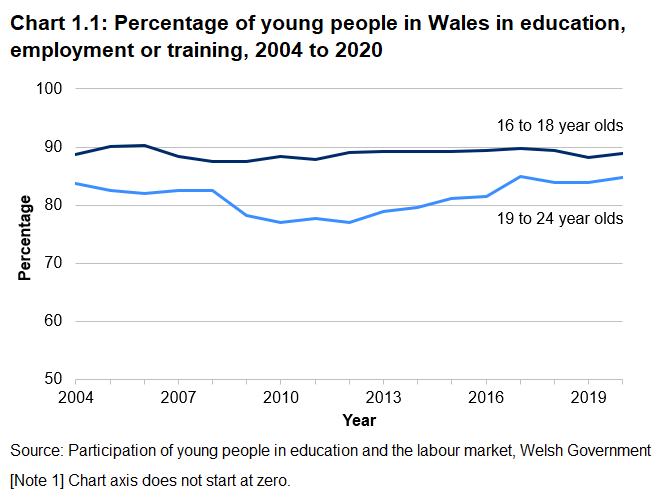
Using the main measure of young people in education, employment or training, there were decreases in both the 16 to 18 and 19 to 24 age groups between 2017 and 2019. The proportion for both groups then increased in 2020. For 16 to 18 year olds, this followed a period where the proportion remained stable at around 89 to 90% between 2012 and 2018.

The effect of the 2008 recession was felt more sharply by the 19 to 24 age group. Since then and up to 2017, the share in education or the labour market gradually increased. At the end of 2020, the first increase since 2017, the rate stood at 84.8%, nearly 8 percentage points higher than in 2012.

Image
Line chart showing the percentage of people aged 16-18 in education, employment or training has remained around 89-90% for the past 15 years, with the equivalent proportion of 19-24 increasing in the years leading up to the pandemic

Relative income poverty

People living in relative income poverty are those who live in a household where the total household income from all sources is less than 60% of the average UK household income (as given by the median).

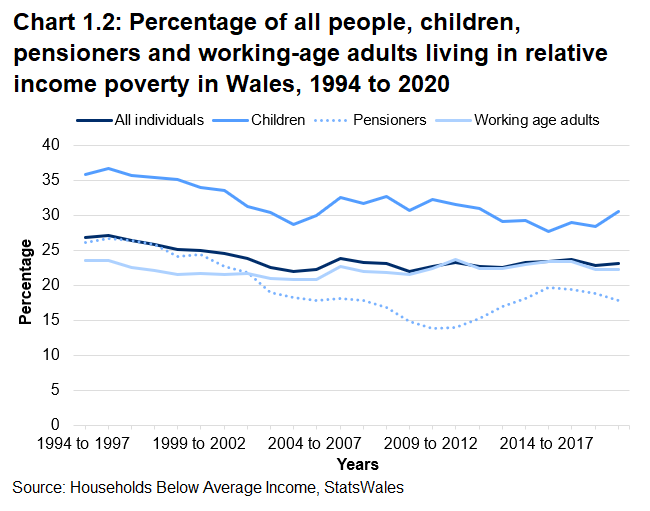
Children are more likely to be in relative income poverty than the population overall. In the most recent data available for Wales there was a small increase in the rate of children in relative income poverty (after housing costs were paid), up to 31% in 2017 to 2020. 

In the most recent period of 2017 to 2020, 71% of children who were living in relative income poverty lived in working households (around 140,000 children). This has increased for the last five periods from 60% in the period 2012 to 2015.

A person is considered to be in persistent poverty if they are in relative income poverty in at least 3 out of 4 consecutive years. An individual in Wales had a 12% likelihood of being in persistent poverty between 2016 and 2020 (after housing costs were paid). A child in Wales had a slightly higher likelihood of being in persistent poverty at 13%.

Image
Chart shows the percentage of all individuals, children, working-age adults and pensioners in Wales living in relative income poverty since the period 1994 to 2020.

Single parent households were more likely to be in material deprivation than other types of households; 49% of single parent households were in material deprivation in 2021-22 compared with 14% of households with two adults and children, and 6% of households comprising two adults with no children.

Of those who are parents, 6% have children who would be classed as materially deprived. Children living in social housing were more likely to be in material deprivation than those in private rented accommodation or owner-occupied homes.

Previous evidence from the 2018-19 National Survey suggests that even when parents are materially deprived, they appear to try to protect their children from the experience of child-specific material deprivation.

Workless households

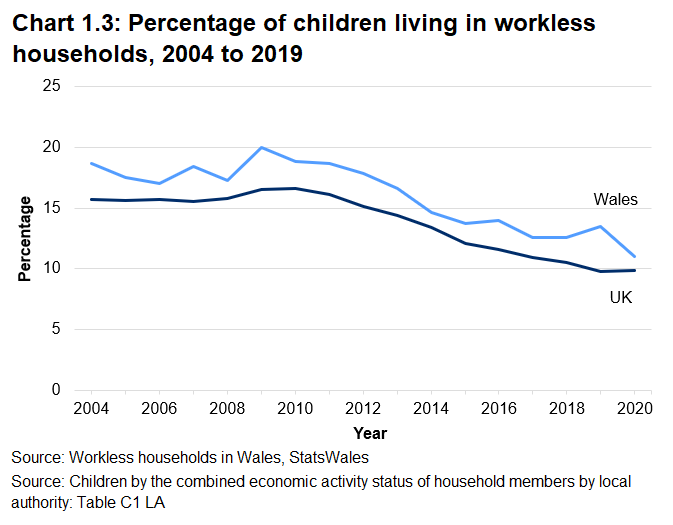
For children, the likelihood of being in relative income poverty is strongly linked to the employment status of adults in the household. In Wales, 11.0% of children lived in a workless household in 2020, compared with 9.9% of children in the UK. In Wales there has been a decrease since 2016 (14.0%), and a significant fall from a peak of 20.0% in 2009. 24.4% of children in Wales live in a household where at least one (but not all) adult works, and 64.5% live in a household with all adults in work. 

Image
Line chart showing the percentage of children living in workless households in Wales and the UK, from 2004 to 2020. The percentage of children living in workless households has been higher in Wales than the UK since 2004, however the gap has narrowed in 2020.

Data sources and further reading

A resilient Wales

The goal for a resilient Wales

A nation which maintains and enhances a bio-diverse natural environment with healthy functioning ecosystems that support social, economic and ecological resilience and the capacity to adapt to change (for example, climate change).

Many of the national indicators used to measure progress towards this goal, are long-term indicators that measure gradual change in the physical environment (for example, biodiversity, air quality, renewable energy, healthy ecosystems and recycling). As these national indicators are based on the physical environment rather than people, there is limited data available on children and young people.

Climate change

The National Survey results for 2021-22 show that the vast majority of 16 to 24 year olds (98%) think the world’s climate is changing. 79% of 16-24 year olds were fairly concerned or very concerned about climate change which is in line with the results in 2020-21 (73%) and in 2018-19 (78%), and an increase compared with the 65% in 2016-17.

In 2021-22, 66% of 16 to 24 year olds think that climate change is mainly or entirely due to human activity. 97% think human activity is involved to some extent in the world’s climate changing.

In May 2020, due to the COVID-19 pandemic the National Survey changed mode from a face-to-face interview to one over the telephone. The wording of some questions was also changed to better suit the mode. For these reasons it is not always possible to make direct comparisons across years but, where relevant, results from previous years are included to add context.

Data from the WISERD Multi-Cohort Study 2022 shows that over two-thirds of children who took part in the study are at least somewhat worried about climate change, with females and older children showing higher levels of worry. Over a half of children in the study (56%) feel that it’s very urgent that we do something about climate change, with a further 37% feeling that this is quite urgent. Over three-quarters of children feel that everyone has a part to play in protecting the environment.

Data sources and further reading

National Survey for Wales provides data on people’s views on environmental issues.

WISERD Multi-Cohort Study 2022, Cardiff University

State of Natural Resources Report 2020 (Natural Resources Wales) provides a comprehensive assessment of the extent to which natural resources are being sustainably managed.

A healthier Wales

The goal for a healthier Wales

A society in which people’s physical and mental wellbeing is maximised and in which choices and behaviours that benefit future health are understood.

Low birth weight babies

The percentage of low birthweight babies has remained relatively steady over the course of the time series, typically fluctuating between 5% and 6%. The lowest figures on record were recorded in 2014 and 2015, since then there has been a slight upward trend with 2020 being the highest on record (6.1%) before falling back again in 2021 (5.8%).

In 2021, a slightly higher percentage of female babies had low birthweight (6.2%) compared to male babies (5.3%). This is broadly consistent with the longer term trend.

Image
Line chart showing the percentage of live singleton births with a birth weight of under 2,500g, the rate has typically fluctuated between 5% and 6% over the course of the time series, with a slight upward trend since 2014.

Maternal health

In 2021, 15% of pregnant women were recorded as smokers at their initial assessment. This accelerates the downward trend since data was first collected in 2016 and is two percentage points lower than in the previous year. However, the large decrease in 2021 may be affected by nearly all data being self-reported, rather than being carbon monoxide monitored.

A greater proportion of younger women were smokers at initial assessment than older women. A third of women aged 16 to 19 were recorded as smokers at initial assessment compared to one in ten women aged 30 or over. Smoking rates at initial assessment have fallen over the last five years for all age groups, (other than those aged under 16, which is subject to volatility due to the low number of women in this group).

Breastfeeding has health benefits for babies and their mothers. The latest annual data of the percentage of babies breastfed at birth was around 64% in 2021. This was 3 percentage points higher than in 2016. Babies of older mothers are more likely to be breastfed than those of younger mothers.

Teenage conceptions reached a record low in 2020 with 66.6 conceptions per 1,000 women. Wales has also seen a large decrease since 2009, down 11% from 74.7 conceptions per 1,000 women.

Healthy lifestyle behaviours

The national milestone on children’s healthy lifestyle behaviours is to increase the percentage of children with two or more healthy behaviours to 94% by 2035 and more than 99% by 2050.

The School Health Research Network Student Health and Wellbeing survey showed the percentage of 11 to 16 year olds meeting the national milestone remained at 88% in 2019 and has remained stable since data collection started in the 2013/14 academic year.

Healthy lifestyle behaviours include not smoking, never/rarely drinking alcohol, eating fruit or vegetables every day and being physically active for an hour or more, seven days per week.

In 2019, 95% of 11 to 16 year olds reported that they did not smoke and 81% reported that they never or rarely drank alcohol. 48% reported that they eat fruit or vegetables every day and 18% reported that they had been physically active for an hour or more, seven days per week.

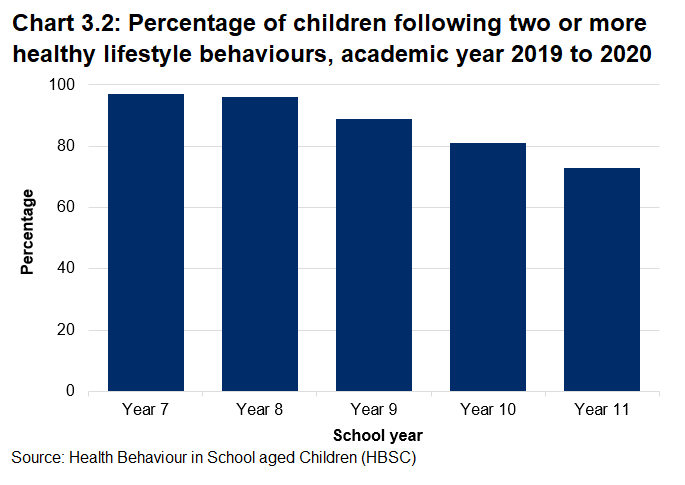
In 2019, the percentage of children with two or more healthy lifestyle behaviours declined with age in secondary school and to a lesser degree lower family affluence. However, there were no large differences between girls and boys.

Reported physical activity levels declined with age in secondary school. Boys and children from a high family affluence background are more active every day.

The percentage of children who reported that they eat fruit or vegetables every day also declined with age in secondary school, with girls and children from a high family affluence background more likely to eat fruit or vegetables every day.

The percentage of children who reported that they did not smoke declined with age during secondary school. Girls and children from a high family affluence background were more likely to report they did not smoke.

The percentage of children who reported that they never or rarely drank alcohol fell with age during secondary school. There was little difference between boys and girls. However, children from a low family affluence background were more likely to report that they never or rarely drank alcohol.

In 2019, around a third of secondary school children walked or cycled to school with a slightly higher proportion of boys than girls walking or cycling to school.

The 2018-19 child measurement programme shows that just over seven in every ten Welsh children have a healthy weight and that reception-age children are significantly more likely than the Welsh average to be obese if they live in areas of higher deprivation. Boys are more likely to be obese or overweight in school, with the gap widening during secondary school.

Image
Chart showing the percentage of children following two or more healthy lifestyle behaviours for the academic year 2019 to 2020. With the percentage of those following two or more healthy lifestyle behaviours falling from Year 7 to Year 11
Image
Line chart showing the percentage of children who drink are non smokers, active every day, eat fruit and vegetables every day and never or rare drink alcohol, between 2013/14 and 2019/20 academic years.


Adverse childhood experiences

Results from the Welsh Adverse Childhood Experience (ACE) study show that when comparing people who suffered 4 or more harmful experiences in childhood with those who suffered none. Those who suffered were more likely to experience high-risk drinking in adulthood, to be a smoker, to be involved in violence in the last year and more likely to have been treated for a mental illness. Having some resilience resources more than halved risks of current mental illness in those with four or more ACEs.

Mental health and wellbeing

National indicator data for children aged 10 to 15 collected prior to the pandemic (2019/20 academic year) shows there has been little change in the mean Strengths and Difficulties Questionnaire score since the 2013/14 academic year.

However more recent data from the School Health Research Network Student Health and Wellbeing survey comparing findings from before to during the pandemic (2019 to 2021) found a fall in the average mental wellbeing for 11 to 16 year olds, using the Short Warwick-Edinburgh Mental Wellbeing Scale (SWEMWBS).

The average SWEMWBS score for 11 to 16 year olds was marginally lower in 2021 (23.0) compared to 2019 (23.7). While seemingly only a small reduction, given the large sample, this is a statistically significant decline in mental wellbeing.

Trends by ethnicity highlight a smaller relative decline in mental wellbeing between 2019 and 2021 among Black, Asian and Minority Ethnic students compared to White students.

Data from the 2019/20 academic year shows that on average, problematic social media use increased with age (from year 7 to year 10) and was higher in girls than boys. 

A fairly small proportion of adolescents reported taking part in cyber-bullying (around one in ten). However, a larger proportion reported experiencing cyber-bullying (almost one in five). Reported experience of being a victim of cyber-bullying differed little by age, but girls were more likely than boys to have reported being cyber-bullied.

Image
Bar chart showing percentage of children with problematic social media use, broken down by girls and boys and also age group.

Data sources and further reading

A more equal Wales

The goal for a more equal Wales

A society that enables people to fulfil their potential no matter what their background or circumstances (including their socio-economic background and circumstances).

Socio-economic disadvantage

Pupils eligible for free school meals (FSM) have poorer educational outcomes in schools on average with the gap widening as pupils get older

Using eligibility for free school meals as a measure of deprivation, there is a link between deprivation and attainment levels at school. While achievement is consistently improving across all pupils, those who are eligible for FSM have poorer performance at every key stage and on all performance measures. This gap increases as pupils get older. National Survey for Wales data also show that parents in deprived households are less likely to be supporting their children with school work, and also have less confidence to do so.

At GCSE there remains a gap in educational outcomes for children eligible for free school meals and those who are not. The gap in entries achieving A* to A grades at GCSE has widened in the last six years, with the gap in entries achieving A* to C grades being relatively stable. Data up to 2019 indicates that at earlier stages of school the gap widens as pupils get older.

In 2020/21, the gap between pupils not eligible for free school meals (FSM) and pupils eligible for FSM awarded GCSE grades A* to A widened to 21.3 percentage points, from 17.8 percentage points in 2019/20. The gap had previously been relatively stable at around 14.7 percentage points between 2015/16 and 2018/19 before widening in the most recent 2 years.

Inequalities also exist for children receiving care and support, again with the gap increasing as pupils get older. Analysis of school performance from 2019 found that children receiving care and support performed less well than pupils overall.

Image
A line chart showing the gap between percentages of students eligible for free school meals and students not eligible for free school meals achieving A*-A, A*-C, and A*-G at GCSE in 2020/21. The gap increased in all three grade ranges between 2019/20 and 2020/21.

The most recent report from the School Health Research Network Student Health and Wellbeing survey comparing mental wellbeing findings from before to during the pandemic (2019 to 2021) found a fall in mental wellbeing for 11 to 16 years olds, using the average Short Warwick-Edinburgh Mental Wellbeing Scale (SWEMWBS). Breakdown by family affluence showed declines of similar magnitude between 2019 and 2021 among students of lower and higher family affluence, suggesting pre-existing socio-economic inequalities in mental wellbeing had not widened over this period.

In 2021, 14% of 11 to 16 year-olds in Wales reported that they often felt alone, up from 12% in 2019, with a higher reported loneliness among students of lower affluence compared to higher affluence.

The School Health Research Network primary school survey of year 6 pupils in 2021 showed that there was a clear socio-economic gradient in reported emotional difficulties scores, with a higher mean score among students from less affluent families, with children from the least affluent families most likely to report clinically significant emotional difficulties. In terms of life satisfaction there was some evidence of a social gradient, with fewer year 6 children from less affluent families reporting high life satisfaction.

Gender

Girls continue to achieve better educational outcomes than boys and are also more likely to continue their full-time education after the age of 16.

In summer 2021, girls were awarded more grades at A* to C than boys. The largest grade disparity was at the A* and A grade. Girls were awarded 6.5 and 4.5 percentage points, respectively, more than boys.

Image
A line chart showing the gap between percentages of girls and boys achieving A*-A, A*-C, and A*-G at GCSE in 2020/21. There was a large increase in the gap at A*-A between 2019/20 and 2020/21, while the gap at A*-C decreased. The gap at A*-G remains small.

A higher proportion of females aged 16 to 18 than males remain in full-time education. This is also the case for those aged 19 to 24 years old.

The most recent report from the School Health Research Network Student Health and Wellbeing survey comparing mental wellbeing findings from before to during the pandemic (2019 to 2021) included breakdowns by gender and year group which showed those self-identifying as neither a boy nor a girl reporting the lowest mental wellbeing, and girls reporting lower mental wellbeing than boys. Mental wellbeing scores declined with age.

More than two-fifths of students self-identifying as neither a boy nor a girl reported often feeling alone in both 2019 and 2021; approximately four and three times greater than the proportion of boys (10% in 2019 and 11% in 2021) and girls (14% in 2019 and 15% in 2021).

The School Health Research Network primary school survey of year 6 pupils in 2021 showed that girls had a higher average emotional difficulties score on the Me & My Feelings measure in comparison to boys (i.e. greater emotional difficulties), whilst boys had a higher average behavioural difficulties score in comparison to girls (i.e. greater behavioural difficulties). A slightly higher proportion of boys reported high life satisfaction.

Ethnicity

In 2021, a higher percentage of Asian babies had a low birthweight (8.4%) compared to other ethnic groups. The number of low birthweight babies per year in Wales is small when categorised by ethnic group, so there can be relatively large changes from year-to-year through natural volatility. However, a larger proportion of Asian babies had low birthweights than any other ethnic group in three out of the four years for which there is data available (starting in 2018).

Children from some ethnic groups (for example, Asian and children with a mixed ethnic background) tend to achieve better on average in school compared to others. 

GCSE results for 2020/21 show that 35.6% of Black, Asian and Minority Ethnic pupils achieved A* to A grades compared to 28.9% of White pupils. This gap has been widening since 2015/16 (4.5 percentage points in 2015/16 to 6.7 percentage points in 2020/21). The gap in pupils achieving A* to C grades has also widened, from 0.9 in 2015/16 percentage points to 3.3 percentage points in 2020/21.

Image
A line chart showing the gap between percentages of Black, Asian and Minority Ethnic students and White students achieving A*-A, A*-C, and A*-G at GCSE in 2020/21. The gap increased in all three grade ranges between 2019/20 and 2020/21. The difference at A*-G remains very small.

At A level, the grade distribution shifted upwards again in 2020/21, but this was not the case for all broad ethnic groups. The proportion of A2 (second year of A level) learners with Black, African, Caribbean, Black British backgrounds who got at least 3 Cs fell steeply, undoing much of the rise in grades in 2019/20. In 2020/21, only 54% of learners with these backgrounds achieved at least three Cs compared to 72% in 2019/20. This was the group with the lowest percentage of A* to Cs at A2 in 2020/21, while the highest percentage of A* to Cs was seen amongst the Asian or Asian British (74%) and White (73%) groups.

Between August 2017 and July 2021, year 11 students with Gypsy, Traveller or Irish Traveller backgrounds were less likely to continue onto post-16 learning than other ethnic groups. For most other minority ethnic groups participation in post-16 learning was close to, or above, the Wales average.

The School Workforce Census reported that the proportion of school teachers who were Black, Asian and Minority Ethnic (excluding White ethnic minorities) was 1.1% in November 2021, significantly lower than the .9.1% of pupils aged 5 or over in Wales who are from a Black, Asian and Minority Ethnic (excluding White ethnic minorities) group in the February 2022 School Census.

9% of Welsh student enrolments at higher education institutions in Wales in 2020/21 were stated to be from an ethnic minority group.

Whilst the most recent report from the School Health Research Network Student Health and Wellbeing survey comparing mental wellbeing findings from before to during the pandemic (2019 to 2021) found a fall in mental wellbeing for 11 to 16 year olds, trends by ethnicity highlighted a smaller relative decline in mental wellbeing among Black, Asian and Minority Ethnic students compared to White students. Compared to a small increase in reported loneliness among White students between 2019 and 2021, no change was observed among Black, Asian and Minority Ethnic students.

Data sources and further reading

A Wales of cohesive communities

The goal for a Wales of cohesive communities

Attractive, viable, safe and well-connected communities.

Homelessness

During 2018-19, around 44% of all households threatened with homelessness were families with dependent children, down from 46% during 2017-18.

Lone parents (with dependent children) and single person households accounted for 84% of all households assessed as eligible, unintentionally homeless and in priority need in 2018-19. These household types are considerably over-represented in comparison with their share of the household population. One parent households (with dependent children) accounted for 32.3% of homelessness cases compared with 7.5% of the household population in 2011.

Crime

The Crime Survey for England and Wales estimated that for Wales, around 11% of children aged 10 to 15 were victims of at least one crime in the latest year ending March 2020.

Across England and Wales a higher percentage of boys aged 10 to 15 relative to girls of the same age experienced victimisation in the last year (ending March 2020), with this the case for the categories of all violence, all thefts and all crime.

Experimental statistics from ONS showed that in 2021-22 the police in Wales flagged 3,729 crimes as involving child sexual abuse and 752 as involving child sexual exploitation. There were 2,612 arrests of children aged 10 to 17 for notifiable offences in Wales in 2020-21. However there was a fall of 28% in the number of first time entrants to the Youth Justice System in Wales in 2021 compared with 2020, although the pandemic may have affected this number.

Volunteering

Data shows that for secondary school pupils, 7% volunteered for a club or organisation at school (outside of lessons) while 18% volunteered for a club or organisation outside of school.

Loneliness

In the 2021 School Health Research Network Student Health and Wellbeing survey, 14% of 11 to 16 year olds in Wales reported that they often felt alone, up from 12% in 2019. On average, girls were more likely to report that they often felt alone than boys (15% vs. 11% respectively). However, the percentage was highest among those self-identifying as neither a boy nor a girl (44%).

Data sources and further reading

A Wales of vibrant culture and thriving Welsh language

The goal for a Wales of vibrant culture and thriving Welsh language

A society that promotes and protects culture, heritage and the Welsh language, and which encourages people to participate in the arts, sports and recreation.

Sport participation

The latest school sport survey ran during 2022 with results due to be published in the autumn. The previous survey from 2018 showed that 48% of pupils in school years 3 to 11 participated in sports three times a week. This was unchanged from 2015, following a large increase from 2013.

There was very little difference in overall participation rates between primary and secondary schools, with 47% of primary pupils (aged 7 to 11) and 48% of secondary pupils (aged 11 to 16) participating three times a week in sports.

Boys were more likely to regularly participate in sport than girls (50% versus 46%), but the gap had narrowed compared to the previous survey in 2015. Participation rates for pupils from the least deprived schools tended to be higher than for pupils from the most deprived schools. Rates were also higher for pupils from a mixed or multiple ethnic group and for pupils who were fluent in Welsh.

Research by Sport Wales during the pandemic found that by August 2021 adults reported that their children were doing more sport or physical activity outside of school hours than they typically would have before the pandemic.

Image
Bar chart showing the percentage of children participating in sport three or more times a week in 2013, 2015 and 2018. In 2015 and 2018 the figure was 48 per cent.

Participation in the arts

Data from the Arts Council of Wales shows that the share of children and young people attending arts events has increased over the last decade, although there was a slight decrease in the most recent year that data is available. It rose from 76.3% in 2010 to 86.7% in 2019. Data is not yet available for the period covering the pandemic.

Arts participation in children has been broadly unchanged over recent years. Around 86% to 87% of children and young people have taken part in the arts in each of the last four years up to 2019.

There are differences in attendance and participation according to gender and socio-economic background. Girls and children from higher social-economic backgrounds were more likely to attend and participate in the arts, although the gap between boys and girls narrowed in 2019.

Image
Line chart covering 2010 to 2019 showing the percentage of 7 to 18 year olds attending arts events once a year or more. The chart shows an increase between 2010 and 2019 from 76 per cent to 87 per cent, although there have been small falls in some years along the way.

Welsh language use

Children and young people are the group most likely to report they are able to speak Welsh according to both the census and surveys, with both sources suggesting that around 40% of 3 to 15 year olds are able to do so. Younger people beyond the age of compulsory education are less likely to report that they speak Welsh.

The Welsh Language Use Survey provides analysis of the use of Welsh language amongst children and adults. It showed that children are most likely to use Welsh daily, likely due to regular use in schools. The percentage of 3 to 15 year olds who spoke Welsh daily was considerably higher than any other age group, with almost a quarter of them speaking Welsh daily. The percentage of 3 to 15 year olds who spoke Welsh daily is similar to the percentage of pupils who receive their education in Welsh-medium or bilingual primary, middle and secondary schools, although we do not know if they are necessarily the same children.

Children aged 3 to 15 are much more likely to have started learning to speak the language at school than those aged 65 or older (69% compared to 15%). This is probably due to the significant change in the Welsh-medium education sector over the last fifty years, with a general increase in the number of pupils learning through the medium of Welsh and in the number of Welsh-medium schools that have been opened across Wales.

The youngest age group are less likely to have at least one parent who is fluent in Welsh. 36% of children aged 3 to 15 reported this, compared to 69% for people aged 65 or older.

Data sources and further reading

A globally responsible Wales

The goal for a globally responsible Wales

A nation which, when doing anything to improve the economic, social, environmental and cultural wellbeing of Wales, takes account of whether doing such a thing may make a positive contribution to global wellbeing. This goal recognises that in an inter-connected world what we do to make Wales a sustainable nation can have positive and adverse impacts outside of Wales.

United Nations Convention on the Rights of the Child

There is limited awareness amongst adults of the United Nations Convention on the Rights of the Child.

The 2021-22 National Survey for Wales shows that 34% of adults have heard of the United Nations Convention on the Rights of the Child. The figure is similar for females (36%), compared to men (33%).

Global citizenship education

Young people in Wales are learning about global issues but there’s been a decline in recent years in international students attending higher education institutions in Wales.

The UN SDG ‘Quality Education’ recognises the importance of obtaining a quality education and all learners acquiring the knowledge and skills needed to promote sustainable development, including sustainable lifestyles, human rights, gender equality and global citizenship.

Physical punishment of children

The physical punishment of children became illegal in Wales on March 21, 2022. The results presented here were collected from July 2021 to January 2022, before this law came into effect.

Parents and non-parents were asked about their views on smacking children and whether they agreed or disagreed that it was sometimes necessary.

There has been a shift in attitudes since this question was asked in 2019-20. In 2019-20 35% of people said it was sometimes necessary to smack a child compared with 25% now. The proportion who strongly disagree that smacking is sometimes necessary has risen to 40% (from 30% in 2019-20).

32% of men and 20% of women say that it is sometimes necessary to smack a child. 84% of people aged 16 to 24 say that smacking is never necessary compared with 42% of people aged 75 and over.

Image
Bar chart showing National Survey responses for the 2019-20 survey and 2021-22 online trial about whether respondents agree smacking is sometimes necessary. In 2019-20 35% of people said it was sometimes necessary to smack a child compared with 25% now. The proportion who strongly disagree that smacking is sometimes necessary has risen to 40% (from 30% in 2019-20).

Up until 2020/21, within the Welsh Baccalaureate Skills Challenge Certificate there was a compulsory Global Citizenship component, which engages students in learning about global issues. Since 2020/21 the Global Citizenship component has been non-compulsory, therefore any comparisons prior to 2020/21 would need to be taken with care.

In 2021/22, there were 32,535 entrants for the Global Citizenship Challenge at key stage 4, and 20,338 at advanced level who chose the global citizenship challenge component. For key stage 4, 99.1% of entries achieved a level 1 pass or above, and at the advanced level, 99.3% achieved a level 3 pass or above.

Eco-Schools

Eco-Schools is a global programme engaging millions of children across 70 countries. It is designed to empower and inspire young people to make positive environmental changes to their school and wider community, while building on their key skills, including numeracy and literacy, and encompassing Education for Sustainable Development and Global Citizenship (ESDGC). There are currently 56,000 schools in 70 countries participating in the Eco-Schools programme.

In Wales Eco-Schools is a voluntary programme run by Keep Wales Tidy. As of April 2022 there were 805 state schools with Eco-Schools Green Flag accreditation, 387 of which had reached platinum status, for long term commitment to the programme. A further 339 schools have a bronze and/or silver award, working their way towards green flag accreditation. There were a total of 1,144 state schools in Wales with an Eco-Schools award.

Higher education

A large number of students from a range of countries attend higher education institutions in Wales. In 2020/21, there were 21,565 enrolments from international students for Higher Education providers in Wales, comprising 17% of all enrolments. Of these, 5,395 were from students of European Union domicile (4% of all enrolments), while 16,170 were from students of non-European Union domicile (12% of all enrolments). At its peak in 2010/11, there were 26,290 enrolments in Higher Education institutions in Wales from international students, which made up 20% of the student population

Image
Line chart showing the percentage of the student population at Welsh higher education institutions who are international students, from 2007/08 to 2020/21. In 2020/21 there were 21,565 international students. This is similar to the figures for the last 5 years but lower than the peak in 2010/11, when there were 26,290 international students in Wales.

Vaccination coverage

Vaccination uptake in young children continues to be high but has decreased slightly since its highest levels.

The UN SDG Sustainable Development goal ‘Good Health and Well-being’ states the importance of providing access to affordable and essential medicines and vaccines. The World Health Organisation has a vision for a world without measles, rubella and congenital rubella syndrome (CRS).

The majority of children for the April 2021 to March 2022 year would have been due their immunisations during the COVID-19 pandemic. Although coverage for younger children who receive their immunisations in general practice remains positive, there has been a slight decreasing trend over the previous year. Uptake of the ‘6 in 1’ vaccine (all three doses) in children reaching their first birthday was 95.2%, compared to 95.6% in the previous year.

Uptake of both the ‘6 in 1’ and pneumococcal conjugate vaccinations remained above 95% in children at one year of age for the fourteenth consecutive year.

MMR uptake was just below 95% for the first dose at two years. This is suboptimal for preventing outbreaks of measles (target uptake is 95%).

The proportion of children who were up to date with their routine immunisations by four years of age was 87% this year. The reported inequality gap in immunisation coverage between four year olds in the most and least deprived areas was 8.5 percentage points, the same as in 2020-21. However, further work is needed to identify the root cause of these inequalities and identify interventions to reduce this gap.

Image
"Line chart showing percentage uptake of MMR and the 6 in 1 vaccine from 2008-09 to 2020-21. Uptake of both the ‘6 in 1’ and pneumococcal conjugate vaccinations remained above 95 per cent in children at one year of age for the thirteenth consecutive year. MMR uptake was just below 95 per cent for the first dose at two years and although it has increased since 2008-09, it is lower than the peak in 2013-14 "

Children aged 5 to 11 years are the most recent general population group who became eligible for primary COVID-19 vaccinations. During the period March to June 2022, coverage of the second dose of this vaccine has increased in those aged 12 to 17 years and coverage of the first dose has increased in children aged 5 to 11 years. 

Data sources and further reading